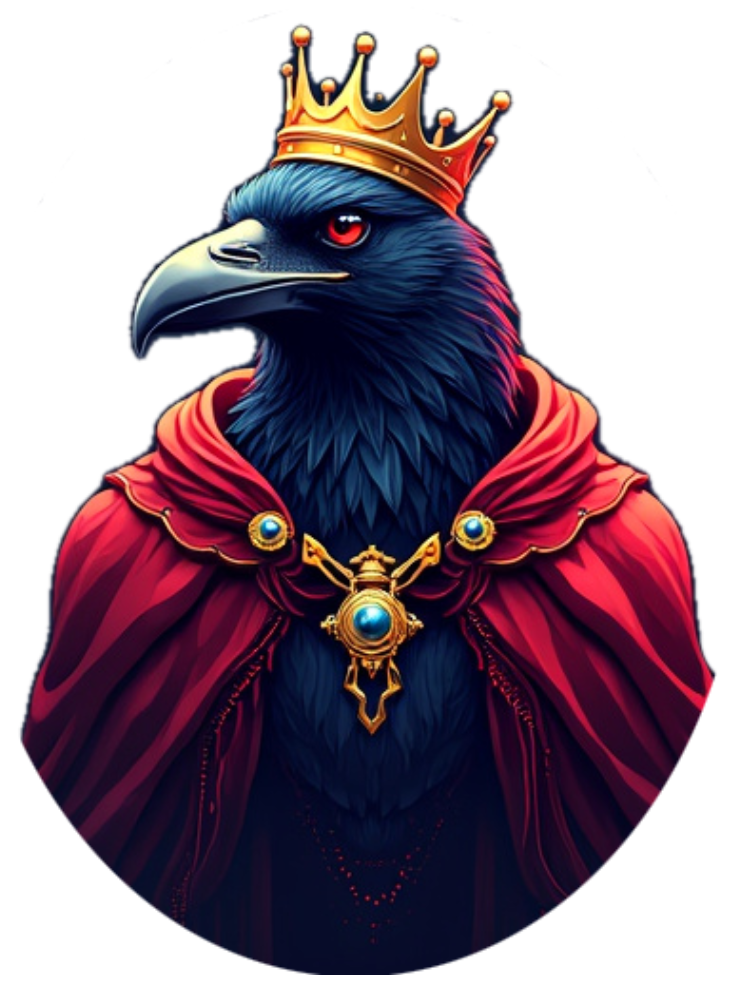

Tale of the Royal Raven
A Short Story
In the darkest corner of a stone fortress, where sunlight never reached and hope went to die, there lived a raven. He had no name—his captors had never bothered to give him one. They called him only "the bird" or "it," as if he were nothing more than a tool or a curiosity to be displayed when visitors came to marvel at the cruelty of their collection.
The raven had been taken as a fledgling, torn from his nest before he'd ever felt the wind beneath his wings. His cage was barely large enough to spread those wings, rusted iron bars that had housed countless prisoners before him. The fortress keeper, a cruel man named Aldric, found amusement in the bird's suffering. Some days there was food—scraps of rotten meat or moldy bread. Other days there was nothing but the echo of Aldric's laughter as he walked past the cage.
Years passed in that darkness. The raven's feathers, which should have gleamed like polished obsidian, grew dull and ragged. His talons, meant for grasping branches and soaring through open skies, could only scrape against the cold iron floor. But something grew within that tiny cage, something Aldric could never see: a fierce, burning will that refused to be extinguished.
The raven watched everything. He learned the rhythms of the fortress, the changing of the guards, the patterns of cruelty and neglect. He studied the lock on his cage during the brief moments when torchlight illuminated his prison. And most importantly, he listened—to the whispered conversations of passing servants, to the boasts of soldiers, to the plans of those who ruled above him.
One winter night, when a great storm battered the fortress walls and everyone huddled deep inside, the raven saw his chance. A young servant girl, perhaps ten years old, had been sent to check on the prisoners. She carried a ring of keys too heavy for her small hands, and her eyes held the same emptiness the raven recognized in his own reflection. When she passed his cage, he did something he had never done before: he spoke.
Not in the mimicked words of humans, but in the ancient language of ravens—a sound that carried memory, pain, and understanding. The girl stopped, startled, and for a moment their eyes met. In that glance passed a recognition of shared suffering, of two souls trapped by forces beyond their control.
The girl's hands trembled as she reached for the keys. She could be beaten for this, perhaps even killed, but something in the raven's voice had awakened a rebellion in her heart too. The lock clicked open, and for the first time in years, the raven stepped beyond those iron bars.
His escape was not graceful. His wings, weakened by years of disuse, barely carried him through the narrow corridors. Guards shouted and gave chase, but the storm provided cover, and the raven's determination fueled what his body could not. He burst through a broken window into the howling wind, rain battering his damaged feathers, and plummeted toward the rocks below.
But he did not fall. Something primal awakened in his blood, some memory older than his captivity, and his wings remembered what they were meant to do. He flew—clumsy and desperate at first, then with growing strength—into the wild darkness of the storm.
The raven flew until his wings could carry him no more, finally collapsing in a forest far from the fortress. There, other ravens found him. They fed him, preened his damaged feathers, and listened to his story. Word spread through the corvid kingdom of the bird who had endured the unendurable, who had refused to break even when breaking seemed the only option.
The raven's legend grew. Other birds, those who had suffered under human cruelty or injustice, sought him out. They were joined by foxes who had lost their dens to hunters, by wolves whose packs had been scattered, by all manner of creatures who had known oppression. The raven, who had once had no name, became known as the Dark Wing, and he led them not with cruelty like Aldric, but with the fierce compassion of one who understood suffering intimately.
Years passed, and Dark Wing's coalition grew into an army. They did not seek revenge through mindless violence, but rather worked to free other captive creatures and to establish territories where humans and animals could coexist without cruelty. Dark Wing himself flew to every corner of the land, his once-ragged feathers now gleaming like midnight given form, negotiating treaties, settling disputes, and building something that had never existed before: a kingdom where strength protected the weak instead of exploiting them.
The day came when the scattered tribes and kingdoms of the wild places gathered at the Heart Oak, an ancient tree whose roots ran as deep as memory itself. There, by acclamation of fox and wolf, hawk and owl, bear and deer, the raven who had once had no name was crowned as their king. They placed upon his head a circlet woven from silver branches and black pearls, and from that day forward he was known as the Royal Raven, first of his name, King of the Wild Places, Protector of the Oppressed, He Who Survived the Darkness.
And though he ruled from a throne beneath the open sky, with the wind always in his feathers and the stars his companions, the Royal Raven never forgot the rusted cage or the young girl who had risked everything to open it. He decreed that the fortress where he had been held would be torn down and transformed into a sanctuary for injured creatures, and he ordered that a statue of a small girl holding a ring of keys be placed at its entrance, so that none would forget that even the smallest act of courage could change the world.
The Royal Raven ruled wisely and well, and though he was offered many luxuries and comforts, he always kept his throne simple—a high branch where he could see the horizons—for he had learned in that cage that true freedom was not the absence of bars, but the presence of choice, and he would never take that gift for granted again.