
Official Rules
Introduction
Royal Raven is a strategic trick-taking card game for four players, played in partnerships. The game is named after its distinctive Royal Raven card, which is the highest trump in play in the standard deck. The combination of bidding, trump selection, and skillful play makes Royal Raven an engaging game of strategy and teamwork.
Objective
The goal is to score points by winning tricks containing point cards. The first team to reach the target score wins the game.
The Deck
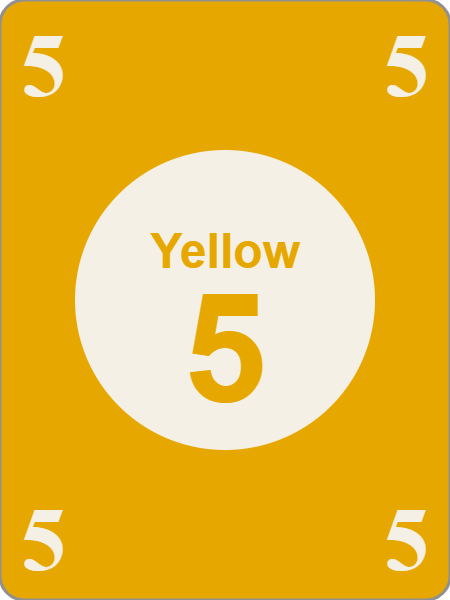
All games begin with a standard deck containing 41 cards numbered 5-14 in each of four royal colors (red, yellow, purple, and blue), plus the Royal Raven card
The deck can be modified in several ways:
- Standard Games: Total Points: 120, Min Bid: 70, Winning Total: 300 points.
- Variation 1: add the 1's, Total Points: 180, Min Bid: 100 points, Winning Total: 500 points.
- Variation 2: add the Lynx. Total Points: 145, Min Bid: 100 points, Winning Total: 400 points.
- Variation 3: add the 1's and the Lynx, Total Points: 205 points, Min Bid: 100, Winning Total: 750 points.
The Royal Raven & The Lynx


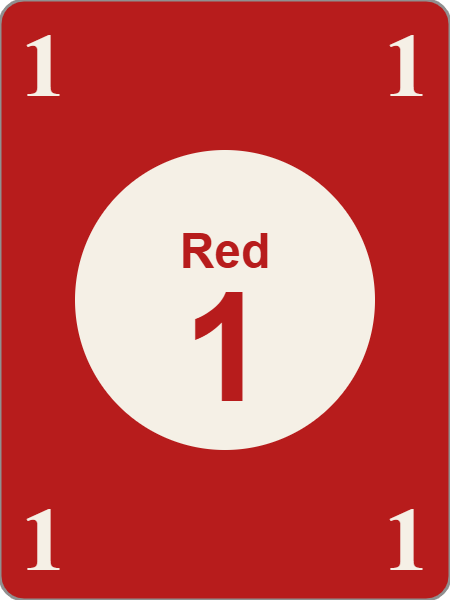
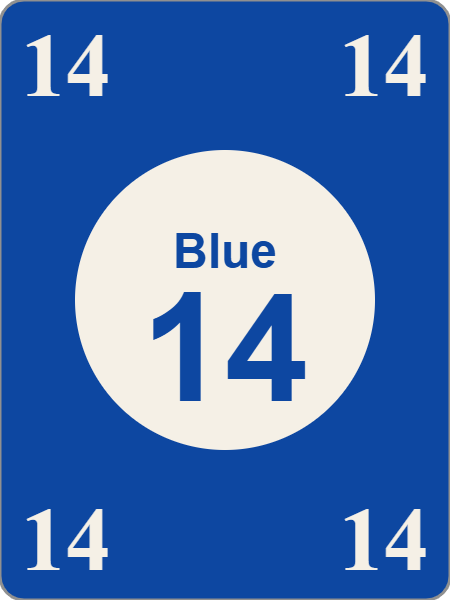
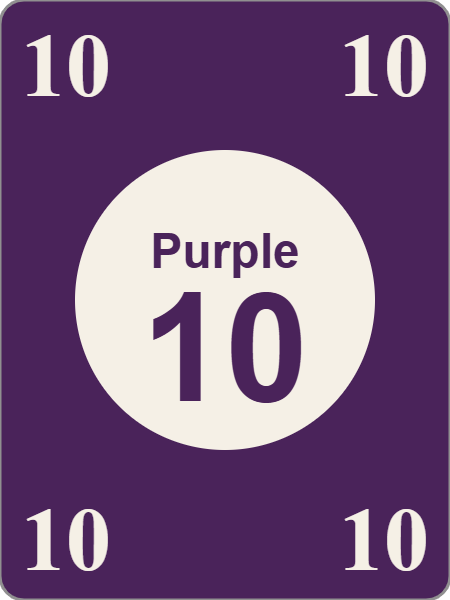
Card Point Values
- The Lynx: 25 points
- Royal Raven card: 20 points
- 1s 15 points
- 14s 10 points
- 10s 10 points
- 5s 5 points
- All other cards 0 points
Players
Played with 4 players in partnerships.
The Shuffle
Cards are shuffled using Fisher-Yates Shuffle (or Knuth Shuffle): This is a widely accepted and efficient algorithm for producing an unbiased random permutation of a finite sequence, such as a deck of cards. It works by iterating through the cards and, for each card, swapping it with a randomly chosen card from the remaining unshuffled portion of the deck.
The Cut
This simulates the traditional card cutting where you split the deck at a random point and put the bottom portion on top. It's a nice touch that adds to the "feel" of proper card handling, even though the Fisher-Yates shuffle with good randomness already gives you perfect distribution. The cut doesn't mathematically improve the randomness (the shuffle already achieved that), but it does add that authentic card game experience!
The Deal
The AI deals cards in rounds: first, it gives one card to each player and the kitty, continuing this rotation until the kitty reaches its target size (5 cards for standard games, or 6 cards when playing with the Lynx). Then it distributes the remaining cards evenly among the players.
Bidding
- Starting with the player to the dealer's left, each player makes a bid.
- Bids represent how many points a player thinks they can win in tricks.
- Minimum bid is typically 70 points, and players must bid higher than previous bids or pass.
- Players may bid "Shooting the Bird" - a bid equal to all available points in the deck.
- The highest bidder becomes the "taker" and chooses the trump color.
- The taker picks up the kitty, adds those cards to their hand, then discards the same number of cards face down (cannot discard the Lynx or Royal Raven).
Trump Selection
The high-bidder chooses the trump color from the four royal colors (red, yellow, purple, blue). The Lynx and Royal Raven are always trump cards regardless of the chosen trump color.
If the game option is enabled, the winning bidder may allow their partner to choose the trump color instead, but this increases their bid by 5 points.
Playing the Game
- The taker leads the first trick by playing any card.
- All players must follow the color led if possible.
- If a player cannot follow the color led, they may play any card, including trump.
- The highest card of the color led wins the trick, unless a trump card is played, in which case the highest trump wins.
- The Royal Raven card is considered the highest trump card, and is worth 20 points.
- The winner of each trick leads the next one.
Game Variations
Royal Raven can be played with different card combinations to create varied gameplay experiences:
| Game Elements | Standard | Include 1s No Lynx |
Include 1s and Lynx |
No 1s Include Lynx |
|---|---|---|---|---|
| Cards in Deck | 41 | 45 | 46 | 42 |
| Cards Per Player | 9 | 10 | 10 | 9 |
| Cards in Kitty | 5 | 5 | 6 | 6 |
| Minimum Bid | 70 | 100 | 100 | 70 |
| Maximum Bid | 120 | 180 | 205 | 145 |
| Points Per Round | 120 | 180 | 205 | 145 |
| Target Score | 300 | 500 | 750 | 400 |
Default Game Settings
- Rated Game: Yes
- Include 1s: No
- Include Lynx: No
- Allow Shooting the Bird: No
- Allow Partner to Choose Trump: No
- Timer Setting: 30 Seconds
Scoring
- After each trick, the scores are calculated.
- If the taker meets or exceeds their bid, they add their points to their score.
- If the taker fails to make their bid, they lose the amount of their bid.
- The non-bidding team always adds their points to their score.
- The first team to reach the target score wins the game.
Shooting the Bird
- If a player bids "Shooting the Bird" (equal to maximum points available), they must collect all the points in the deck. If they succeed, they get a 100 point bonus. If they fail to get all points, they lose their bid amount plus an additional 50 point penalty.
CELO Rating System
Royal Raven uses a rating system that combines two equally weighted components to determine your CELO Rating: ELO and Rating Points. Your visible CELO Rating is the sum of both.
How Your Rating is Calculated
All players start with a CELO Rating of 0 (ELO 0 + Rating Points 0). After each rated game, both components are updated:
- ELO: A skill-based rating that adjusts after each game based on the relative strength of your team versus the opposing team. Beating stronger opponents earns more ELO, while losing to weaker opponents costs more. Because Royal Raven is a team card game with inherent luck, the ELO system uses a wider divisor than standard chess ELO, so rating gaps carry less predictive weight and upsets are treated more fairly.
- Rating Points: An engagement-based rating awarded after each game based on the outcome. Consistent play is rewarded — even a player with a 50% win rate will see their Rating Points climb over time.
ELO adjustments per game are tied to your ELO score. Low-rated players have the biggest swings (helping them find their true level quickly), mid-rated players have moderate swings, and high-rated players have smaller swings (since they've already proven their skill). This means every game matters regardless of how long you have been playing.
Luck Protection
When a heavily favored team loses (large ELO gap), their ELO loss is reduced to account for card luck. The larger the skill gap, the more the loss is cushioned. Winners always receive full credit for their win.
Ranking Tiers
Your CELO Rating determines your tier. Each main tier is divided into 4 sub-tiers (I, II, III, IV), each spanning 200 rating points. Click a tier to see its sub-tiers.
| Tier | Rating Range | |
|---|---|---|
| + | Novice | 0 – 749 |
| + | Beginner | 750 – 1,599 |
| + | Neophyte | 1,600 – 2,399 |
| + | Apprentice | 2,400 – 3,199 |
| + | Experinced | 3,200 – 3,999 |
| + | Silver | 4,000 – 4,799 |
| + | Gold | 4,800 – 5,599 |
| + | Platinum | 5,600 – 6,399 |
| + | Diamond | 6,400+ |
| + | Legend | 7,200+ |
Rating Points per Game
Completed Game:
- Both winning players: +15 rating points each
- Both losing players: -5 rating points each
Abandoned Game:
- Both winning players: +10 rating points each
- The quitter: Receives the escalating abandonment penalty (see Game Abandonment below) instead of the normal -5
- The quitter's partner (non-offending): +5 consolation rating points
Rated Games
When creating a game, you can choose whether it is a rated game. Only rated games affect your CELO Rating, ELO, and tier status. Unrated games are perfect for casual play or practice without impacting your standings.
Game Abandonment
When a player leaves a rated game in progress, the game ends immediately. The quitter receives escalating rating point penalties based on how many times they have previously abandoned:
- 1–5 penalized leaves: -25 rating points per leave
- 6–10 penalized leaves: -50 rating points per leave
- 11–15 penalized leaves: -100 rating points per leave
- 16–20 penalized leaves: -200 rating points per leave
- 21+ penalized leaves: -400 rating points per leave
Free Leaves
Players earn 1 free leave for every 50 games completed without abandoning (maximum 10 banked). Using a free leave absorbs the rating points abandonment penalty. The ELO loss still applies.
What Happens to Each Player When Someone Abandons
The Quitter:
- Takes full ELO loss for the game
- Receives the escalating abandonment penalty (on top of the ELO loss)
- Games played is incremented
- Games lost is incremented
- Games left is incremented
- Loss streak is incremented
- If they have a free leave banked, the abandonment penalty is absorbed but the ELO loss still applies
The Quitter's Partner (Non-Offending):
- ELO does not change
- Receives +5 consolation rating points
- Games played is not incremented
- Games lost is not incremented
- Loss streak is not incremented
- The game has no negative impact on this player's record
The Opposing Team (Both Winners):
- ELO gain is halved (50% of normal) since the game did not complete naturally
- Each player receives +10 rating points instead of the usual +15
- Games played is incremented
- Games won is incremented
- Win streak is incremented
Misc Rules
- Players may not reveal their cards to their partner.
- Players may not communicate about their cards during play.
- Players who abandon a game receive escalating rating penalties (see CELO Rating System section above).