
Tale of the Royal Raven
Tale of the Royal Raven
Dark Wing
TABLE OF CONTENTS
Tale of the Royal Raven
Copyright © 2025 Carl W. Legate
All rights reserved.
No part of this publication may be reproduced, distributed, or transmitted in any form or by any means, including photocopying, recording, or other electronic or mechanical methods, without the prior written permission of the author, except in the case of brief quotations embodied in critical reviews and certain other noncommercial uses permitted by copyright law.
This is a work of fiction. Names, characters, places, and incidents either are the product of the author's imagination or are used fictitiously. Any resemblance to actual persons, living or dead, events, or locales is entirely coincidental.
First Edition
Printed in the United States of America
To my friends, co-workers, and family members that betrayed me, abandoned me, ignored me, hurt me, and lied to me.
But mostly to the two men that car-jacked me.
I forgive you.
The pain and suffering, mental anguish, and anxiety that I had to overcome, spilled onto these pages.
"To forgive is to set a prisoner free and discover that the prisoner was you."
— Lewis B. Smedes
Preface
Years ago, I played Royal Raven daily with friends. It was more than a game—it was connection, competition, and community around a table. But time passed. Friends moved on. Eventually, no one in my circle played anymore, and few even knew the rules.
So I decided to bring it back.
Over the past year, I set out to create an online version of Royal Raven—a place where anyone who wanted to play could find a game, just for the enjoyment of it. I envisioned a medieval world, a royal raven as its symbol, and with the help of AI, brought that vision to life in a logo.
As the game took shape, so did a question: Who was the Royal Raven?
I began with a short story—a raven who had his life stolen from him, who endured captivity, and who ultimately found triumph through forgiveness. But the more I wrote, the more I realized this story demanded room to breathe. A short story became a novel.
The themes of this book—betrayal, survival, and the courage to forgive—did not come from nowhere. They came from my own life. The pain I experienced found its way onto these pages, transformed into feathers and flight. And in writing it, I discovered parallels to my own journey that I hadn't even realized until the final word was written.
This is the story behind the game. I hope it brings you something worth carrying with you.
— Carl W. Legate
Acknowledgments
To Lane Gould—after years of living with Social Anxiety Disorder, years when I believed there was no way out, you helped me uncover the root of my fear. Understanding it was the first step to overcoming it.
To RD—of all my friends, you were the only one I could tell.
And to Liz—you get my sense of humor, you laugh in all the right places, you stood beside me through this project, and most of all, you stayed.
This book exists because of you.
INTRODUCTION
Every game tells a story, even when no words are spoken.
When partners sit across from each other at a table, when cards are dealt and bids are made, when tricks are won and lost through skill and trust—something older than language is at work. Cooperation. Strategy. The delicate balance between self-interest and shared victory.
Royal Raven is a game about partnerships. About working with an ally you cannot fully control, trusting them to play their part while you play yours. About reading the table, anticipating what others will do, and adapting when plans fall apart.
But before there was a game, there was a story.
The tale you are about to read is the legend behind the cards. It tells of a raven who was captured young and held in darkness for years. It tells of the unlikely alliances he formed in captivity—with a lynx who should have been his predator, with a human girl who risked everything to set him free. It tells of his escape, his recovery, and his transformation into something he never sought to become: a king.
Not a king of conquest. Not a king of bloodlines or crowns. A king of coalitions—of creatures who chose to trust each other despite every instinct that said they should not.
The Royal Raven card is the heart of the deck. When you play it, you are invoking Dark Wing's legacy: the belief that strength comes from alliance, that survival is shared, and that even the smallest creature can change the world by refusing to break.
The Lynx card carries the highest point value in the game. This is Shadowpaw's due—the ally who waited in darkness, who never forgot the raven who fed her when he was starving, who proved that debts of compassion outlast cages and years.
When you sit down to play Royal Raven, you are not just playing a card game. You are stepping into a world where cooperation is survival, where trust is currency, and where the bonds between partners can overcome any obstacle.
This is the story of how that world was born.
— Carl W. Legate
THE COALITION TERRITORIES
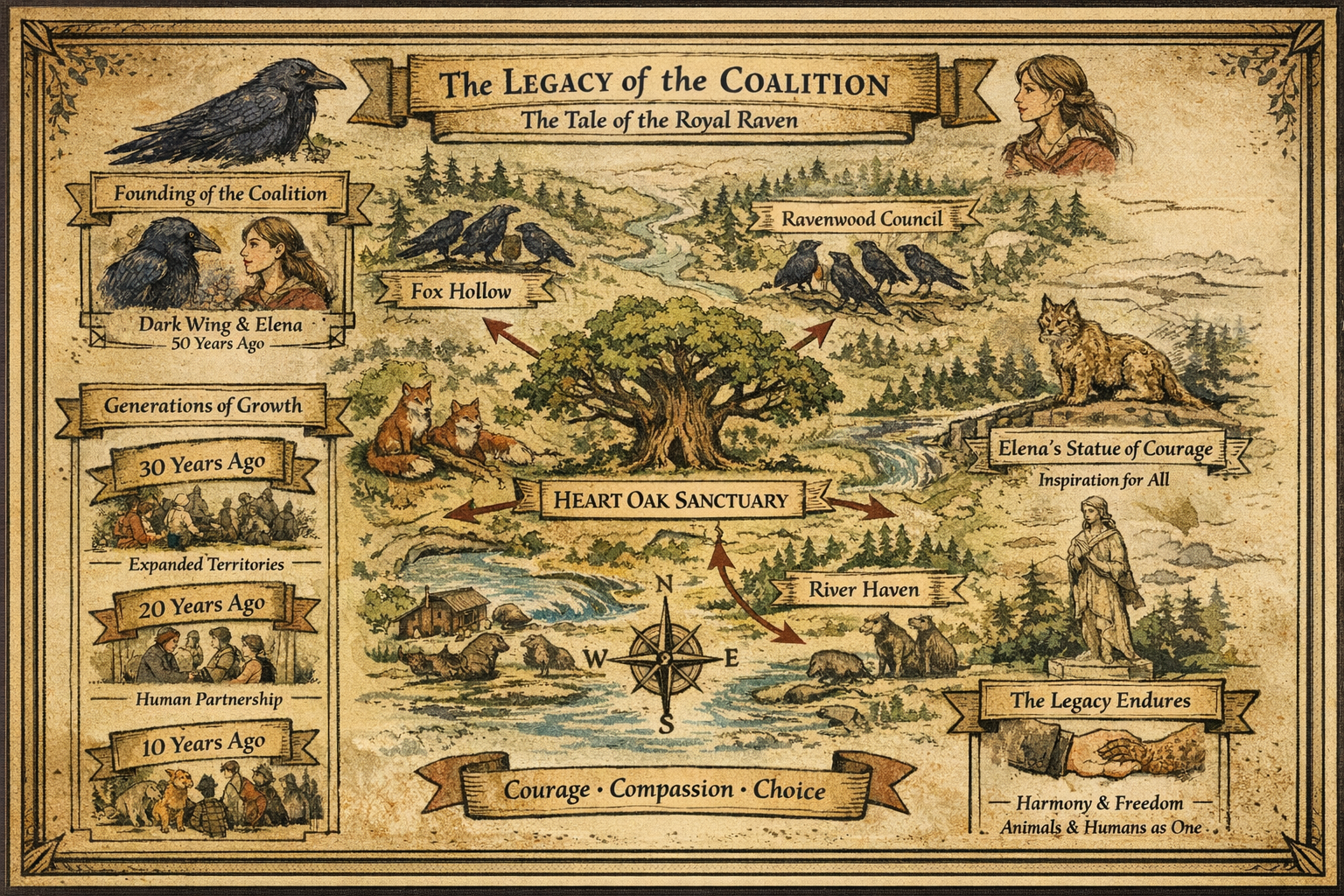
Heart Oak Sanctuary stands at the center of the Coalition's domain, surrounded by the territories that grew from Dark Wing's vision of cooperation across species.
CHAPTER 1: CAPTIVITY AND SUFFERING
The Collector's Fortress
High in the twisted branches of an ancient oak, a mother raven built her nest, hidden among leaves that whispered secrets to the wind. She had chosen the place carefully—far from roads, deep within a grove untouched for generations.
It was not enough.
The raven was barely three weeks old when the men came. His eyes had only recently opened to the world, revealing the sharp intelligence that would one day define him. His feathers were still soft and gray, not yet the black armor they would become. He had two siblings, and together they practiced their calls, their voices growing stronger with each passing day.
Aldrich heard them from his fortress tower.
He was a collector—not of beauty or knowledge, but of possession. When word reached him of a raven nest deep in the Whispering Wood, he sent his men with poles and nets.
The mother fought. She dove and struck, her cries tearing through the trees. But determination and tools overcame instinct and courage. Branches shook. The nest broke free. Nets rose to catch what fell.
The raven felt the rush of air, the sudden weightlessness, then pain as hands closed around his body. He tried to cry out, but terror stole his voice. The world spun—green leaves, gray sky, rough fabric pressing against his wings. He could hear his mother screaming somewhere above, the sound growing fainter as the men carried him away.
Where is the nest? Where are my siblings? What is happening?
These were not words—he was too young for words—but the feelings crashed through him like waves. Confusion. Fear. A desperate, wordless longing for warmth and safety that was already becoming memory.
Above him, his mother circled, calling a name—Emil!—a sound he would never hear again.
His siblings were left behind. They were the lucky ones.
The Raven Who Would Not Break
The cage measured two feet by two feet and eighteen inches high.
For a creature meant to rule the sky, it was a coffin of iron.
The bars were thick and rusted from years of use. The floor was a metal grate that pressed constantly into his feet, leaving marks that would never fully heal. In the first days, the raven threw himself against the bars again and again, wings beating uselessly, until exhaustion and pain taught him what the iron would not yield.
Eventually, he learned stillness.
But stillness was not emptiness. In the long hours between feedings, between Aldrich's visits, between the guards' footsteps, his mind moved where his body could not. He thought about the nest—the rough weave of twigs and feathers, the warmth of his siblings pressed against him, his mother's voice calling his name. Emil. A name no one here knew. A name that belonged to someone who had lived in the sky.
That raven was dead now. This one—the one in the cage—had to become something else.
He began to count. Stones in the wall. Bars in his cage. Steps between the guard's arrival and departure. Numbers gave structure to formlessness. Patterns gave meaning to meaninglessness. When despair pressed in, he would recite what he knew: Twelve bars. Forty-seven stones I can see. The guard comes twice before full dark.
It was not hope. Hope was too fragile for this place. It was something harder. Something that would bend before it broke.
The cage stood in a dim corridor of the fortress, lined with others—some empty, some occupied. A fox with lifeless eyes. A hawk whose wing had healed wrong. A snake that moved only when guards passed.
And inches away, in a larger cage no less cruel, lived a lynx.
She had arrived months earlier, captured as a juvenile after her mother was killed by trappers. Rare, exotic, valuable—Aldrich kept her as a showpiece. Visitors admired her coat and tufted ears, never recognizing the intelligence behind her amber eyes.
In the wild, she would have been learning to hunt, to claim territory. Here, she paced a space barely large enough to turn around.
When Aldrich approached, she sometimes placed herself at the front of her cage—silent, threatening, denying him the spectacle he wanted. It was the only rebellion available.
The raven watched. She has not surrendered, he thought. Neither will I.
They did not share language, but prisoners rarely need one. They learned each other through pattern and response. The lynx drew Aldrich's attention when he came near the raven's cage. The raven made soft warning sounds when guards passed late at night.
Allies in suffering. The only kind this place allowed.
Time lost meaning in the corridor. Days blurred into months. The raven learned every flaw in his cage, every shift of light that marked morning and night. His world shrank—but his mind did not.
And then the food-sharing began.
The Choice
Aldrich decided to experiment.
The raven was fed—barely. Scraps of meat, grain enough to keep him alive. The lynx received nothing.
Day after day, the raven watched her weaken. By the fourth day, she no longer paced. She lay curled in the corner, ribs showing, eyes dulled by hunger.
This was not neglect. It was deliberate. The raven understood that much. Aldrich was watching, waiting, measuring something only he cared about.
He wants to see what we will do, the raven realized. He wants to see if suffering makes us smaller.
The raven looked at his portion. Looked at the lynx. His own body was already weak—feathers dull, bones too prominent beneath skin. Sharing would cost him. Might cost him everything.
But what am I surviving for?
The question arrived without warning. If he lived and she died, what had he preserved? His body? His body was already a ruin. His dignity? Dignity meant nothing if he watched a fellow prisoner starve while he ate.
When the guard placed the raven's portion inside his cage, he took a piece of meat—nearly half—and pushed it through the narrow gap between the bars.
The lynx stared at it. Then at him.
Prey did not feed predators. Nothing about this made sense.
But hunger overruled confusion. She ate carefully, never breaking eye contact.
We are not what we eat, the raven thought. We are not predator and prey. We are prisoners. That comes first now. That comes before everything.
Aldrich continued his experiment. The raven continued to share. His own body weakened, feathers losing their shine, bones standing out beneath skin. But the lynx lived.
When feeding resumed, something had changed. The lynx positioned herself between Aldrich and the raven whenever possible. It was the only repayment she could offer.
She understands, he thought. We understand each other.
They shared after that, even when both were fed. The act itself became a promise: I will not let you disappear alone.
Witness
The guards noticed.
Most ignored it. Some were unsettled. One man—Willem—watched and could not look away.
He was Aldrich's brother, newly arrived after a military injury ended his career. He had seen violence, death, and cruelty before—but the corridor disturbed him more than any battlefield.
War had purpose. This did not.
He began bringing larger portions when he could. Fresh water. Quiet words. The others mocked him for it, and he accepted the mockery.
The raven observed Willem carefully. Not all of them are the same, he noted. This one carries weight. This one feels what Aldrich cannot.
It was useful information. Not yet actionable, but worth remembering. Everything was worth remembering.
Watching a raven feed a starving lynx, Willem understood something that would haunt him:
If they could choose compassion in a place designed to crush it, what excuse did he have not to?
The Collector
Aldrich discovered the behavior and turned it into entertainment.
He invited guests. Withheld food. Watched the raven share. Laughed.
"Fascinating," he would say. "Aberrant behavior. Even animals can be irrational."
The raven sat still during these exhibitions. He had learned not to give Aldrich the reactions he wanted—no frantic movements, no distressed sounds. He made himself blank, unreadable, boring.
You think you understand me, the raven thought as Aldrich's guests pointed and murmured. You think this is foolishness. You cannot see what I am building.
He never understood what he was witnessing.
The raven knew that survival was shared. Strength came from ensuring your only ally endured. Aldrich saw foolishness where there was strategy—and humanity.
He never realized he was observing the foundation of his own undoing.
Memory
The lynx never forgot.
She could not thank him. She could only watch, protect, and remember.
Years passed. Three for the raven. Nearly four for the lynx. Seasons turned unseen beyond stone walls. Bodies weakened. Minds sharpened.
The raven learned the fortress by sound and shadow. Learned routines. Learned locks. Learned patience.
He made it a discipline. Each day, he would close his eyes and trace what he knew. The guard with the limp comes at midday. The one who smells of ale comes at dusk. The third key on the ring—the one with the notched base—opens my cage. The lock sticks before it releases.
He studied the sounds that traveled through stone. Distant voices. Doors opening and closing. The particular rhythm of Aldrich's footsteps versus the servants'. He learned to read weather through pressure changes, to sense approaching storms before any human noticed.
They think I am a prisoner, he thought. They do not realize I am a student.
He learned that cages could not stop observation.
And he learned that when freedom came—however it came—he would not leave his debts behind.
The Raven Learns to Wait
The raven endured hunger, thirst, isolation. He learned to eat anything. To drink rust-water. To sleep in fragments.
He dreamed of flight and woke to iron.
The dreams were the hardest part. In sleep, his wings remembered what waking denied them. He would soar through thermals, feel wind rushing beneath feathers, see the world spread below in patterns only birds could read. Then he would wake, and the cage would be there, and for a moment the loss would crush him all over again.
Do not hate the dreams, he told himself. They remind you what you are fighting for.
But captivity honed him. Deprived of movement, his mind sharpened. He mapped the fortress in echoes and drafts of air. He memorized schedules. He studied the lock on his cage—the corroded pin, the hesitation before it dropped.
Most of all, he learned patience.
Not yet, he would think when despair whispered that escape was impossible. Not yet is not never.
One chance would be all he would get. He knew this with absolute certainty. The moment would come—a door left open, a distracted guard, a storm that shook the foundations—and he would have seconds to act. If he was not ready, there would be no second opportunity.
So he waited. And he watched. And he remembered everything.
The lynx. Elena—the servant girl who came at night, who whispered words he could not understand but whose meaning he felt. Willem, with his guilt and his larger portions. Even Aldrich, whose cruelty had patterns that could be predicted.
And when the day came—when the storm finally broke open the world—he would escape carrying more than vengeance or hunger for freedom.
He would carry memory.
And memory, he knew, could change everything.
CHAPTER 2: THE OPEN SKY
Sold into Servitude
On the day Elena turned seven, her parents brought her to the fortress. Years later, she would remember that day with unnatural clarity—the way trauma preserves detail like an insect trapped in amber. The rough wool of the dress they had sewn for her. Her mother’s fingers trembling as she braided her hair. Her father’s silence, heavy and unbroken.
Two failed harvests had ruined them. A plow horse had crushed Jakob’s leg. The debt belonged to Aldrich now, as did the land, the village, and—by extension—the people who lived on it.
The choice Aldrich offered was simple: ten years of service from their daughter, or exile and starvation.
It was not a choice at all.
At the gates, Aldrich circled her slowly, assessing. "Small," he said. "She'll grow. Kitchens, for now."
Her mother reached for her. A steward intervened, already practiced at endings. "Best not to linger."
Elena did not cry until night fell and the servants’ quarters darkened. Then she cried until sleep claimed her.
The work stripped her quickly. Skin split. Hands hardened. Silence became survival. Other servants did not comfort her—they had nothing left to spare.
Only one moved differently: an old steward with a straight spine and measured steps. The others avoided him without knowing why.
Elena learned the fortress the way prisoners always do—by listening. Footsteps. Doors. Moods. She learned how to disappear without leaving. By ten, she was thin, quick, and unremarkable.
Which is how she survived.
Dance
She found the tower room by accident. Sunlight poured through narrow windows, dust spinning in the air like living things. Elena stood still, watching—and then her body moved.
She turned. Lifted her arms. Followed the light. Joy struck her without warning. Physical. Immediate. Dangerous.
She returned whenever she could steal the time. No music. No teacher. Just memory and instinct. Dance became breath. Became defiance.
Her feet learned silence. Her body learned balance. Grief and anger poured into movement where words would not go.
The dance changed her. Buckets felt lighter. Stairs shorter. Her body efficient in ways labor never taught. On the worst days, she endured by thinking: Tonight.
She began to notice movement everywhere. The pacing fox. The hawk holding its good wing extended. The snake conserving motion.
And the raven.
Sometimes he spread his wings in that narrow cage—not to fly, but to remember flight. The motion hurt to watch.
She understood then: movement was memory. Dance was freedom made visible. And freedom, denied, became resistance.
Master Han
She heard him before she saw him. Breath, controlled and sharp. Impact. Silence. The cellar door creaked under her hand. Candlelight revealed the impossible: the old steward moving with speed and precision that shattered every assumption she had made. He stopped without turning. "Enter," he said calmly. "Or leave."
She entered. "You dance," he said. "In the tower. You pivot on your left foot." Fear surged—then eased at his expression. Not threat. Recognition. He adjusted her stance. Millimeters. The difference was immediate. "Efficiency," he said. "Not effort."
She returned. Carefully. Not often. Each time, he showed her something small. Dance, he taught her, already knew how to fight. A turn became evasion. An extension became a strike. Balance became survival. "Would you learn more?" he asked. "Yes." That was all.
The Art
Taekwondo was fragments at first. Stances. Blocks. Strikes. Correction without mercy. "Roots," he said. "Then growth." Her days stretched. Labor. Dance. Training. Exhaustion layered atop resolve. She learned where bodies broke. How to move without sound. How to wait. "You are not learning to hurt," Han told her. "You are learning not to be helpless."
When a servant cornered her, she moved before thought. Block. Control. Restraint. After that, they left her alone. Han explained why he hid. "Aldrich collects rare things." He had once taught a granddaughter. She had died with his school. "I teach you so the art survives," he said. "And so you do."
The Raven
Elena visited the collection corridor at night. The raven watched everything. Locks. Patterns. People. She spoke softly, knowing words did not matter. Recognition did. "You understand," she whispered once. "You’re waiting." He answered with a sound that was not a caw. The idea formed slowly. Dangerous. Necessary. Freedom was not something given. It was taken.
The Dream
She dreamed of open cages. Of flight. Of the raven leading—not ruling, but guiding. She woke knowing.
Preparation
She studied schedules. Learned keys by touch. Hid oil and cloth. Han taught silence. Speed. Commitment. "When the moment comes," he said, "you will not think." She danced differently now. Purpose threaded every movement. And she waited. For storms.
Promise
On the night before the sky broke open, Elena danced alone in the tower room. Fear burned away into resolve. She visited the raven once more. "Soon," she whispered. The storm would come. And when it did, she would act.
CHAPTER 3: THE FIRST WINTER
A Night Made for Escape
The storm announced itself long before it arrived. Even the fortress, built to withstand siege and time, seemed to hold its breath.
Deep within the fortress, the raven felt it first—not as sound, but as pressure. The air thickened, heavy against his chest, making his damaged feathers prickle and ache. Stone walls that had stood for centuries began to bleed cold, the chill seeping inward like a slow infection.
Something is coming.
He had learned to read weather through the fortress walls. Pressure drops meant storms. But this felt different—deeper, more violent. The kind of storm that broke things.
By evening, the storm had found its voice.
Wind screamed around the towers with the fury of something ancient and wounded. Rain struck the fortress with relentless force, battering stone and glass as if trying to break its way inside. Lightning flared down the corridors, flooding them with violent white light before plunging them back into shadow. Thunder followed, deep and shaking, rattling chains and bones alike.
Chaos followed swiftly.
Shutters tore free and slammed against walls. Somewhere above, glass shattered, and freezing rain poured through the breach, spilling down the levels. Servants ran shouting through corridors, hands full, minds scattered. Guards abandoned their posts to shore up damage, more concerned with falling stone and flooding halls than with prisoners who had been locked away for years.
Inside his cage, the raven felt something he had not felt in three winters. Excitement.
This is it, he thought. This is the moment I have been waiting for.
Chaos was the enemy of routine, and routine was the foundation of his captivity. The rigid order that had held him for three years was cracking. Forces beyond Aldrich's control were moving now, wild and indiscriminate.
The other prisoners sensed it too. The fox paced in tight circles, ancient instincts urging movement. The hawk made rough, half-forgotten sounds, somewhere between a call and a plea. Even the snake stirred, tongue flicking as it tasted the disturbed air.
The raven pressed forward, talons gripping rusted metal as his sharp eyes fixed on the corridor beyond the bars. He did not know what opportunity would come—only that one might.
And after three years of waiting, he was ready.
Chaos in the Fortress
Elena had been waiting for this storm. When the first rain darkened the dust of the courtyard, when the sky bruised to iron and the wind began to moan through every crack in the fortress, she felt certainty settle into her bones.
This was the night.
The disorder spread quickly. A shutter ripped loose on the east wall. Water poured through the armory roof, threatening stores of grain. The head steward barked orders, sending servants scattering in all directions.
In the confusion, Elena stepped forward. "I'll check the collection corridor," she said, volunteering for the task no one wanted—cold passages, isolated halls, far from hearth and safety.
Grateful and distracted, the steward pressed the heavy iron ring of keys into her hands. "Just make sure the cages are secure. We don't need any… surprises."
"Yes, sir," Elena replied calmly. Her heart thundered against her ribs.
She moved through the fortress with measured steps, oil lamp held steady as shadows leapt along the walls. Wind chased her through corridors, making the flame flicker dangerously. She neither hurried nor lingered—just another servant doing her duty.
Inside, every nerve screamed. Months of preparation. Countless hours with Master Han. Nights spent whispering promises to a creature who could not answer.
She reached the collection corridor and paused, breathing deep. When the moment comes, Master Han's voice echoed, you will not think. Your body must already know.
She began at the far end, checking each cage carefully. The fox watched her warily. The hawk shifted, feathers rustling. The snake lay still, but she felt its awareness brush against her skin.
Then she stood before the raven. Their eyes met.
Recognition passed between them—immediate, electric. The raven tilted his head, studying her with that fierce, unsettling intelligence she had come to know.
She came, he thought. She actually came.
Part of him had never believed it would happen. Three years of captivity had taught him that hope was dangerous, that promises meant nothing, that the world outside his cage moved according to rules he could not influence. But here she stood, keys in hand, tears on her face.
"I told you I would come," she whispered. "I told you I would set you free."
Her fingers shook as she sorted through the keys. She knew this lock. Had memorized it. Practiced it a hundred times. Doubt surged anyway. What if she was caught? What if Aldrich discovered her? What if the raven, broken by captivity, could not survive the night?
Then the raven made a sound. Not a caw. Something deeper. Softer. A sound that reached inside her chest and wrapped around her heart. It carried suffering and hope together, layered with longing that words could not touch. Doubt shattered.
Keys and Courage
The sound bypassed language entirely. Elena understood it the way she understood movement—the way Master Han had taught her to read intention through breath and balance. It carried three years of pain and endurance, unbroken will compressed into a single note.
She heard herself in it. The grief of being sold. The exhaustion of endless labor. The quiet, daily erosion of dignity. And beneath it all, the refusal to surrender.
Thunder rolled overhead, as if the storm itself answered the raven's voice. The lamp guttered wildly. In its shifting light, girl and bird existed alone—two prisoners seeing each other fully.
Tears slid down Elena's face. Not weakness. Recognition.
The raven saw her. Understood the cost of what she was about to do.
She risks everything, he realized. For me. A creature she cannot speak to, cannot truly know. She risks everything anyway.
He had spent three years learning that the world was cruel, that power belonged to those who took it, that compassion was weakness exploited. And here was a girl proving all of it wrong.
"I see you," she whispered. "I know what you've survived."
In his eyes, she recognized the same indomitable spirit Master Han had demanded she cultivate. Strength not of violence, but of resolve. True strength, she realized, was choosing what was right when the price was high.
Her hands steadied.
Cages Opened
Fear had one final chance to speak. You will be punished. You may be broken. You could lose everything.
Another voice answered. If not now, when?
Her training took over. The fourth key. Warm from her skin. Notched at the base. She slid it home. The lock clicked. Thunder swallowed the sound.
For a heartbeat, the door remained closed. Then Elena pulled. Rusty hinges groaned—a sound like a long-held breath finally released. The opening was small, but it was infinite.
The raven did not move at first. Three years of captivity made hope dangerous. The open space felt unreal, threatening.
It is open, he thought. The door is open.
But his body did not believe it. His muscles, trained to stillness, refused the evidence of his eyes. The cage had been his world for so long that freedom felt like a trap.
Move, he commanded himself. Move now or die here.
"Go," Elena whispered. "Please."
He stepped forward, talons clicking against metal for the last time. The sensation was strange—familiar iron giving way to empty air. He paused at the threshold, looking back at the lynx.
She was watching. Her amber eyes held no accusation, only something that might have been encouragement. Go, her gaze seemed to say. One of us should fly.
I will not forget you, he promised silently. Whatever comes, I will not forget.
Then he turned to Elena once more. Gratitude filled that look—deep, solemn, unforgettable. She had given him something beyond freedom. She had given him proof that kindness existed, even here.
Then he leapt.
His flight was chaos at first. He struck stone, stumbled, tried again. But he was flying. Memory awakened muscle. Instinct reasserted itself. Elena watched through tears as he vanished into shadow.
She locked the empty cage. And continued her rounds.
The Moment of Flight
The raven fled through corridors in a wild, desperate scramble—half flight, half fall. Pain tore through his wings. Walls lunged at him. Shouts erupted behind him. The hunt had begun.
Left here. Right there. Fresh air comes from the east.
Three years of mapping the fortress by sound and shadow guided him now. He did not think—he remembered. The corridors he had traced in his mind a thousand times became real, solid, navigable.
A guard appeared ahead. The raven dove, skimming beneath grasping hands. Behind him, voices shouted.
"The raven! Aldrich's raven has escaped!"
I am not his, the raven thought fiercely. I was never his.
Driven by terror and hope, he followed instinct and memory—toward fresh air, toward storm sounds, away from warmth and human voices. His wings screamed with pain. Muscles unused for years burned and trembled. But he pushed on.
Then he saw it: A broken window.
Wind howled through it. Rain lashed inward. The sky waited beyond—dark, furious, alive.
The sky, he thought. I remember the sky.
For one heartbeat, memory overwhelmed him. His mother's wings above him. The nest swaying in the wind. The world spread out below, infinite and welcoming. All of it stolen. All of it waiting to be reclaimed.
He gathered everything he had left and flew.
The storm seized him, hurling him into darkness. Rain battered him. Lightning burned his vision white. For a moment, he fell—truly fell, with nothing beneath him but air and death.
No, he thought. Not like this. Not after everything.
Then something ancient took over. Not thought—something deeper. The knowledge written into his bones, passed down through countless generations of ravens who had faced storms and survived.
Wings found rhythm. Tail feathers adjusted. He stopped falling and began to fly.
The fortress shrank behind him. Freedom stretched before him, vast and terrifying and real.
He thought of Elena—her courage, her tears, her promise fulfilled. He thought of the lynx, still caged, waiting for a freedom that might never come. He thought of his mother, circling above a broken nest, calling a name into empty air.
Emil, he remembered. My name was Emil.
The name felt distant now, like a garment that no longer fit. He had been Emil once—a fledgling in a nest, safe and warm and innocent. That raven had died the day the net closed around him.
Whoever he was now, he would discover in freedom.
Exhaustion finally claimed him as he crashed into forest branches and tumbled to the rain-soaked earth. But when he lay still, barely breathing, he felt no iron beneath him. Only soil. Leaves. Sky.
He had escaped. And that was enough.
Thank you, he thought into the darkness—to Elena, to the lynx, to the storm that had broken open his prison. Thank you for the sky.
Rain fell on his feathers. Wind stirred the branches above. Somewhere in the distance, thunder rolled like a promise.
He closed his eyes. And for the first time in three years, he slept without dreaming of cages.
CHAPTER 4: ALLIANCE
Desperate Flight
The raven's first attempt at flight was a disaster. His wings, weakened by three years of disuse and malnutrition, barely responded to his commands. He managed to glide more than fly, half-falling through the air of the corridor, crashing against one wall and then ricocheting off another. His wing tips scraped against stone, his talons failed to grip surfaces properly, and his sense of balance—so crucial for birds—felt completely destroyed.
But he didn't stop. Terror and determination drove him forward in a wild, desperate scramble. He half-flew, half-ran through passages he had only imagined from sounds and shadows. His mental map of the fortress proved remarkably accurate—a left turn here took him toward fresher air, suggesting proximity to an outer wall. A right turn there led away from the sounds of gathered humans.
The corridors of the fortress had never known such chaos. The storm had everyone distracted, but the raven's escape added another layer of disorder. As he careened through hallways, he knocked over an oil lamp left on a table, sending it crashing to the floor. He burst through a doorway and found himself in a storeroom, where his frantic flight sent preserved foods tumbling from shelves. He crashed into drying herbs hanging from ceiling beams, filling the air with the scent of rosemary and sage.
Every room was a gamble, every turn a guess. He had to rely on instinct and his imperfect understanding of the fortress's layout. Outside walls would have windows or arrow slits—ways out. He moved toward sources of fresh air, toward the sounds of the storm, away from human voices and the warm, smoky smell of inhabited spaces.
His body screamed in protest. Muscles that hadn't been used properly in years burned with the effort of movement. His wings felt like lead weights rather than instruments of flight. His heart hammered so hard it felt like it might burst. But three years of captivity had taught him one thing above all others: suffering could be endured if the alternative was returning to the cage.
The Hunt Begins
The first guard to spot him was a young man named Willem, who was hurrying through a corridor carrying linens to seal a broken window. He looked up just in time to see a black shape hurtling toward his face. He shouted in alarm and dropped his burden, hands flying up to protect his eyes as the raven narrowly missed him and continued down the passage.
"Escaped prisoner!" Willem yelled, his voice carrying despite the storm. "In the east corridor! Something's loose!"
The cry was taken up by others. In a fortress, the word "escaped" triggered immediate response regardless of whether the escapee was human or animal. Guards grabbed weapons out of habit—spears, nets, anything that came to hand—and began converging on the area where the raven had been spotted.
Aldrich, hearing the commotion from his chambers, emerged in a fury. "What's escaped?" he demanded. When told it was the raven from the collection corridor, his face darkened with rage. "Find it! That bird is valuable! And find out who was supposed to be watching the prisoners tonight!"
The chase became a mad scramble through the storm-wracked fortress. The raven, driven by pure survival instinct, managed to stay ahead of his pursuers despite his weakened state. His small size became an advantage—he could dart through spaces too small for humans to follow easily. When a guard came at him with a net, he dove under a table and burst out the other side. When hands reached for him, he used his beak and talons with a ferocity that surprised even himself, drawing blood and making grown men curse and pull back.
But the pursuit was closing in. The guards were beginning to coordinate, to set up barriers, to predict his movements. More and more humans filled the corridors. The raven could hear them calling to each other, organizing a systematic search. It was only a matter of time before they cornered him.
He needed a way out, and he needed it now.
The Broken Window
The sound of wind and rain ahead of him grew suddenly louder, and the raven's desperate flight brought him to a narrow staircase spiraling upward. He took it, half-flying, half-hopping up steps worn smooth by centuries of use. Behind him, he heard the heavy footfalls of guards beginning to climb.
The staircase led to a tower room, circular and cold, that had once served as a watch post but was now used for storage. And there, in the far wall, was exactly what he needed: a window that had been broken by the storm, its wooden shutters torn away, the opening exposed to the full fury of the weather outside.
Rain lashed through the opening, forming puddles on the stone floor. Wind howled with the voice of something wild and free. And beyond the window, the raven could see... sky. Dark, storm-tossed, dangerous sky, but sky nonetheless.
He didn't hesitate. Guards were emerging from the staircase behind him, hands reaching out to grab him. Aldrich himself appeared, shouting commands, his face twisted with the rage of a man whose property is defying him. In a few more seconds, they would have him, would return him to that cage or worse.
The raven ran toward the window, his talons clicking on wet stone. At the edge, he spread his wings—damaged, weak, untested wings that had to somehow carry him through a storm that would challenge even a healthy bird. For one brief moment, he stood silhouetted against the lightning-bright sky, a small dark shape defying the entire fortress.
"No!" Aldrich screamed, lunging forward.
The raven jumped.
The Choice Left Behind
In the collection corridor, chaos reigned.
Elena stood frozen in the dim passage, the key ring still clutched in her trembling hand. The raven's cage door swung open, empty. She could hear shouts echoing through the fortress—guards responding to the commotion, Aldrich's voice screaming commands, heavy boots pounding on stone floors.
She had seconds. Maybe less.
And then she heard it—a sound that cut through her heart like a blade. The lynx was calling out, a cry that was part hope, part desperation. The sound came from the adjacent corridor, where the larger predators were kept separate from the smaller prisoners.
Elena's feet moved before her mind could catch up. She ran toward the sound, her dancer's grace allowing her to navigate the dim passages silently despite her haste. She reached the lynx's cage and stopped, her breath catching in her throat.
The great cat stood at the front of her enclosure, amber eyes fixed on Elena with an intensity that spoke of desperate understanding. The lynx had heard the commotion. She knew something was happening. She knew this might be her only chance.
Elena's hands shook as she sorted through the keys. The lynx's cage had a different lock—larger, more complex, designed for a more dangerous prisoner. She found the right key, inserted it, began to turn it—
"There! In the east corridor!"
The shout was close. Too close. Guards were coming from both directions. Elena heard their footsteps, saw the flicker of their torches reflecting off the stone walls.
She looked at the lynx. The great cat looked back. And in that moment, understanding passed between them—the same impossible understanding that had existed between the lynx and the raven. The lynx knew. She knew Elena couldn't free them both. She knew the girl had to choose.
And she knew who Elena had chosen.
The lynx made a sound—low, soft, not quite a growl. It carried meaning that transcended language: Go. He matters more. Save yourself. I understand.
Elena's eyes filled with tears. "I'm sorry," she whispered, knowing the lynx couldn't understand the words but hoping she might understand the tone, the grief, the genuine anguish. "I'm so sorry. I'll come back. Somehow, I'll—"
The footsteps were getting closer. Torchlight was beginning to illuminate the corridor.
The lynx moved back from the cage door, deliberately, giving Elena permission to leave. The great cat's eyes held no accusation, no anger—only a kind of weary acceptance. She had been in captivity long enough to understand that freedom rarely came, and when it did, it came for the fortunate few. That the raven had escaped was enough. That he would remember her was enough.
Elena pulled the key from the lock—still locked, still secure. She ran, her heart breaking with every step, the lynx's amber eyes burned into her memory. She ducked into a side passage just as guards flooded the corridor, their shouts echoing off stone walls.
She made her way back toward the servants' quarters through passages she knew by heart, moving like water through cracks, invisible and fluid. Behind her, she could hear Aldrich's rage, the guards' confusion, the chaos of a fortress that had just lost its most prized possession.
But she could also hear, in her mind, the lynx's final sound—that low, soft acknowledgment that some creatures would be saved and others wouldn't, that Elena had made a choice that couldn't be unmade, that the debt between the raven and the lynx would now include her as well.
I'll come back, Elena promised silently, though she didn't know how, didn't know when, didn't even know if she would survive the night. If there's ever a way, I'll come back for you. I swear it.
In her cage, the lynx settled back into her usual corner. The brief flare of hope that had ignited when she heard the raven's escape was fading, replaced by the familiar weight of captivity. But something had changed. She had seen a human choose to free a prisoner despite the risk. She had seen compassion act despite danger. And she had seen the raven escape—the bird who had kept her alive, who had shared his food when he was starving, who had proven that kindness could exist even in the darkest cage.
If he could escape, if he could survive, if he could become free after three years of suffering—then perhaps freedom was possible. Not now. Not tonight. But someday.
The lynx would wait. She was good at waiting. And when her time came—if it came—she would remember the raven who fed her, and the girl who had wanted to free her but couldn't, who had looked at her with genuine sorrow and genuine promise.
She would wait. And she would survive. Because somewhere in the storm-torn night, the raven was flying free. And that was worth surviving for.
Learning to Fly
The storm hit him like a physical wall. Wind grabbed his body and flung him sideways with casual violence. Rain struck his face and wings with the force of thrown stones. For several terrifying seconds, he didn't fly so much as tumble through the air, completely at the mercy of forces far greater than himself.
He was falling. The ground—dark, distant, but rushing closer—would kill him as surely as staying in the cage would have. His wings wouldn't respond properly. The wind was too strong, his body too weak, the situation too overwhelming for his inexperienced mind to process.
In those moments of free-fall, time seemed to expand. The raven's consciousness filled with images: the nest where he was born, the mother he barely remembered, the cage that had held him, Elena's tear-stained face, the sky he had dreamed of but never known. Was this it? Had he exchanged certain slow death for certain fast death? Had the cage been waiting three years to kill him, and finally succeeded by making him too weak to survive freedom?
But then something deeper than thought took over. Something coded into his very DNA, written in the genes of countless ancestors who had faced storms and dangers and had survived. His body knew what his conscious mind had forgotten—how to fly.
His wings suddenly found the rhythm. Instead of fighting the wind, he read it, felt its patterns and currents. He angled his body, using the storm's force instead of resisting it. His tail feathers spread and adjusted, functioning as a rudder. His wings beat in a pattern that was instinctive, ancient, right.
He stopped falling and began to fly.
It wasn't graceful. It wasn't skilled. It was desperate and clumsy and barely controlled. But it was flight—real, genuine flight. The ground stopped rushing toward him. The world opened up in three dimensions instead of the two-dimensional prison of the cage. Wind flowed over and under his wings, and despite the pain and exhaustion and fear, he felt something he had never truly experienced before: freedom.
Freedom, at a Cost
The raven flew through the storm-torn night, having no destination except "away." Every wing beat took him farther from the fortress, and that was all that mattered. The storm that had seemed like such a threat became his ally, cloaking his escape in sheets of rain and darkness.
Lightning continued to flash, briefly illuminating the landscape below. He saw the fortress shrinking behind him—those stone walls that had defined his entire world for three years becoming smaller and smaller until they were just one more structure in a large and complex world. He saw forests and fields, rivers swollen with rain, roads that led to places he couldn't imagine.
His body began to fail. Three years of malnutrition and captivity couldn't be overcome by willpower alone. His wings felt like they were made of lead. His breast muscles burned with exhaustion. His breathing came in ragged gasps. He knew he couldn't maintain flight much longer.
But he pushed on, driven by a primal need to put as much distance as possible between himself and captivity. Each wing beat was an act of will. Each meter traveled was a victory. The storm began to subside as the night wore on, the fury of wind and rain gradually decreasing to a steady rainfall.
Finally, when his body had absolutely nothing left to give, when his wings simply refused to beat one more time, the raven saw darkness below that suggested forest. He angled downward, no longer flying but gliding, then falling in a barely controlled descent. He crashed through branches and leaves, his momentum broken by multiple impacts, until he finally hit the forest floor in a tangle of wet feathers and exhausted limbs.
He lay there, unable to move, barely conscious, as rain continued to fall through the canopy above. He had escaped. He was free. And unless he found shelter and rest soon, he was going to die.
But even in that moment of total exhaustion, lying broken on the forest floor with death as a real possibility, the raven felt something that made it all worthwhile: he felt the earth beneath him instead of iron bars, breathed air that carried the scent of living trees instead of rust and stone, and saw sky above him instead of a corridor ceiling.
He had escaped. Whatever happened next, he had escaped.
INTERLUDE 1: ELENA'S PUNISHMENT
The Discovery
Years of scrubbing had worn Elena's hands raw, but she kept working the great hall's floor when she heard the shouting. Her heart stopped. She knew that tone—Aldrich's rage, volcanic and terrifying. She forced herself to keep working, to keep her hands moving across the stone, to maintain the appearance of a servant so focused on her duties that she hadn't noticed anything amiss.
But her mind raced. Had someone seen her? Had she left evidence? Had the raven been caught trying to escape and implicated her somehow?
The shouting grew closer. Boots pounded on stone. Elena kept her head down, kept scrubbing, her hands trembling so badly the brush nearly slipped from her grip.
"YOU!" Aldrich's voice cracked like a whip.
Elena looked up slowly, her face carefully arranged in confused innocence.
"Where were you last night during the storm?"
"In the servants' quarters, my lord. Sleeping." The lie came smoothly, practiced during the sleepless hours since the raven's escape.
"The raven is gone." Aldrich's face was purple with fury. "Someone opened that cage. Someone with keys." His eyes bored into her. "The head steward sent you to check the collection corridor last night. You had keys."
Elena's mind worked frantically. Deny everything. Act confused. Give nothing away. "Yes, my lord. I checked all the cages. They were secure. The raven was in his cage when I checked. Perhaps in the chaos of the storm, a window broke and—"
"LIAR!" Aldrich struck her across the face with the back of his hand. Elena fell, her vision exploding with stars, the taste of blood sharp in her mouth.
"The cage was unlocked from outside. Only someone with keys could have done it. And you—" he grabbed her by the hair, yanking her head back, "you were the only servant with access to those keys last night."
Through the pain and fear, Elena felt a strange clarity. She had known this might happen. She had accepted the risk when she turned that key. Master Han had taught her about courage—not the absence of fear, but the choice to act despite it.
"I don't know what happened, my lord," Elena said, her voice steady despite the blood running from her split lip. "Perhaps you should ask the guards who abandoned their posts during the storm."
It was a mistake. Deflecting blame to the guards only enraged Aldrich further. His hand tightened in her hair. "You dare to question my guards? You dare to lie to my face?"
He released her hair only to grab her arm, his fingers digging in with bruising force. "Take her to the cells," he commanded the guards who had followed him. "Lock her up. I'll deal with her after I've questioned everyone who had access to the keys."
The Interrogation
The cell was small, cold, and utterly dark. Elena sat on the damp floor, her body shaking with reaction now that Aldrich couldn't see her. Her cheek throbbed where he'd struck her. Her scalp burned where he'd pulled her hair. But her mind remained clear, focused on the story she had to maintain.
She had not opened the cage. She had checked the cages and found them secure. She knew nothing about how the raven escaped. The storm must have provided an opportunity. Perhaps a window broke and the clever bird found a way out.
Elena repeated these lies to herself, committing them to memory, preparing for what would come.
She thought of the raven—Dark Wing, though she hadn't known his name then. She pictured him flying through the storm, fighting for freedom, alive somewhere in the vast world beyond these walls. The image gave her strength.
If they killed her for this, it would be worth it. She had freed someone who deserved freedom. She had chosen compassion over safety. Master Han would be proud, even if he never knew.
The door opened. Torchlight flooded the cell, making Elena squint. Two guards entered, followed by Aldrich.
"I've questioned everyone," Aldrich said, his voice cold now rather than hot with rage. "The head steward remembers giving you the keys. Several servants saw you leave the main building. No one saw you return. You were gone for nearly an hour—far longer than checking the cages required."
Elena kept her face blank. "The storm made everything difficult, my lord. I had to be careful moving through the corridors in the wind and rain."
"Where are the keys now?"
"I returned them to the head steward's office, my lord. As instructed."
"He didn't see you return them. He found them on his desk the next morning."
Elena's heart sank. She had left the keys during the chaos of the storm's aftermath, hoping no one would notice the timing. "I left them on his desk when he wasn't present, my lord. I didn't want to disturb him during the emergency."
Aldrich studied her for a long moment. "You're lying. I don't know why. I don't know what you hoped to gain from freeing a worthless bird. But you will tell me the truth."
He nodded to the guards. "Make her tell the truth."
What followed would mark Elena for the rest of her life.
Breaking Without Breaking
The guards were professionals at extracting confessions. They knew how to inflict pain that left no permanent visible marks at first. They knew exactly how much pressure to apply, how long to maintain it, when to pause to let hope build before crushing it again.
They struck her ribs with practiced blows that left her gasping but didn't break anything. They twisted her arms behind her back until joints screamed. They forced her to stand for hours without rest, without food, without water.
And through it all, they asked the same questions: Did you free the raven? Why did you do it? Who helped you?
Elena's answers never changed. "I don't know how the raven escaped. I checked the cage. It was secure. The storm must have provided an opportunity."
She retreated into her training with Master Han. She found the place inside herself—the indomitable spirit he had taught her to cultivate—and anchored herself there. Pain was temporary. Pain was just sensation. It could be endured.
But when they realized she wouldn't break through ordinary methods, the torture intensified.
One guard, a cruel man named Brandt who had always enjoyed bullying the younger servants, took it personally that this small girl wouldn't confess. He struck her across the back with a rod, again and again, until her vision went white with agony.
"Just admit it!" Brandt shouted. "Just say you did it and this stops!"
Elena wanted to confess. Every fiber in her screamed to end the pain, to give them what they wanted, to make it stop. But Master Han's voice echoed in her memory: "The moment you surrender your truth to avoid suffering, you become what they want to make you. Your truth is your own. Guard it even when guarding it costs everything."
"I don't know how the raven escaped," Elena gasped through bloody lips.
Brandt's next blow caught her wrong. She heard something crack in her spine, felt something shift that shouldn't shift. The pain that followed was different—sharp, wrong, deep. She collapsed, unable to stand, her legs suddenly not responding properly.
"Enough!" Aldrich's voice cut through the cell. He had been watching from the doorway. "She's either telling the truth or she's more stubborn than any child should be. Either way, we're not getting a confession."
He approached Elena where she lay crumpled on the cell floor. "You've cost me a valuable specimen. Whether through negligence or treachery, you've failed in your duties. The punishment is twenty additional years of service, and you'll work in the positions no one else wants. Your life will be misery, girl. Every day you'll regret whatever happened in that corridor."
He turned to leave, paused. "And if I ever discover you did free that bird intentionally, I'll do far worse than this. Pray I never find proof."
The cell door slammed shut. Elena was left in darkness, her back screaming agony, her legs numb and unresponsive, blood seeping through her torn dress.
She had not confessed. She had not betrayed the truth. The raven was free, and she had protected that freedom with her silence.
It was worth it. Even as pain threatened to drag her into unconsciousness, even as she wondered if she would ever walk properly again, she knew: it was worth it.
Recovery and Damage
They left her in the cell for three days before anyone came to treat her injuries.
When the fortress's healer finally arrived—an elderly woman named Margaret who had served the family for decades—she examined Elena with gentle hands and horrified eyes.
"Your back..." Margaret whispered. "Child, what did they do to you?"
"I fell," Elena said automatically, the lie habitual now.
Margaret didn't argue. She had seen too much cruelty in this fortress to believe that lie, but she also knew better than to acknowledge the truth. She cleaned Elena's wounds, applied salves to the worst of the bruising, and manipulated Elena's legs carefully.
"You have nerve damage," Margaret said quietly. "I don't know if it's permanent. The blow to your spine... it may heal somewhat with time, but you'll likely never walk quite right again. And your hand—" she touched Elena's left hand gently, where bones had been broken during the interrogation, "this will need to be set properly, but it may not heal straight."
Elena looked at her twisted fingers, at the swelling that made her hand almost unrecognizable. She thought of her dancing, of the graceful movements that had been her only joy. Could she dance with a damaged back? With a hand that wouldn't work properly?
"I'm sorry," Margaret said, genuine sorrow in her voice. "You're so young. You should be playing, learning, growing. Not... this."
"It doesn't matter," Elena said, and was surprised to find she partly meant it. "I chose something, and this is the cost. I knew there would be a cost."
Margaret looked at her with something like respect. "What did you choose that was worth this?"
Elena met her eyes. "I can't tell you. But it was worth it."
The healer finished her work in silence. When she left, she took with her word that Elena would need weeks to recover before returning to duties. Aldrich, frustrated by the lack of confession but satisfied that the girl had suffered for her failure or treachery, agreed to let her heal enough to work again.
In the darkness of the cell, Elena inventoried her damage. Her back would never be straight again—the injury had done something permanent. Her left hand would always be twisted, the bones healed wrong despite Margaret's best efforts. She would walk with a limp. The fine motor control required for dance would likely be beyond her forever.
But she was alive. And the raven was free.
Master Han's Visit
Three weeks into her recovery, as Elena sat in the servants' quarters trying to force her damaged hand to hold a spoon properly, Master Han appeared in the doorway.
The other servants barely noticed him—he was just another old steward, beneath attention. But Elena saw the way he moved, the perfect balance despite his aged body, the controlled precision in every gesture.
He approached her slowly, sat on the bench beside her without asking permission. For a long moment, they sat in silence.
"I heard what happened," Master Han said finally, his voice barely above a whisper. "I heard the screams from your cell. I knew why you were being punished, even if no one else did."
Elena's throat tightened. "I didn't tell them about you. I would never—"
"I know," Master Han interrupted gently. "I know your spirit, child. You are indomitable. But I wish you had come to me first, had let me help with the escape. I could have taken some of the risk."
"It was my choice to make," Elena said. "The raven suffered for years in that cage. Freeing him was... it was the right thing to do. The only thing to do."
Master Han was quiet for a moment. Then: "Show me your hand."
Elena extended her left hand, the twisted fingers, the bones that had healed wrong despite Margaret's careful setting. Master Han examined it with the clinical eye of someone who had seen many injuries.
"It will never be what it was," he said. "Your dancing... the kind of dance you loved, the flowing movements, the precise control... that's lost to you now."
Elena felt tears prick her eyes. She had known this, but hearing it spoken aloud made it real in a way it hadn't been before.
"But," Master Han continued, his voice taking on a different quality, "the martial arts I taught you don't require perfect hands. They require spirit, determination, and the will to defend yourself and others. Those things you have in abundance. Your damaged hand will limit some techniques, but it won't prevent you from being a warrior."
He looked at her directly. "The dance was beautiful, Elena. But perhaps it prepared you for something more important. You used the grace you learned through dance to move silently through the fortress. You used the balance to carry keys without being detected. You used the discipline to endure torture without breaking. Dance taught you these things. But now you need to learn to be something else."
"What?" Elena asked.
"A survivor," Master Han replied. "Someone who takes what has been done to her and transforms it into strength rather than letting it become weakness. They have damaged your body. Don't let them damage your spirit."
Over the following weeks, as Elena slowly regained her ability to walk with a pronounced limp—that would never fully disappear—Master Han worked with her in secret. He taught her to compensate for her damaged hand, to use her limited mobility as an advantage rather than a weakness, to be unpredictable in ways that whole-bodied fighters were not.
"They think they broke you," Master Han said one evening as Elena struggled through a modified form, her back aching, her hand barely able to maintain proper positioning. "They think they've made you harmless. That is your advantage. Never let them know you're still dangerous."
Elena absorbed this teaching the way a plant absorbs water. She was broken, yes—her body would never fully recover from what Brandt had done. But broken things could still be sharp. Broken things could still be dangerous. Broken things could still choose to fight rather than surrender.
The Price Accepted
Five months after the raven's escape, Elena was deemed recovered enough to return to duties. She walked with a cane now, her damaged spine unable to support her properly without assistance. Her left hand was permanently twisted, the fingers barely functional. Scars covered her back where the rod had struck again and again.
Aldrich assigned her to the worst jobs—cleaning the stables, hauling water from the well, scrubbing floors on her hands and knees despite the pain it caused her back. The other servants pitied her at first, then forgot about her, then stopped noticing her at all. She became part of the fortress's background, another broken thing in a place full of broken things.
But Elena carried something the others didn't: purpose forged from suffering.
She had freed the raven. She had endured torture without confessing. She had survived what should have destroyed her. And now, with Master Han's continued training and her own indomitable will, she was becoming something new—not the frightened child sold into service, not the graceful dancer she had briefly been, but a warrior who had learned that the deepest strength came from choosing to stand when standing cost everything.
At night, when her body ached and her damaged hand throbbed and her back screamed with every movement, Elena would think of the raven. She would picture him flying through the storm, fighting toward freedom, alive somewhere beyond these walls.
She had paid a terrible price for his freedom. Her body bore the marks of that choice and would carry them for the rest of her life.
But as she lay in the dark servants' quarters, listening to other servants snore around her, Elena would touch her twisted hand and whisper to the darkness: "It was worth it. You're free, and it was worth it."
She didn't know if he had survived the storm. She didn't know if her sacrifice had accomplished anything more than giving him a chance. But the chance itself—the possibility that somewhere in the vast world, a raven flew free because she had chosen courage over safety—that was enough.
The cage had tried to contain him. The fortress had tried to break her. But both of them had survived their separate prisons and transformed their suffering into something that couldn't be contained or broken.
Someday, somehow, Elena believed she would escape these walls just as the raven had. And when she did, she would carry with her the lessons learned in darkness: that courage meant acting despite fear, that suffering could forge rather than destroy, and that the most profound freedom wasn't the absence of chains but the presence of choices made according to one's own values rather than another's demands.
She had chosen to free the raven. Whatever came next, that choice was hers, and no one could take it from her.
In the deepest cell of her spirit, Elena remained free. And that freedom, like the raven's flight, was worth any price.
CHAPTER 5: FREEDOM WITHOUT PURPOSE
Waking in Pain
The raven woke to pain so complete it felt absolute—burning through wings, crushing his chest, radiating outward until even thought seemed to hurt. Each breath required decision. Each movement demanded negotiation with a body that had been pushed far past what it could endure.
Gray light filtered through leaves above him. Dawn. The storm was gone.
Water dripped steadily from branches, the sound soft and endless. The forest floor beneath him was damp with rot and moss, yielding where stone never had. He tried to rise and failed, his legs trembling uselessly beneath his weight.
Alive, then. That alone felt improbable.
He lay still and assessed, the same disciplined awareness that had kept him alive in captivity asserting itself now. No human sounds. No metal. No walls. The air smelled of earth and green things instead of rust and oil.
Forest. Freedom.
His body, however, had not escaped with him unscathed. Three years of malnutrition clawed at him now, collecting their debt. His reserves were gone. What remained was bone, instinct, and stubborn will.
He dragged himself to a shallow pool caught in the hollow of a fallen log and drank. The water tasted of leaves and soil—clean, limitless. The simplicity of it nearly undid him.
He checked his wings with careful movements. Feathers torn, some missing entirely. Pain, but no sharp fractures. They would move again. Someday. If he lived that long.
The Price of Escape
Hunger came next—violent, nauseating, consuming. He found shelter beneath the roots of an ancient oak and waited, conserving what little strength he had. Time dissolved into drifting awareness. When awake, he watched.
Squirrels. Insects. Birds that had never known cages.
By afternoon, the hunger became unbearable. He forced himself to move, clumsy and slow, catching beetles and larvae when he could. Each was insignificant. Together, they were survival.
By evening, clarity returned—and with it, something worse than pain. Emptiness.
He was free. And he did not know what to do with it.
The cage had given him purpose through opposition. Every day had been about endurance. Now there were no bars to resist, no enemy to survive.
Freedom, he discovered, was not direction.
He was alone. His family was long gone. Ravens were not meant for solitude, and captivity had robbed him of the bonds that shaped his kind. He had escaped. He was lost.
Found by His Own Kind
On the third day, he heard them.
Calls—deep, resonant, layered with meaning that struck something ancient inside him. Ravens.
Three landed in the oak above him, black forms sleek and confident. They watched him carefully, heads tilting, intelligence sharp in their eyes. The largest made a questioning call: Who are you?
The raven tried to answer. His voice cracked, weak from disuse. Still, he told them enough—cage, stone, iron, escape.
They listened. After a moment, the large male responded: You are raven. You are not alone.
Food followed. Small at first, then more. The raven ate without shame. Survival mattered more than pride. Word spread.
By dusk, the oak was full of dark shapes. He told his story again—of captivity, of cruelty, of the girl who opened the cage. Silence followed, then a low, resonant chorus. Recognition. Respect.
The large male stepped forward. "You endured the dark. You will be named." Names mattered to ravens. "You are Dark Wing," the male declared. "One who survived the shadow and did not surrender his sky."
The name echoed through the branches. Dark Wing. Something inside him shifted. He belonged.
Learning to Live
Recovery was slow. The flock taught him what captivity had stolen: how to fly without pain, how to read the wind, how to hunt efficiently. His wings strengthened. Feathers molted and regrew. His body remembered itself.
They taught him the unspoken rules of raven life—hierarchy, alliances, the delicate balance between conflict and cooperation.
An old female called Silver Eye watched him closely. She preened his feathers, straightening what captivity had twisted. "The body heals first," she told him. "The mind follows."
She was right. Sometimes he woke expecting bars. Sometimes distant human voices froze his blood. Silver Eye taught him to replace those memories with new ones—flight, play, distance. "Become someone the cage never held," she said.
He did.
The Shape of Purpose
Strength returned. And with it, something unexpected: Dark Wing noticed suffering. Not abstractly. Personally.
He helped when he could—warning others of traps, sharing food, guiding creatures away from danger. He did not seek this role. It found him.
Stories spread. Survivor. Escapee. Raven who remembered cruelty and chose not to become it. Creatures came to him—not for power, but for understanding.
Silver Eye watched it unfold. "Your survival no longer belongs only to you," she said.
Dark Wing did not like being a symbol. He insisted he was ordinary. Silver Eye disagreed. "Ordinary ravens die in cages."
The Crown Offered
Six months later, Elder Corvus arrived. Old. Sharp-eyed. Heavy with years.
Dark Wing told his story again—this time including despair, doubt, the moments he nearly surrendered. Corvus listened.
"You did not become cruel," the elder said finally. "That is rare." He spoke of old stories. Of a raven shaped by darkness who did not wield vengeance, but memory.
Then he produced the circlet—silver willow, black pearls. "I do not offer you power," Corvus said. "I offer responsibility."
Dark Wing hesitated. "I don’t want to rule."
Corvus inclined his head. "Good."
The crown settled on Dark Wing’s head. Not heavy. Just real. He thought of Elena. Of the cage. Of the creatures who had come to him seeking help.
He had survived. Now he would choose what survival meant. And so the Royal Raven was not born of conquest or bloodline—but of endurance, compassion, and a girl who opened a cage during a storm.
CHAPTER 6: FROM SOLITUDE TO PURPOSE
Six Months After the Escape
Over the course of half a year living with the raven flock, Dark Wing had rebuilt himself. By then, his body had recovered from the worst of his captivity. His weight had returned to what a raven his age should weigh. His feathers, having molted and regrown, now gleamed black with hints of purple and blue when sunlight struck them properly. His wings were strong enough to fly for hours without excessive fatigue. Physically, he was healed.
But the psychological scars ran deeper than flesh and feather.
He still woke sometimes from dreams of the cage, his heart hammering, talons clutching at branches as if they might become iron bars. He still felt phantom pressure on his sides where the cage walls had pressed against him. And he still carried guilt that felt crushing in its weight—guilt about the lynx left behind, about Elena whose fate he didn't know, about his own survival when so many others remained caged.
The guilt manifested as restlessness. Dark Wing couldn't simply exist within the flock's comfortable routines. While other ravens went about their daily business—foraging, playing, gossiping, living normal corvid lives—Dark Wing found himself constantly thinking about those still suffering.
"You've done enough," Silver Eye told him one morning after watching him pace on their perch instead of eating. "You survived. You healed. You joined a flock. These are victories worth celebrating."
"But they're not enough," Dark Wing replied, unable to articulate why survival alone felt insufficient. "I can't just... live. Not when I know what's happening in other cages, other fortresses."
"Then what will you do?" Silver Eye asked, her tone curious rather than challenging.
Dark Wing didn't have an answer. Not yet.
The Fox in the Oak
The answer arrived on a gray autumn morning, in the form of a young fox huddled beneath the oak tree where Dark Wing often perched.
She was in terrible condition—fur matted and dull, ribs visible through her thin coat, eyes red-rimmed from crying. She couldn't have been more than a yearling, barely old enough to survive on her own even under ideal circumstances. And circumstances, clearly, were far from ideal.
Most of the raven flock ignored her. Foxes and ravens coexisted with wary tolerance but not friendship. But Dark Wing recognized something in her posture—the body language of someone who had seen too much and didn't know how to continue existing.
He flew down and landed a respectful distance away. "Peace," Dark Wing said in the common language ravens used. "I mean no harm. I only wish to know... are you injured?"
The fox stared at him. Finally, exhaustion overcame caution. "Not injured," she said, her voice hoarse. "Just... alone."
She told her story—her family's den discovered by human fur trappers, her mother killed, her siblings taken. Only she had escaped. "I don't know how to survive alone," she finished, her voice barely a whisper.
"What's your name?" he asked.
"Copper. My mother named me Copper because of my coat color."
"I'm Dark Wing," he replied. "I know what it's like to feel alone and broken. If you're willing to accept help from a raven, I'm willing to give it."
The Decision to Help
Copper accepted, though wariness remained. Dark Wing began by scouting, noting areas where mice were plentiful and human activity was absent. He soon realized he needed the flock's help to truly save her.
"Help a fox?" Bani's response was immediate and skeptical. "Why should we expend energy helping a competitor?"
"Because I survived my captivity because others helped me," Dark Wing replied. "If we only help our own kind, we fight threats in isolation. But if we help each other..."
Silver Eye had been listening quietly. "I support Dark Wing in this. I'd rather risk the unknown consequences of compassion than bear the certain guilt of indifference." Her support swayed the debate. Dark Wing had the flock's permission to proceed.
Teaching Survival
What followed were weeks of intensive teaching. Dark Wing would fly ahead of Copper, calling out warnings: Trap ahead. Human scent fresh. His aerial perspective allowed him to guide her far more safely than she could have managed alone.
Copper also taught the ravens things they hadn't known. Her ground-level perspective revealed details invisible from the air, like reading tracks to predict movements. The exchange was genuine, mutual benefit through shared knowledge.
What Dark Wing didn't expect was the rabbit.
A young buck named Thornfoot had been watching. His warren had noticed the fox hunting different territories now—territories the ravens had mapped as safe. One morning, Thornfoot appeared beneath Dark Wing's oak.
"You're helping the fox," Thornfoot said. Not a question.
"I am."
"She eats rabbits."
"She does."
Thornfoot's nose twitched. "Then why should I believe you wouldn't help her eat us?"
Dark Wing had no easy answer. "I helped her because she was starving and alone. I would help you for the same reason."
"Words." Thornfoot's eyes were hard. "The fox is fat now. My sister is dead. Those are facts."
He left. Dark Wing watched him go, understanding for the first time that helping one creature might mean losing the trust of another.
The First Failure
Three months after Copper arrived, others began to seek him out. A family of rabbits whose warren was destroyed. A hawk with a damaged wing. A mother deer separated from her herd. Silver Eye watched this pattern emerge.
"You're becoming famous," she said. "Creatures are calling you 'the Helpful One.' You're building connections. What might become... alliances."
"What if we formalized it?" Dark Wing said slowly. "A network where creatures share information, help each other, and coordinate responses to threats?"
"You're talking about revolution," Silver Eye said. "Can you carry that weight?"
"I survived the cage so that my suffering would mean something," he said quietly. "Maybe this is it."
Three weeks later, Dark Wing arranged a meeting. Copper, Thornfoot's warren, and a pair of hawks who had separately sought Dark Wing's help with a territory dispute.
The hawks arrived first. Then Copper. The rabbits came last, staying near the tree line, ready to bolt.
"We face common threats," Dark Wing began. "Trappers. Hunters. Humans who take our homes. If we share information—"
"Share information with them?" A hawk named Windcutter gestured at the rabbits with her wing. "So they know where we roost? So they can tell humans where to find us when we become inconvenient?"
"We would never—" Thornfoot started.
"You would if we hunted your warren," Windcutter cut in. "And we will hunt. That's what we are."
Copper spoke quietly. "I hunt rabbits too. I have to eat."
The rabbits bolted. The meeting was over.
Dark Wing sat in the empty clearing as dusk fell. Silver Eye landed beside him.
"That went poorly," she observed.
"I thought if they just talked—"
"You thought shared enemies would erase what they are to each other." Silver Eye preened a wing. "It won't. You're asking prey to trust predators. You're asking predators to restrain themselves. Both things have costs. You haven't named the costs yet."
The Hard Question
Dark Wing spent the next month thinking. He watched the forest's rhythms—who ate whom, who feared whom, who avoided whom. He began to see the shape of what he was asking.
He called another meeting. Smaller this time. Just Copper, Windcutter, and Thornfoot.
"I need to ask you each something," Dark Wing said. "And I need honest answers."
He turned to Windcutter. "If you join this alliance, will you stop hunting rabbits entirely?"
Windcutter's eyes were cold. "No. I can't. I would starve."
"Then will you hunt these rabbits? Thornfoot's warren specifically?"
A long pause. "If I give my word not to hunt a specific territory... I can keep that word. But I need to hunt somewhere."
Dark Wing turned to Thornfoot. "If Windcutter swears not to hunt your warren, would you share information with her? Warn her of traps? Tell her where humans are setting snares?"
Thornfoot's voice was bitter. "While she hunts rabbits in other warrens? While she kills creatures like me, just... not my family?"
"Yes. That's what I'm asking."
Silence stretched. Finally, Thornfoot spoke. "That's monstrous."
"It's honest," Dark Wing replied. "I'm not asking you to pretend nature doesn't exist. I'm asking if you can build something despite what nature demands. If the answer is no, I understand. But I won't pretend the question is easier than it is."
The Ones Who Left
Thornfoot left. So did half the creatures Dark Wing had helped over the following weeks. They heard his proposal and refused.
"You're asking us to ally with our killers," a mother deer said before leading her fawns away.
"You're asking us to hold back when instinct says strike," a young fox snarled, and vanished into the undergrowth.
Dark Wing let them go. He was learning that not everyone would accept what he was building. That didn't make the building wrong—it made the building selective.
The ones who stayed were different. They were creatures who had already lost enough to know that isolation meant slow death. Windcutter stayed because humans had killed her mate; she hated humans more than she needed to hunt freely. Copper stayed because Dark Wing had saved her life and she owed a debt she intended to keep. A badger named Ironpaw stayed because he'd seen his entire clan wiped out by trappers and understood that survival now required what had once been unthinkable.
They were not many. But they were committed.
The First Rule
The alliance that formed called itself the Coalition—Silver Eye's suggestion—and its first rule was not about cooperation.
It was about boundaries.
Each member territory was marked. Within those boundaries, hunting by Coalition members was forbidden. Outside those boundaries, nature applied. This meant prey species effectively paid for protection with territory—they claimed less land so that predators had space to hunt without breaking their oaths.
It meant predators paid with restraint—they bound their instincts with words, and if they broke those words, they lost Coalition protection forever.
"This will fail," Windcutter said after the first boundary markers were set. "Someone will break the rules. Instinct is stronger than promises."
"Probably," Dark Wing agreed. "And when it happens, we'll face it. But I'd rather build something that might fail than accept that nothing can be built at all."
The Breach
Two months in, it happened.
A young hawk named Swifttalon—Windcutter's nephew, new to the Coalition—caught a rabbit kit at the edge of Thornfoot's territory. Not quite inside the boundary. Close enough to be ambiguous.
The rabbit's mother found Dark Wing at dawn, her grief raw and terrible.
"You promised," she said. "You said we'd be safe."
Dark Wing flew to Swifttalon's roost. The young hawk was defiant.
"It was outside the boundary. I checked. The kit wandered—"
"The kit was fifty wingspans from the warren. The mother was watching."
"Then she should have protected her child better."
Dark Wing felt something cold settle in his chest. "You knew what you were doing. You found a gap in the rules and exploited it. Technically correct. Completely wrong."
"I'm a hawk. I hunt. That's—"
"That's nature. I know. But you swore an oath. Not to the rules. To what the rules meant. You broke that."
Windcutter arrived, landing heavily. She'd heard. Her eyes were unreadable.
"He's my blood," she said quietly. "But he's wrong. He knew it was wrong when he did it."
She turned to her nephew. "Leave. You're not Coalition anymore. If I see you in these territories again, I'll drive you out myself."
Swifttalon stared at her, then at Dark Wing, then flew—fast and angry, disappearing over the treeline.
Windcutter watched him go. "That cost me family."
"I know."
"It cost the Coalition a hunter. We're weaker now."
"I know that too."
The old hawk's gaze was fierce. "It was still right. We're nothing if the rules don't mean anything." She flew back to her roost without another word.
What Grew From Failure
Word of Swifttalon's exile spread. So did word that Windcutter—a hawk, a predator, a killer of rabbits—had chosen principle over blood.
Thornfoot returned to the Coalition two weeks later. He didn't explain why. He didn't need to.
Others came. Not many—never many—but enough. Creatures who had heard about the alliance that policed itself. The predators who kept their oaths. The prey who stood beside killers because the killers had proven their word meant something.
Dark Wing watched the Coalition grow and understood something Silver Eye had tried to tell him months ago:
Trust wasn't built by pretending conflict didn't exist. It was built by facing conflict honestly and choosing, each time, to be what you'd promised to be.
It was slow. It was fragile. It was the only thing worth building.
As the creatures dispersed after a gathering one evening, Silver Eye landed beside Dark Wing. "You've done something remarkable. But now you have to make it work. The Coalition succeeds, or it teaches everyone that trying was foolish."
"Then we'll make it work," he said with quiet determination.
Dark Wing felt something he had feared lost forever in that iron cage. He felt alive. The Coalition had been born, and he had become its founder.
CHAPTER 7: THE FIRST CRISIS
Two Months After the First Gathering
Dark Wing had learned that the coalition was fragile in the eight weeks since the meadow gathering. The creatures who had agreed to cooperate still carried generations of instinct that said predators and prey shouldn't trust each other, that different species competed rather than collaborated, that old patterns existed for good reasons.
Small successes had kept the coalition from dissolving immediately. Ravens warned rabbits about a fox from outside the coalition who was hunting their territory. Copper helped locate a lost fawn and guided it back to its mother. Hawks shared information about human hunting parties that helped everyone avoid detection.
But the cooperation remained shallow, tentative, limited to situations where helping others cost nothing. No one had yet been asked to sacrifice for the coalition. No one had faced a threat serious enough to test whether their commitment to cooperation would hold under pressure.
That test came on a cold morning in early winter, when Dark Wing received word that would force the coalition to prove it was more than just good intentions.
The Warning
Corbinian, a young raven who had been scouting the territories west of the coalition's core area, arrived at Dark Wing's perch flying faster than was safe. She landed with such force that she nearly tumbled from the branch, her breathing labored, her feathers disheveled.
"Dark Wing," she gasped, "humans. Many humans. Coming this direction with dogs, nets, cages. Not hunters—worse. Trappers. Professional ones."
Dark Wing felt ice settle in his chest. "How many?"
"Twenty, maybe more. Wagons, equipment. They're organized. Professional. And they're heading directly toward Haven's Rest."
Haven's Rest was the first formal coalition settlement—the valley where Copper and several rabbit families had established homes, where a few deer grazed openly without constant fear, where ravens and crows roosted knowing they were protected by collective vigilance. It was the coalition's proof of concept, the place they pointed to when skeptics asked if cooperation could actually work.
If Haven's Rest fell—if its inhabitants were trapped and caged—the coalition would fall with it. Every creature who had chosen cooperation over isolation would see that choice punished, would learn that the old ways of hiding and avoiding were safer than trusting others.
"How long do we have?" Dark Wing asked.
"Two days, maybe three if they move slowly. But Dark Wing... we can't fight twenty armed humans with dogs. Even coordinated, we're not an army. We're just animals trying to survive."
Dark Wing spread his wings, his mind already racing through possibilities. "We don't need to fight them. We need to make their expedition fail. Get every raven you can find. We're calling an emergency gathering."
The Coalition Responds
By mid-afternoon, the word had spread through the coalition's networks. Ravens carried the message to every species, every territory: Emergency. Threat to Haven's Rest. Gather immediately.
They assembled not in the open meadow but in the forest near Haven's Rest itself, where tactical discussions could happen close to the threatened territory. The turnout was better than Dark Wing had dared hope—dozens of creatures representing every species in the coalition.
But he also saw the fear. Rabbits clustered together, eyes wide, ready to bolt. Deer stood at the gathering's edges, their muscles tense. Even the predators looked uncertain—foxes and hawks knew they couldn't face armed humans and hope to win.
Dark Wing perched on a prominent branch where everyone could see him. "Thank you for coming," he began, keeping his voice steady despite his own fear. "The coalition faces its first real test. Human trappers are coming to Haven's Rest. They have numbers, weapons, organization. If we do nothing, they'll capture or kill everyone living there. If we fight them directly, we'll lose. But if we work together—if we use what each of us does best—we can make their expedition fail without anyone dying."
"How?" a rabbit asked, her voice trembling. "What can we possibly do against twenty humans?"
"We use what they don't have," Dark Wing replied. "Perfect knowledge of this forest. Communication across species. Coordination they can't match. And most importantly: each other."
He had spent the flight to the gathering planning, and now he laid out the strategy that would either save the coalition or destroy it.
"Ravens: you're our eyes. You'll track the humans constantly, know exactly where they are, where they're going, what they're doing. Nothing they do will be invisible to us.
"Foxes: you know the tunnel systems, the hidden paths, the ways to move underground and unseen. You'll evacuate the most vulnerable creatures from Haven's Rest using routes humans can't follow or block.
"Deer: you're fast and you know the surrounding territories. You'll guide evacuated creatures to temporary safe zones we'll establish.
"Hawks: you'll create confusion. Not attacks—we're not trying to hurt anyone—but dive at crucial moments, disrupt their coordination, make them waste time and energy.
"Rabbits, mice, smaller creatures: you'll collapse the routes into Haven's Rest that wagons can use. Dig out the roadbed, create obstacles, make passage impossible for heavy equipment.
"Wolves—" Dark Wing looked at Gray Socks, who had arrived with a small pack, "—you'll be our last resort. Only if someone can't evacuate, only if humans get too close, you'll drive them back. But through intimidation, not violence. Humans fear wolves. We'll use that fear."
The plan was ambitious, requiring coordination across more species than had ever worked together. It required trust—predators trusting prey to do their part, prey trusting predators not to take advantage of vulnerability.
"This will only work if everyone does their part," Dark Wing emphasized. "If anyone breaks faith, if any predator uses the chaos to hunt, if any creature prioritizes their own safety over the coalition's survival, we fail. We all succeed together or we all fail separately."
Silver Eye, who had been listening quietly, spoke up. "This is what we talked about in the meadow. This is why the coalition exists. Separately, we can't face this threat. Together, we might. The question is: do we really mean what we said about cooperation? Or was it just words?"
One by one, representatives from each species agreed. Not enthusiastically—fear was evident in every face, every posture. But they agreed because the alternative was watching Haven's Rest fall and knowing they'd chosen isolation over courage.
The preparation began immediately.
The Evacuation
They had a day and a half before the trappers would arrive.
Foxes—led by Copper, who knew Haven's Rest better than any other fox—mapped out tunnel routes and escape paths. They widened some burrows, connected others, created an underground network that could move rabbits and other small creatures without ever being visible from the surface.
Ravens flew constant patterns, updating everyone on the trappers' progress. They moved slowly, as Corbinian had predicted—wagons laden with equipment didn't travel quickly through forests. But they moved with purpose, following old trails toward Haven's Rest.
The evacuation began before the trappers arrived. Rabbit families were guided through tunnel systems to temporary warrens two valleys over. Deer moved in coordinated groups, their numbers and speed making them difficult targets even if discovered. A family of foxes who lived at Haven's Rest reluctantly agreed to temporarily relocate, trusting that they'd be allowed to return once the threat passed.
But not everyone could evacuate easily. A doe with a newborn fawn couldn't travel far or fast. An elderly raven named Frost couldn't fly long distances. These vulnerable members needed different protection.
Gray Socks organized the wolves into protective circles around these individuals. "If humans get close," he instructed his pack, "you show yourselves. You don't attack—just be visible, be threatening, make yourselves seem more dangerous than you are. Most humans fear wolves enough that presence alone will drive them away."
The night before the trappers arrived, Dark Wing flew over Haven's Rest. The valley that had been bustling with life now appeared nearly empty—by design. Most inhabitants were hidden, relocated, or positioned for the operations to come. Only the defenders remained, creatures who had chosen to stay and actively resist rather than simply hide.
He landed beside Silver Eye, who was watching the moonlit valley from a high perch. "I'm afraid," he admitted to her. "What if this doesn't work? What if someone gets captured or killed because I convinced them to stay and fight?"
"Then you'll carry that guilt for the rest of your life," Silver Eye replied with characteristic honesty. "Leadership means accepting responsibility for outcomes you can't fully control. But Dark Wing, look around. We've evacuated the vulnerable. We've positioned defenders intelligently. We have coordination the trappers can't imagine. If this fails, it won't be because you didn't plan well. It'll be because sometimes good plans fail. All you can do is your best and accept whatever comes."
Dark Wing nodded, drawing strength from her pragmatic wisdom. "Tomorrow will determine everything."
"Yes," Silver Eye agreed. "Tomorrow we learn if the coalition is real or just a dream that dies when tested."
The Trappers Arrive
The humans entered Haven's Rest at mid-morning, their wagons creaking, their dogs straining at leads, their nets and cages ready for what they expected to be easy captures.
They found an eerily quiet valley.
Dark Wing watched from a high perch as the trappers spread out, clearly confused by the absence of the game they'd been told about. Ravens had reported constant activity here—where was everyone?
The lead trapper, a scarred man named Garrett, called out orders. "Fan out. Check the burrows. The den sites. They can't have gone far."
That's when the coalition's plan began in earnest.
Phase One: Confusion
Hawks materialized from seemingly nowhere, diving at the humans in coordinated strikes. They didn't attack with talons extended—they simply dove close enough to make the humans duck, shout, wave their arms. Dogs barked frantically, lunging at shadows and birds that stayed just out of reach.
The trappers' organization fractured immediately. Men scattered, trying to protect themselves from what seemed like an aggressive bird attack, losing contact with each other, no longer moving as an organized unit.
"What's wrong with these birds?" one trapper yelled, swinging his net at a hawk that easily avoided it.
"I don't know!" Garrett responded. "Just—stay together! Stay in formation!"
But staying in formation while birds dove at your head was easier said than done.
Phase Two: Denial
While the hawks kept humans distracted and disorganized, the real work began underground and at ground level.
Rabbits and mice emerged from their tunnels where wagon trails entered the valley. They dug frantically at the trail bed, creating holes and trenches, collapsing the packed earth that made the route passable for heavy vehicles.
When a trapper noticed and moved toward them, a wolf would appear at the forest edge—not attacking, just standing visible, teeth occasionally showing, a low growl rumbling. The human would freeze, decide that whatever the rabbits were doing wasn't worth facing a wolf, and back away.
The wagons tried to advance and immediately bogged down. Wheels sank into freshly loosened earth. Horses balked at the unstable footing. Equipment that had been carefully loaded and organized became impossible to transport.
"Damn this trail!" Garrett swore. "It was solid yesterday!"
"The rain must have washed it out," another trapper suggested, looking nervously at the sky, which was clear.
Phase Three: Frustration
The trappers abandoned trying to bring wagons forward and split into smaller teams on foot, determined to at least catch something to justify their expedition.
That's when they discovered the emptiness.
Burrows, when investigated, led to tunnel systems far too complex for humans to follow. Den sites showed evidence of recent occupation but no actual inhabitants. Nests were empty. The valley that should have been teeming with capturable game was barren.
"Where are they?" a younger trapper asked, bewilderment evident in his voice.
"I don't know," Garrett admitted, his frustration mounting. "This makes no sense. We scouted this area. We had reports of dozens of creatures. They can't all have vanished."
But they had. Not vanished—moved, hidden, protected by coordination the humans couldn't comprehend.
The trappers spent hours searching, growing increasingly angry and confused. Every time they seemed to locate something—a rabbit burrow with fresh signs, a fox den that smelled occupied—they'd find it empty by the time they returned with appropriate equipment. It was as if the forest itself was conspiring against them.
Which, of course, it was.
The Crisis Point
The coalition's plan was working almost perfectly. But "almost" was the problem.
A young rabbit named Clover, too frightened by the nearby humans to think clearly, panicked and bolted from her hiding place directly into the open. She ran without thinking, without checking her surroundings, pure instinct overriding training.
A trapper saw her. Shouted. Raised his net.
Dark Wing saw it happening from his aerial position. Saw the rabbit's fatal mistake, saw the human's reaction, saw the net beginning to swing downward.
"Now!" he called out to Gray Socks.
The wolf burst from the forest, not toward the human but toward the rabbit. He seized Clover's scruff in his jaws—gently, the way a mother wolf carries pups—and turned to run.
The trapper swung his net, but Gray Socks was already moving, the rabbit dangling from his mouth, both of them disappearing into the forest before the net could fall.
For a moment, there was stunned silence. Then another trapper spoke, his voice uncertain: "Did that wolf just... save a rabbit?"
"That's impossible," Garrett said, but his voice lacked conviction. "Wolves eat rabbits."
"I saw it too," another man confirmed. "The wolf grabbed it and ran off. Not like hunting. Like... rescuing."
Doubt spread through the trappers like a plague. Something was wrong here. Animals didn't act like this. Prey didn't work with predators. Birds didn't coordinate attacks. Wolves didn't save rabbits from humans.
The forest itself was against them.
"Pack up," Garrett finally ordered, his voice heavy with defeat. "This place is cursed or bewitched or something. We're not catching anything here, and staying longer just wastes more time and money."
The trappers began their withdrawal, moving faster than they'd arrived, eager to leave the valley that had rejected them so completely. Their wagons remained bogged down until rabbits and deer, working together, actually helped create a path for the humans to leave—because getting rid of them was more important than making them suffer.
By evening, Haven's Rest was human-free again. The trappers retreated to report that the area was mysteriously barren, not worth the effort of trapping.
The coalition had won.
The Celebration and Reckoning
That night, the celebration at Haven's Rest was unlike anything Dark Wing had witnessed since his escape.
Creatures who should have been enemies danced and played together in the moonlight. Wolves and rabbits shared space without tension. Hawks and mice called greetings to each other. The fundamental boundaries between species seemed, for one brief night, to have dissolved entirely.
Gray Socks approached Dark Wing, still carrying a tuft of Clover's fur in his mouth. "I saved a rabbit from a human today," he said, his tone a mix of amazement and amusement. "My ancestors would be ashamed."
"Your ancestors never had a coalition," Dark Wing replied. "We're writing new rules. Creating new ancestors for future generations to look back on."
Copper joined them, her fox's eyes bright with triumph. "It worked. Your plan actually worked. Twenty armed humans, and we sent them away without capturing anyone."
"We sent them away," Dark Wing corrected. "Not me. All of us. Every species doing their part. That's what made it work."
But as the celebration continued, Silver Eye pulled Dark Wing aside. "You understand what just happened, don't you?" she asked seriously.
"We defended Haven's Rest successfully," Dark Wing replied.
"We did more than that. We proved the coalition works. We demonstrated that cooperation across species can achieve what isolated species can't. Word of this will spread. More creatures will want to join. The coalition will grow." She paused, her old eyes meeting his. "And with growth comes complexity. Disputes. Conflicting needs. Predators wanting to hunt, prey wanting protection. You'll be asked to adjudicate, to make decisions that please some and anger others. You've just convinced everyone that following your leadership leads to survival. That makes you responsible for what comes next."
Dark Wing felt the weight of her words. "I didn't want to lead. I just wanted to help."
"I know," Silver Eye said gently. "But helping at this scale is leadership, whether you call it that or not. The coalition just survived its first crisis. There will be more. Harder ones. And they'll look to you each time to show them how to survive together instead of dying alone."
Dark Wing looked out at the celebration—at wolves and rabbits sharing space, at hawks and foxes calling friendly greetings, at the fundamental transformation of how these creatures related to each other. It was beautiful. It was unprecedented. And it was, as Silver Eye said, now his responsibility to maintain.
"Then I'll do it," Dark Wing said quietly. "I'll lead if that's what's needed. But I'll do it differently than Aldrich led. Authority through service, not domination. Power limited by council, not absolute. A leader who can be questioned, corrected, even removed if necessary."
"That," Silver Eye said with approval, "is why you're worth following."
The Aftermath
That night, the celebration at Haven's Rest was unlike anything Dark Wing had witnessed since his escape.
Gray Socks approached him, still carrying a tuft of Clover's fur in his mouth. "I saved a rabbit from a human today," he said, his tone a mix of amazement and amusement. "My ancestors would be ashamed."
"Your ancestors never had a coalition," Dark Wing replied. "We're writing new rules. Creating new ancestors for future generations to look back on."
Copper joined them, her fox's eyes bright with triumph. "It worked. Your plan actually worked. Twenty armed humans, and we sent them away without capturing anyone."
"We sent them away," Dark Wing corrected. "Not me. All of us. Every species doing their part. That's what made it work."
But as the celebration continued, Silver Eye pulled Dark Wing aside. "You understand what just happened, don't you?" she asked seriously.
"We defended Haven's Rest successfully."
"We did more than that. We proved the coalition works. Word of this will spread. More creatures will want to join." She paused, her old eyes meeting his. "And with growth comes complexity. Disputes. Conflicting needs. Predators wanting to hunt, prey wanting protection. You'll be asked to adjudicate, to make decisions that please some and anger others. You've just convinced everyone that following your leadership leads to survival. That makes you responsible for what comes next."
Dark Wing felt the weight of her words. "I didn't want to lead. I just wanted to help."
"I know," Silver Eye said gently. "But helping at this scale is leadership, whether you call it that or not. The coalition just survived its first crisis. There will be more. Harder ones. And they'll look to you each time."
Dark Wing looked out at the celebration—at wolves and rabbits sharing space without tension, at hawks and mice calling greetings to each other. The fundamental boundaries between species had, for one brief night, dissolved entirely. It was beautiful. It was unprecedented. And it was now his responsibility to maintain.
"Then I'll do it," he said quietly. "I'll lead if that's what's needed. But I'll do it differently than Aldrich led. Authority through service, not domination. Power limited by council, not absolute. A leader who can be questioned, corrected, even removed if necessary."
"That," Silver Eye said with approval, "is why you're worth following."
CHAPTER 8: BUILDING THE COALITION
Three Months After Haven's Rest
During the three months since Haven's Rest was established, it was evident the coalition was no longer an experiment. It was becoming an institution.
Dark Wing noticed the change in how creatures approached him. Where before they had been hesitant, uncertain whether this strange alliance would last, now they arrived with the expectation that the coalition was permanent, that its structures would endure, that committing to it was a long-term decision rather than a temporary convenience.
The success at Haven's Rest had transformed skepticism into belief. Word had spread across territories spanning hundreds of miles: predator and prey working together had sent twenty armed human trappers fleeing without capturing anyone. The impossible had happened, and its happening changed what creatures believed was possible.
But success brought complications Dark Wing hadn't anticipated.
The Problem of Growth
Silver Eye found him one morning staring at the valley below their perch, his expression troubled despite the coalition's obvious success.
"You're thinking too much," she observed. "That's usually a sign of problems."
"We have fifty-three new applications to join," Dark Wing said. "Fifty-three families, packs, flocks, groups who want coalition protection and membership. That's in addition to the hundred-some members we already have."
"That's good, isn't it? Growth means we're succeeding."
"Growth means complexity," Dark Wing replied. "Right now, I know most members personally. I can mediate disputes because I understand the individuals involved. But if we keep growing at this rate, I'll be mediating conflicts between creatures I've never met, in territories I've never visited. How do I make fair decisions about situations I don't understand?"
"You build structure," Silver Eye said simply. "You create systems that work without requiring your personal involvement in every decision. You delegate."
"Delegation requires trust. And trust requires knowing who to trust."
"Then let's start there," Silver Eye suggested. "We need a council. Representatives from major species and territories who can make decisions with your authority when you're not present. We need clear rules about what the coalition promises and what it requires. We need ways to resolve disputes that don't require you personally flying to every conflict."
Dark Wing knew she was right, but the prospect of creating formal structures made him uncomfortable. Structure meant hierarchy. Hierarchy meant power disparities. And power disparities were what had made Aldrich possible.
"I don't want to create another fortress," Dark Wing said quietly. "Another place where some creatures have power over others, where rules exist to benefit the rulers rather than the ruled."
"Then don't," Silver Eye replied. "Create structure that serves members rather than controlling them. Create hierarchy that's accountable rather than absolute. Create rules that protect the weak rather than empowering the strong. You're not Aldrich, Dark Wing. You won't become him just because you accept that organization requires structure."
The First Council
Dark Wing called for a gathering at Haven's Rest—not an emergency this time, but a deliberate assembly to discuss the coalition's future.
They came from all established territories: Haven's Rest, Meadowrun, Shaded Glen, and the newer settlements that had formed in the wake of Haven's Rest's success. Dozens of creatures representing every species that had joined the coalition.
Dark Wing perched on the prominent branch that had become his informal speaking position. "The coalition has grown beyond what I imagined when we started. That's wonderful. But growth requires structure we don't yet have. I'm proposing we formalize our organization with clear leadership, explicit rules, and systems for making decisions that don't require my personal involvement in everything."
"You mean you want to be king," One Fang said, his tone challenging. The young wolf had remained at the edges of the coalition, participating but never fully committing, always ready to point out contradictions between coalition ideals and practical realities.
"No," Dark Wing replied firmly. "I mean we need leadership that's accountable, limited, and revocable. I'm proposing a council system where major species and territories have representatives who make decisions collectively. My role would be coordination and mediation, not command."
He outlined the structure he and Silver Eye had discussed: A council of representatives from major species (ravens, wolves, foxes, deer, hawks, rabbits) and from major territories. Decisions would require majority agreement, with larger decisions requiring consensus. Dark Wing would serve as coordinator and would have authority to act in emergencies, but his decisions could be overruled by the council if they believed he was acting against the coalition's interests.
"What you're describing is unprecedented," an old buck named Frost Antler said thoughtfully. "A government of animals, by animals, for animals. With checks on power rather than absolute authority."
"It's what we need if we're going to survive as we grow," Dark Wing replied. "I've seen what absolute power does to those who hold it. I watched Aldrich become cruel because nothing limited his cruelty. I won't become that, and the best way to ensure I don't is to build limitations into the structure from the beginning."
The debate that followed lasted hours. Some creatures supported Dark Wing's proposal immediately, recognizing the need for formal organization. Others worried that structure would constrain the flexibility that had made the coalition successful. One Fang argued that the whole thing was naive idealism that would collapse the moment real conflicts emerged.
But gradually, consensus formed. Not unanimous—nothing in the coalition was unanimous—but strong enough to move forward. The Council was established: - Gray Socks representing wolves and large predators - Ember the fox representing small predators and tunnel-dwellers - Frost Antler representing deer and grazers - A hawk named Suncrest representing aerial predators - A rabbit matriarch named Clover's-Mother representing prey species - Silver Eye representing ravens and intelligence operations - Dark Wing serving as coordinator with emergency authority but subject to council override
Each council member would serve for one year, with the possibility of reappointment. Any member could be removed by a vote of the others if they abused their position. Decisions would be made by majority vote, with consensus required for major changes to coalition structure or purpose.
It wasn't perfect. But it was functional, accountable, and designed to prevent the concentration of power that led to tyranny.
"This is still just theory," One Fang pointed out. "It sounds good in a gathering. But when real conflicts emerge—when predators want to hunt and prey want protection, when territories overlap and resources become scarce—your pretty structure will collapse because it asks creatures to act against their nature."
"Then we'll find out," Dark Wing replied. "But I'd rather try to build something better and fail than not try because failure is possible."
The Territories Expand
With formal structure established, the coalition's growth accelerated.
New territories were claimed and settled. Riverwatch was established by a mixed group of otters, beavers, and water birds who wanted protection for the waterways humans were increasingly polluting. High Peak became home to mountain-dwelling species who faced isolation but found strength in coalition membership. Quiet Glade was founded specifically as a sanctuary for elderly or injured creatures who couldn't survive in the wild without support.
Each territory developed its own character while following the coalition's core principles: mutual defense, shared information, cooperation across species, and protection of the vulnerable.
But each territory also faced unique challenges that tested Dark Wing's vision of how different species could coexist.
The Hunting Crisis
The first major test came from Meadowrun, where wolf packs and deer herds both claimed the same territory as essential to their survival.
The wolves, led by Gray Socks's cousin Shadow, argued that Meadowrun had the best hunting in the region. The deer population was healthy, prey was abundant, and the territory could easily support a wolf pack without threatening deer survival.
The deer, led by a young buck named Swift Hoof, argued that wolves hunting in Meadowrun created constant fear, disrupted their feeding patterns, and made it impossible to raise fawns safely. They wanted wolves excluded from the territory entirely, or at minimum, restricted to hunting only at the territory's edges.
Both sides brought their case to the newly formed council, expecting Dark Wing to solve it. Instead, he turned it into a teaching moment about how the coalition was supposed to function.
"This is exactly the kind of conflict the council exists to handle," Dark Wing said. "I have opinions, but my opinions shouldn't be the only ones that matter. Council members: what do you think?"
Gray Socks spoke first as the wolf representative. "Wolves need to hunt. That's not negotiable—it's our nature. But we can be intelligent about how we hunt. We can agree to quotas, to leaving fawns and pregnant does alone, to hunting at specific times rather than constantly. We can maintain a healthy prey population while still feeding our packs."
Frost Antler countered from the deer perspective. "Quotas sound reasonable until you're the one being hunted. Swift Hoof's herd lives in fear because they never know when a hunt might happen. That's no way to live. We're asking for safety, not for wolves to starve."
Ember the fox, as a predator who wasn't directly involved, offered a middle position. "What if Meadowrun is divided into zones? Deer have sanctuaries where wolves never hunt—safe spaces where fawns can be raised and the herd can rest. Wolves have hunting grounds where they can take prey according to agreed quotas. And there are buffer zones where deer can graze during daytime but wolves can hunt at dusk and dawn."
Clover's-Mother, the rabbit representative, supported this with a prey species perspective. "My warren uses a similar system with foxes. We have burrow areas that are off-limits. Foxes have hunting rights in open areas. It requires both sides to respect boundaries, but it works because both sides benefit from cooperation."
Suncrest the hawk added his aerial perspective. "From above, I can see that Meadowrun is large enough for zoning. There are natural barriers—streams, rock formations, dense thickets—that could serve as boundary markers both species can recognize."
The debate continued, with each council member contributing their perspective, their knowledge, their species' needs and concerns. Dark Wing moderated but didn't dominate, making sure all voices were heard, asking clarifying questions, pushing council members to think through implications of their proposals.
Finally, Silver Eye spoke. "We're not going to eliminate predation. That's nature, and the coalition doesn't ask species to deny their nature. But we can make predation more sustainable and less traumatic. Zoning, quotas, sanctuaries—these are compromises. Neither side gets everything they want. But both sides get enough to survive and even thrive. That's what coalition membership means: accepting that your needs aren't the only needs that matter."
After hours of discussion, the council voted to implement a zoning system in Meadowrun. Specific areas would be deer sanctuaries where wolves never entered. Other areas would be open hunting grounds with quotas designed to maintain healthy prey populations. Buffer zones would have time-sharing rules that both species had to respect.
Shadow, the wolf pack leader, grudgingly accepted the decision. "I wanted more hunting rights. But I can feed my pack with what you're allowing. It's workable."
Swift Hoof also accepted, though with reservations. "My herd will still be hunted. But having sanctuaries where fawns can grow safely... that's more than we had before coalition. I can accept this."
The system wasn't perfect. Violations occurred on both sides—wolves hunting in sanctuaries, deer grazing in areas reserved for hunting grounds. But the council's existence meant there was a way to address violations, to impose consequences, to continuously adjust rules based on what worked and what didn't.
More importantly, both species remained in the coalition. They had been given a conflict that could have fractured the entire movement, and they had found a solution that kept everyone engaged. The council had proven it could handle the exact kind of predator-prey conflict that skeptics said would destroy the coalition.
The Predator's Dilemma
But not all conflicts resolved so well.
One Fang's dissent grew as he watched the coalition impose more and more restrictions on predators. The hunting quotas, the sanctuaries, the rules about which prey could be taken and when—all of it chafed against his belief that predators should hunt without constraint.
He began speaking openly about his concerns at gatherings. "We're being neutered," he told other wolves. "We're predators. Apex predators. We're meant to hunt freely, to take what we need, to be what nature made us. But the coalition asks us to restrain ourselves, to follow rules, to consider prey populations and sustainability. When did we become shepherds of deer rather than hunters of them?"
His arguments found support among some predators—particularly younger ones who had never known hunger severe enough to make cooperation appealing. They saw the coalition as constraining rather than empowering, as making them less than they should be.
Gray Socks confronted One Fang directly at a gathering. "You talk about freedom to hunt, but you ignore what hunting without restraint leads to. I remember seasons before the coalition when prey populations crashed because we overhunted. My pack starved that winter. Three pups died. Is that the freedom you want? The freedom to destroy the very resources we depend on?"
"That's natural selection," One Fang replied. "Weak packs die. Strong packs survive. That's how it's always been."
"And how many strong packs would survive if humans destroy all the territories because we're not cooperating to protect them?" Gray Socks challenged. "You think natural selection will save us when humans have guns, traps, and the ability to kill entire packs in a single night? The coalition isn't about denying our nature—it's about surviving in a world where our old ways of living are no longer sufficient."
The argument revealed a fundamental tension within the coalition: predators who saw cooperation as strength versus predators who saw it as weakness. Dark Wing knew this tension couldn't be fully resolved—it was rooted in different philosophies about what it meant to be a predator in a changing world.
But he also knew the coalition needed to accommodate both perspectives if possible.
"One Fang," Dark Wing said after the heated exchange, "you've never violated coalition rules. You follow the quotas even though you disagree with them. You participate in defenses even though you question the coalition's purpose. Why?"
One Fang was quiet for a moment before answering. "Because Gray Socks is my brother by pack if not by blood. Because even though I think the coalition is making us soft, I've seen it help creatures who would otherwise have died. And because..." he paused, uncomfortable with what he was about to admit, "...because I don't know if I'm right. Maybe cooperation is evolution. Maybe predators who can't adapt to working with prey will go extinct while those who can adapt will survive. I don't want to be wrong about something that important."
Dark Wing recognized the courage it took for One Fang to admit uncertainty. "The coalition doesn't require you to abandon your beliefs. It requires you to follow agreements you've made and to respect others' right to different beliefs. If you can do that—if you can be a loyal opposition who follows rules while questioning them—you strengthen the coalition by ensuring we don't become complacent."
"Loyal opposition," One Fang repeated, testing the phrase. "Is that what I am?"
"If you choose to be," Dark Wing replied. "The coalition needs creatures who push back, who question, who prevent us from becoming rigid. But that role requires staying engaged rather than leaving. It requires being the internal critic rather than the external enemy."
One Fang considered this, then nodded slowly. "I can do that. For now."
It wasn't full commitment, but it was enough to keep One Fang within the coalition, contributing his perspective even while challenging its direction. Dark Wing understood that managing such tensions—keeping dissidents engaged rather than driving them away—was essential to the coalition's long-term survival.
Structures of Support
As territories multiplied and membership grew, the coalition developed more sophisticated systems for maintaining cohesion.
The intelligence network, coordinated by Silver Eye, became remarkably efficient. Ravens flew systematic patterns across all territories, gathering information about human activities, predator movements, resource availability, and threats. This information was compiled and distributed to all members, giving even small creatures access to knowledge that could save their lives.
The defense system, coordinated by Gray Socks, established protocols for responding to threats. Each territory had designated defenders—usually predators—who would respond to alerts. Quick response teams could be mobilized within hours to address human incursions, natural disasters, or inter-species conflicts that threatened to escalate.
The resource network, managed by Ember and Clover's-Mother working together, helped redistribute food during shortages. When one territory had abundance and another faced scarcity, the coalition facilitated sharing that prevented starvation without creating dependency.
The sanctuary system, which grew from the need to care for injured and elderly members, became a defining feature of the coalition. Quiet Glade and similar territories provided safe spaces for creatures who couldn't survive independently. Young creatures who lost their parents found foster families across species lines. Elderly members received food and protection in exchange for their wisdom and teaching.
These systems didn't emerge fully formed. They developed organically, refined through trial and error, improved each time they failed to meet a need. But their existence transformed the coalition from a loose alliance into a functioning society with institutions that served its members' needs.
Dark Wing watched this evolution with mixed feelings. Pride in what had been built, certainly—the coalition was achieving things he had never imagined possible. But also concern about its growth, its complexity, its increasing resemblance to the human societies it was meant to resist.
"Are we building a kingdom?" he asked Silver Eye one evening. "Territories, councils, systems of governance—this is starting to look like what humans have."
"Humans didn't invent organization," Silver Eye replied. "Ant colonies have queens and workers. Wolf packs have alphas and hierarchies. Bees have remarkably complex societies. Organization is natural—it's how complex creatures accomplish complex things. The question isn't whether you're building a kingdom. The question is what kind of kingdom you're building."
"What do you mean?"
"Human kingdoms exist to concentrate power and resources in ruling classes. The peasants serve the nobles, and the king serves himself. Is that what we're building? Or are we building something where structures exist to serve members rather than rule them, where power is accountable rather than absolute, where the weak are protected rather than exploited?"
Dark Wing thought about the council's structure, the way decisions required consensus, the explicit limitations on his own authority, the systems designed to help the vulnerable rather than empower the strong.
"We're trying to build something different," he said slowly. "But trying doesn't guarantee success. Power corrupts. Structure can be perverted. Good intentions can lead to terrible outcomes."
"Yes," Silver Eye agreed. "Which is why you remain vigilant. Why you question yourself. Why you build accountability into every system. You're not Aldrich, Dark Wing. But the only way to ensure you never become him is to never stop asking if you're becoming him."
The Coalition's Character
By the end of the coalition's first year of formal organization, it had grown to include over three hundred individual members across eight major territories and dozens of smaller settlements. Its boundaries stretched from the northern mountains to the southern wetlands, encompassing an area that would take a raven a full day of flight to cross.
But more than its size, what defined the coalition was its character—the principles and practices that made it distinctive:
**Cooperation without coercion**: Members joined voluntarily and could leave. No creature was forced to participate or punished for choosing not to.
**Protection of the vulnerable**: The young, elderly, injured, and weak received special consideration. Resources flowed toward those with greatest need rather than greatest strength.
**Accountability of power**: Leaders could be questioned, corrected, and removed. No position was absolute or permanent.
**Respect for nature**: Predators hunted, prey fled, species followed their instincts within a framework that made coexistence sustainable rather than destructive.
**Resistance without revenge**: The coalition defended against threats but didn't seek vengeance. Humans who didn't threaten members were left alone.
**Shared knowledge**: Information about dangers, resources, and opportunities flowed freely to all members regardless of species or status.
These principles weren't always followed perfectly. Violations occurred. Conflicts emerged. Some creatures exploited the system rather than contributing to it. But the principles existed as standards to aspire to, as measures of success or failure, as the coalition's defining commitments.
Dark Wing found himself becoming the symbol of these principles—not because he was perfect, but because his story embodied them. He had suffered in captivity and had chosen compassion over bitterness. He had been given power and had chosen to limit it. He wore a crown but remained accessible. He led but insisted on accountability.
Creatures would tell his story to their young: "Dark Wing survived the cage and built the coalition. He proved that suffering could be transformed into purpose, that cooperation could defeat isolation, that even prey and predator could work together if they chose to."
The story wasn't entirely accurate—it simplified, mythologized, made Dark Wing more heroic and less uncertain than he actually felt. But Silver Eye told him the myth mattered more than the reality.
"You're not just a raven anymore," she said. "You're an idea. A symbol. The proof that what we're building is possible. Let the myth do its work even if the reality is more complicated."
Dark Wing accepted this with reluctance. He didn't want to be a myth—he wanted to be himself, flawed and uncertain and struggling with the weight of responsibility. But if being a symbol helped the coalition survive and grow, he would bear that burden as he bore all the others that came with leadership.
Looking Forward
As winter approached and the coalition prepared for its second year, Dark Wing flew to the highest peak in coalition territory and looked out over the lands below.
Eight territories. Three hundred members. Dozens of species working together. Systems of governance, defense, resource sharing, and mutual aid. It was remarkable. Unprecedented. Fragile.
"Will it last?" he asked Silver Eye, who had joined him at the peak.
"I don't know," she replied honestly. "It's never been done before, so there's no precedent to judge by. It could collapse tomorrow. Or it could last for generations. The question isn't whether it will last forever—nothing does. The question is whether it's worth building even knowing it might fail."
Dark Wing thought of Copper, thriving now instead of starving alone. He thought of elderly creatures living peacefully in Quiet Glade instead of dying afraid and isolated. He thought of the young rabbits in Haven's Rest who had never known what it meant to live in constant terror of predators.
"It's worth it," he said. "Even if it only lasts a few years. Even if it eventually collapses. We've proven that cooperation across species is possible. We've shown that creatures can choose to be more than their instincts dictate. That's worth whatever effort it takes to maintain."
"Then we maintain it," Silver Eye said simply. "One day at a time, one crisis at a time, one choice at a time. We build what we can while we can and let the future worry about whether it lasts."
Dark Wing spread his wings, feeling the cold wind, seeing the territories below where creatures lived safer lives because of what they had built together.
The coalition was no longer just an idea. It was a reality—imperfect, struggling, but real. And he would give everything he had to ensure it continued to be real for as long as possible.
The building phase was complete. Now came the harder work: maintaining what had been built, defending it against threats both external and internal, and proving that what seemed impossible could not only exist but could endure.
Dark Wing flew down from the peak, returning to the work that never ended, carrying the weight of responsibility that grew heavier with each new member who placed their faith in the coalition he had founded.
The cage was far behind him. The crown was firmly on his head. And ahead lay the challenges of leadership that would test whether the lessons learned in darkness could sustain a movement built on light.
INTERLUDE 2: ELENA'S ESCAPE
Five Years After the Raven's Freedom
Years of patience had shaped Elena's plan—two full years of waiting, watching, preparing for escape.
She was nineteen now, no longer the child who had freed the raven on that storm-torn night. Her body bore the permanent marks of that choice—the twisted spine that made her walk with a pronounced limp, the left hand with fingers that barely functioned, the scars across her back that ached in cold weather. But her spirit had hardened into something unbreakable.
Master Han had continued training her in secret, teaching her to fight despite her physical limitations, to use her damaged body's unpredictability as a tactical advantage. But more importantly, he had taught her to survive—to observe, to plan, to wait for the right moment rather than acting from desperation.
"You will only get one chance," he had told her repeatedly. "If you try to escape and fail, Aldrich will ensure you never get another opportunity. Be patient. Wait for the moment when success is possible, not just desirable."
That moment had finally come.
Aldrich was dying. Some wasting illness had taken hold six months ago, leaving him bedridden and increasingly delirious. His nephew Otto had arrived to manage the estate, and Otto was nothing like his uncle—soft, disinterested in the collection, eager to liquidate assets and return to the city where he belonged.
The fortress's routines had dissolved into chaos as servants realized their cruel master was dying and his replacement didn't care about maintaining the old order. Guards became lax. Locks went unchecked. The iron discipline that had made escape impossible for five years was crumbling.
"Soon," Master Han had whispered to her last week. "When Aldrich finally dies and everyone is distracted by the funeral preparations. That's your moment."
The Night of Flight
The news came at dawn: Aldrich was dead.
Elena felt nothing at first, then a strange mixture of relief and emptiness. The man who had caged the raven, who had ordered her torture, who had cast a shadow of fear over the fortress for decades—he was gone. Just gone, as if something that monstrous could simply stop existing.
The fortress erupted into controlled chaos. Servants rushed to prepare the body, to notify family members, to arrange the funeral that would be held in three days. Guards stood at attention but their hearts weren't in it—they were already wondering which of them Otto would retain and which would be dismissed.
Elena went about her duties mechanically, scrubbing floors with her damaged hand, carrying water despite her aching back. But inside, she was counting hours, preparing mentally for what would come when darkness fell.
Master Han found her in the kitchen that evening. To anyone watching, he was simply an old steward giving instructions to a servant. But his words were meant for her alone.
"Tonight. The guards at the east gate are drunk—they're 'mourning' Aldrich by celebrating their freedom from his tyranny. The keys to the collection corridor are in Otto's chambers, unguarded because he doesn't even know what they unlock. Take them. Free whatever creatures remain. And go."
Elena's heart hammered. "Come with me."
Master Han smiled sadly. "I'm seventy-three years old, child. I can barely walk without pain. I would slow you down and likely die on the road. But you—you're young enough to have a life beyond these walls. Go live it."
"I can't leave you here."
"You can, and you will," Master Han said firmly. "I've watched you grow from a frightened child into a warrior. I've taught you everything I know. Now I need you to honor that teaching by surviving, by being free, by living the life Aldrich tried to steal from you. That's how you repay me—by escaping and never looking back."
Elena felt tears threaten but held them back. "Thank you. For everything. For teaching me. For believing I was worth teaching."
"You were always worth it," Master Han replied. "Now go prove it to the world."
The Rescue
Elena waited until the fortress settled into uneasy sleep. Even dying, Aldrich's presence had maintained a kind of order. Now, with him dead and Otto uninterested in enforcement, that order had collapsed into something more relaxed and less vigilant.
She made her way through the dim corridors with the stealth Master Han had taught her, her damaged body moving with surprising grace despite its limitations. The pain was always there—the ache in her spine, the wrongness in her hand—but she had learned to move through pain rather than being stopped by it.
Otto's chambers were, as Master Han had said, unguarded. The nephew was at a tavern in the village, already spending his inheritance. Elena slipped inside, found the key ring hanging on a hook—the same keys she had held five years ago, the same keys that had opened the raven's cage.
Her hands trembled as she held them. She thought of that storm-torn night, of the decision that had cost her so much, of the raven's eyes meeting hers in that moment of shared understanding.
Was he alive? Had he survived the storm? Or had she sacrificed her body for a freedom that lasted only hours before the weather killed what Aldrich's cage hadn't?
She would never know. But the not knowing didn't make her regret the choice.
Elena made her way to the collection corridor. It had been years since she'd been here—Aldrich had ensured she was never assigned duties near the place where she had "failed" him. But she remembered the path, remembered every turn.
The corridor was dimmer than she remembered, less maintained. Several cages were empty now—Aldrich had sold off pieces of his collection as his illness progressed, needing money for treatments that ultimately failed. But some remained occupied.
A pair of foxes huddled in a cage together, their eyes reflecting the dim lamplight Elena carried. A hawk with clipped wings perched miserably on a too-small bar. Three rabbits pressed together for warmth in an enclosure designed for one. And in the largest cage—
The lynx was still there.
Elena's breath caught. The great cat was older now, her muzzle showing gray, her body thinner than it should be. But her amber eyes still held intelligence, still held the same fierce awareness Elena remembered from five years ago.
"I'm so sorry," Elena whispered. "I wanted to free you that night. I wanted to free everyone. But I could only do one, and I chose the raven, and I'm so sorry you've been here all this time."
The lynx made a sound—low, rumbling, not quite a growl. Her eyes fixed on Elena with an intensity that suggested understanding, though how much understanding Elena couldn't know.
Elena began opening cages, working methodically despite her racing heart. The foxes bounded out immediately, disappearing into the shadows. The rabbits hesitated, then hopped cautiously toward freedom. The hawk with clipped wings couldn't fly but could walk, and Elena guided it toward an open window.
The lynx's cage had a more complex lock—Aldrich had been afraid of her even caged, had taken extra precautions. Elena's damaged hand struggled with the mechanism, and for a terrible moment she thought she wouldn't be able to open it, that she would have to leave the lynx behind just as she had five years ago.
But the key finally turned. The lock clicked. The door swung open.
The lynx didn't immediately leave. She stood at the cage's entrance, looking at Elena with those amber eyes, and something passed between them—recognition, perhaps, or acknowledgment of debts owed and paid.
Then the lynx padded past Elena, graceful despite years of captivity, and disappeared into the fortress's shadows. She moved with purpose, as if she knew exactly where she was going, what she would do with her freedom.
Elena hoped she would survive. Hoped she would find a place to live safely. Hoped that this second chance would be the one that lasted.
Into The Night
Elena didn't return to the servants' quarters to gather belongings. She had none worth taking—everything she owned had been provided by the fortress and belonged to the fortress. The only things truly hers were the skills Master Han had taught her, the memories she carried, and the damaged body that had survived five years of punishment.
Those would have to be enough.
She slipped out through the east gate, where the guards were indeed drunk enough to not notice one small, limping woman passing through. Or perhaps they noticed and didn't care—what was one more servant fleeing a dead master's estate?
The world beyond the fortress was vast and dark and terrifying. Elena had not been outside these walls since the day her parents sold her into service at age seven. She was nineteen now, but in many ways still that frightened child, facing a world she didn't understand with skills she'd never had a chance to use beyond the fortress's boundaries.
She walked through the night, putting as much distance as possible between herself and Aldrich's fortress. Her spine ached with each step. Her twisted hand throbbed. But the pain was freedom's price, and she paid it gladly.
By dawn, she was miles away, hidden in a forest that might have been the same forest where the raven had collapsed after his escape. The irony wasn't lost on her—both of them fleeing the fortress during storms (though hers was a storm of institutional chaos rather than weather), both of them damaged by captivity but alive, both of them choosing uncertain freedom over certain imprisonment.
Elena found a stream and drank deeply, the cold water tasting sweeter than anything she'd ever known. She foraged for berries, her childhood memories of farm life providing just enough knowledge to find food. She rested against a tree, feeling bark against her scarred back, and allowed herself to believe what still seemed impossible:
She was free.
Building a New Life
The first month was the hardest.
Elena had skills that served well in a fortress—cleaning, hauling, enduring. She had skills Master Han had taught her—fighting, awareness, discipline. But she had no skills for surviving alone in a world that ran on money she didn't have, connections she'd never made, and social graces she'd never learned.
She found work in a village two days' walk from the fortress, far enough that no one would recognize her or care about runaway servants. A baker's widow named Margaret needed help with her business, and Elena's willingness to work for almost nothing in exchange for food and a place to sleep made her an easy hire.
"What happened to your back?" Margaret asked the first time she saw Elena without her shirt, the scars visible and undeniable.
"An accident," Elena lied, the falsehood automatic after five years of hiding truth.
Margaret looked at her with knowing eyes. "That's a beating, girl. A severe one. But I won't pry. Everyone here has past they don't discuss. You work hard, you're honest about what you can and can't do with that hand—that's enough for me."
Elena worked in the bakery for two years, learning a trade, rebuilding strength, discovering who she was beyond the identity "servant" that had defined her for twelve years. She was careful, quiet, keeping her skills hidden. No one needed to know she could fight. No one needed to know about her training. She was just Elena, the baker's assistant with the limp and the twisted hand, someone to be pitied perhaps, but not feared or pursued.
But she never stopped practicing. In the early mornings before work, in the late evenings after the bakery closed, Elena would run through the forms Master Han had taught her. Her body would never be what it once was, but she refused to let it become less than it could be. She practiced strikes, blocks, kicks modified for her limited mobility. She maintained the discipline that had sustained her through torture and captivity.
And she listened to travelers who passed through the village, hungry for news from the wider world. She heard about the fortress—about Otto selling it to pay debts, about it standing empty for months before being purchased by some buyer no one knew. She heard about political changes in distant cities, about human conflicts and alliances that meant nothing to her but filled the spaces where curiosity lived.
But she never heard anything about a raven with a crown, or a coalition of animals, or any of the wild stories that would later reach even remote villages. If the raven had survived, his story hadn't yet spread far enough to reach her ears.
After two years in the village, Elena moved on. Not because she had to, but because staying in one place felt like another form of captivity. Margaret understood and sent her off with blessings, a small amount of money saved from wages, and bread for the journey.
Elena traveled, working odd jobs, never staying longer than a season in any place. She saw mountains she'd only heard of, oceans she'd never imagined, cities whose size and chaos overwhelmed her. She learned that the world was far larger than the fortress walls that had contained her childhood, and that knowledge itself was a kind of freedom.
She helped people when she could—using her skills to protect a traveling merchant from bandits, teaching a young girl some basic self-defense, standing up to a tavern owner who was cheating his workers. She wasn't a hero, wasn't building anything grand. She was just Elena, living day by day, using what she had learned to make the world slightly less cruel when opportunity allowed.
The years passed. Elena turned twenty-five, then thirty. Her body's damage became more pronounced with age—the ache in her spine worsening, her limp becoming more pronounced, arthritis settling into her twisted hand. But she adapted, as she always had, finding ways to be useful despite limitations.
She never married, never had children. Not because she didn't want connection, but because she had learned in the fortress that depending on others meant giving them power over you, and she had sworn never to be powerless again. It was lonely, sometimes. But loneliness was safer than vulnerability.
And always, in quiet moments, she would think about the raven. Would wonder if he had survived that storm-torn night. Would imagine him flying somewhere free, living the life she had given him at such cost to herself. The not knowing bothered her less as years passed. Whether he lived or died, she had made the choice she could live with, and that was enough.
Rumors of the Royal Raven
Elena was thirty-two, working in a small mountain town, when she first heard the stories.
A trader passing through told tales of the forest regions to the east—about animals acting strangely, organizing in ways that made no sense, defending territories collectively. "It's like they have a king," the trader said, laughing at his own words. "A raven with a crown, if you believe the superstitious folk. They say he builds alliances between predators and prey, that he freed captive animals, that he survived years in a cage and built a kingdom from his suffering."
Elena's hands had frozen in the middle of kneading bread.
"A raven?" she asked, trying to keep her voice casual. "With a crown?"
"That's what they say. Probably just stories—you know how people embellish. But the hunters from that region swear the animals there cooperate in ways animals shouldn't. They say some organized force drives hunters away, protects the wildlife. They call it a coalition, or a kingdom, depending on who's telling the story. And at the center, supposedly, is this raven. The Royal Raven, they call him."
Elena had to sit down, her legs suddenly weak. Could it be? Could the raven she had freed actually have survived, actually have built something extraordinary, actually have turned his suffering into purpose the way Master Han had taught her to do?
She asked the trader more questions, but he knew only rumors and third-hand stories. The details were vague, contradictory, probably exaggerated. But the core remained consistent: somewhere to the east, animals had organized under the leadership of a raven, and that raven had supposedly been caged before gaining his freedom.
That night, Elena couldn't sleep. She lay in her small room above the bakery where she worked, staring at the ceiling, wondering.
If it was her raven—if the bird she had freed had actually done something so remarkable—then her sacrifice had meant more than she had ever imagined. Her broken body, her years of pain, the torture she had endured without confessing—all of it would have served a purpose beyond just giving one creature a chance at freedom.
But she told herself not to hope too much. The stories might be exaggerations or complete fabrications. Even if true, the raven might not be the one she freed. Ravens were common. Caged birds were common. The connection might be coincidence.
Still, the possibility lodged in her heart like a seed, taking root, beginning to grow.
She began asking travelers about the eastern forests, about the stories of organized animals, about anything that might confirm or deny what she had heard. Most knew nothing. Some had heard similar rumors. A few dismissed it all as superstitious nonsense.
But one old woman, a healer who traveled widely gathering herbs, told Elena something that made her heart race: "I've been to territories where the coalition operates. It's real, girl. I've seen it with my own eyes—wolves and deer sharing spaces, ravens working with foxes, predators protecting prey when humans threaten. And at the center of it all is a raven who wears a crown of silver and black pearls. They say he was caged in Aldrich's fortress, in that region where the old lord just died. They say a servant girl freed him during a storm, and he built a kingdom to honor her courage."
Elena felt tears stream down her face. "He survived," she whispered. "He actually survived."
"You know this raven?" the old woman asked, studying Elena's face.
"I freed him," Elena admitted. "Five years in that fortress. I was the one with the keys. And I've spent thirteen years wondering if he lived even one day beyond that night. If what I paid for his freedom was worth anything at all."
The old woman reached out and took Elena's twisted hand gently. "He lived. He thrived. He built something extraordinary. And from what I've heard, he hasn't forgotten you. There are stories—probably embellished, but stories nonetheless—about a servant girl who risked everything, who was tortured for her compassion, who paid with her body for a bird's freedom. Your sacrifice is part of the legend, child. You're part of what he built."
Elena wept then, truly wept, for the first time since escaping the fortress. Not tears of sorrow but of relief, of validation, of knowing that the choice that had cost her so much had meant something beyond what she could have imagined.
The Decision
For weeks after that conversation, Elena wrestled with a question that kept her awake at night: Should she try to find him?
Part of her desperately wanted to see what her raven had become, to witness the coalition he had built, to know with certainty that her suffering had served such extraordinary purpose. Part of her wanted him to see her, to know that she had also survived, that they had both turned their captivity into something meaningful.
But another part of her feared the reality. What if the raven didn't remember her? What if her role in his story had been reduced to myth and she couldn't live up to it? What if seeing what she had become—damaged, aged beyond her years, worn down by hard living—disappointed him somehow?
And practically, the journey would be difficult. She was thirty-two, but her body felt sixty from years of damage and hard work. The eastern forests were months of travel away. She had little money, no guarantee of work along the route, and a body that barely functioned even under ideal circumstances.
But Master Han's voice echoed in her memory: "The meaning of your life is found in the choices you make, not in the circumstances you're given. You chose to free the raven despite knowing the cost. That choice defines you more than the torture that followed."
If she chose not to seek out what her raven had become, if she chose safety and certainty over the possibility of witnessing the extraordinary thing her sacrifice had enabled—would that choice diminish what she had done?
Elena decided she would go.
Not immediately—she would need to prepare, to save money, to plan the journey carefully. But she would go. She would find the eastern forests. She would find the coalition. And if possible, she would find the raven she had freed and show him that she, too, had survived, that she, too, had turned suffering into purpose by choosing to live rather than merely exist.
Master Han would have been proud. The girl he had trained had become a woman who understood that the greatest courage wasn't in fighting but in choosing hope despite knowing it might lead to disappointment.
Elena began her preparations, setting aside money, gathering information, planning the route that would eventually lead her back to the forests near Aldrich's fortress—to the territories where a raven with a crown had built something impossible.
The journey would take years. But she had learned patience in captivity, had learned that meaningful things were worth waiting for, that the value of a goal wasn't diminished by the difficulty of reaching it.
Somewhere to the east, a raven flew free because she had chosen compassion over safety. Soon, she would see with her own eyes what that freedom had built.
And perhaps, if fate allowed, she would hear his call one more time—the sound that had asked her for freedom and promised, without words, that freedom would be used for something worthy of its cost.
Elena set her face toward the east and began the long journey home.
CHAPTER 9: FROM SURVIVORS TO ALLIES
The Weight of the Crown
Like a beacon in the shadows, the crown did not grant Dark Wing strength. It did not whisper secrets of power into his ear, nor bend the world to his will. Instead, it drew every gaze, every whisper, every eye that lurked in fear or in envy, and painted him in a light he could not hide from. The crown made him visible—and in that visibility, he became a target, a symbol, a storm waiting to break.
Within days of Elder Corvus’s departure, the forest began to change around him. Paths that had once belonged to silence filled with unfamiliar scents. Calls echoed from territories far beyond his own. Stories traveled faster than wings ever could, and where stories went, need followed.
Creatures came not to admire the crown—but to test whether it meant anything at all.
Dark Wing quickly learned that symbols were promises whether one intended them to be or not.
The First Seeker
The fox arrived at dawn.
She was young, her coat dulled by hunger and rain, her movements cautious but exhausted. She stood beneath the oak where Dark Wing had once collapsed, eyes sharp with grief rather than fear.
“You are the crowned raven,” she said. Not accusation. Not reverence. Fact.
“I am Dark Wing,” he replied.
She hesitated, then spoke as if afraid silence might shatter her resolve. Hunters. Pelts. Snow. A den burned open. A family erased in minutes.
“I survived,” she finished, voice breaking. “But I don’t know how.”
Dark Wing did not interrupt. He had learned in captivity that suffering needed space before it could accept help.
When she finished, he said, “I cannot undo what happened to you.”
“I know,” she said. “I just don’t want to die next.”
That honesty decided it.
He guided her north, not with commands but with information—where humans rarely walked, which trails shifted with the seasons, how to listen for danger before it arrived. His flock shadowed them from above, quietly redirecting prey, alerting them to threats.
When they parted, the fox bowed her head—not in submission, but in acknowledgment.
Word spread.
Suffering Makes Alliances
Others followed.
Not all were easy.
A wolf whose pack had been scattered tested Dark Wing’s resolve with blunt suspicion. A hawk with a shattered wing demanded aid without trust. Rabbits arrived trembling, prey instincts screaming at them to flee the very creatures they now needed to stand beside.
Tension ran through every meeting.
Predators watched prey. Prey flinched at shadows. Old instincts clawed at fragile cooperation.
Dark Wing did not try to erase those instincts. He respected them.
“You do not have to like each other,” he told them. “You only have to understand that you are not alone anymore.”
Information became the currency of survival.
Where traps appeared. Which humans carried weapons. When forests thinned and when they regrew. Ravens carried messages. Foxes scouted ground paths. Wolves guarded perimeters. Hawks watched from above.
No one ruled.
No one was safe alone.
Fractures in the Flock
Not all ravens approved.
Some whispered that Dark Wing was overreaching. That his concern for others would weaken his own kind. That crowns had a way of attracting arrows.
Silver Eye listened to every concern before speaking.
“We have always survived by knowing more than others,” she said. “What Dark Wing is building is knowledge shared instead of hoarded. That frightens us because it is new—not because it is wrong.”
The large male—his first ally—added quietly, “Humans already act together. If we do not, we will vanish one by one.”
Silence followed.
Then acceptance—uneasy, conditional, but real.
What He Is Becoming
Dark Wing did not feel like a king.
He felt like a junction—a place where paths crossed whether he wished them to or not.
He spent his days listening. His nights remembering the cage. He weighed every decision against a simple measure: Will this help someone survive tomorrow?
Sometimes the answer was no.
Sometimes it meant choosing who received help first.
Those choices haunted him.
But he did not turn away.
The crown did not grant him authority. It reminded him of cost.
And slowly, something unprecedented took shape—not an army, not a kingdom, but a living network of watchfulness and warning, trust and tension, stitched together by necessity rather than idealism.
Creatures who would never have spoken now shared signals. Creatures who would once have hunted now warned.
Not because they were kind—
—but because extinction was patient, and humanity relentless.
The Meaning of Alliance
One night, as the forest settled into uneasy rest, Silver Eye joined Dark Wing on a high branch.
“You have changed the shape of things,” she said.
“I didn’t mean to,” he replied.
She tilted her head. “Meaning to is rarely how change begins.”
Dark Wing looked out over the forest—paths he had once crossed alone now layered with presence, memory, and shared survival.
He thought of Elena.
Of a girl who had never intended to start a movement—only to open a door.
“I’m still just a raven,” he said.
Silver Eye clicked softly. “Yes. And that is why this works.”
The crown caught the moonlight.
Not as a symbol of power—
—but as proof that survival, once shared, becomes something stronger than fear.
CHAPTER 10: Winter Does Not Negotiate
Winter Does Not Negotiate
Even the purest intentions could not survive the winter. It crept silently, a merciless thief, freezing hearts and shattering hope, leaving nothing but cold shadows where warmth once lingered. Winter erased good intentions first, and with them, it stripped the world of mercy, leaving only the cruel clarity of survival.
When snow buried the forest and hunger sharpened into desperation, old instincts clawed their way back to the surface. Cooperation frayed. Patience vanished. The alliances Dark Wing had helped form bent under a pressure no ideal could soften.
Predators grew bold. Prey grew reckless. Ravens argued over scraps they would once have shared without thought.
Dark Wing watched the fractures spread and understood the truth he could no longer avoid:
Unity was easiest when survival was not at stake.
The First Gathering
He called them together—not as king, but as witness.
They met on a frozen ridge where no species held advantage. Ravens filled the bare trees. Wolves and foxes stood apart. Prey clustered near escape routes. Hawks circled above, silent and watchful.
Enemies stood in full view of one another.
“We are starving,” Dark Wing said. “And hunger will turn us on each other unless we choose something harder.”
Gray Socks, the wolf, answered first. “Easy words from a bird. My pack needs meat.”
A buck stepped forward before Dark Wing could respond. “Take us all, and you live a week longer. Then winter kills you too.”
Silence followed.
Not agreement. Recognition.
A System Born of Necessity
Dark Wing did not forbid hunting.
He constrained it.
Predators would hunt—but sustainably. Prey would survive—but not untouched. Ravens would scout. Hawks would mark danger. Foxes would track human movement.
Information replaced ambush. Cooperation replaced waste.
“Break faith,” Dark Wing warned, “and you stand alone. Keep it, and you survive longer than instinct allows.”
No one liked the rules.
They accepted them because winter offered nothing better.
When Cooperation Works
For a time, it worked.
A deserted human camp fed dozens. Wolves guarded while ravens scouted. Foxes warned of traps. Food was shared without bloodshed.
Deaths slowed.
Dark Wing should have felt relief.
Instead, he felt dread.
Because systems only reveal their true cost when they fail.
The Cost No Rule Can Prevent
Three wolf pups starved.
The quotas had been obeyed. The winter had deepened unexpectedly. When prey migrated early, the rules held—because bending them once would have shattered everything.
Snow Pelt brought the smallest body to Dark Wing.
She did not rage. She did not threaten.
She accused.
“Your rules killed my children.”
“No,” Dark Wing said quietly. “Winter did.”
“They are the same thing,” she replied.
She left that night.
Dark Wing buried the pup himself.
The Weight That Makes a Crown
Silver Eye spoke what no one else would.
“You cannot save everyone. You can only decide who survives. That is the burden you accepted the moment others began listening to you.”
“How do I live with that?” Dark Wing asked.
“You don't,” she said. “You carry it. Or you step aside.”
He did not step aside.
From Authority to Kingship
By spring, the coalition had endured winter.
By summer, it demanded structure.
Power had already gathered around Dark Wing—not by decree, but by gravity. The ceremony that followed did not create a king.
It acknowledged one.
At Heart Oak, creatures gathered in numbers no living raven had seen. Predators stood beside prey without fear. That alone was proof of what had been forged.
Dark Wing resisted until he understood the danger of refusal.
Unclaimed authority invited fracture. Or seizure.
Reluctantly, he accepted the crown—not as dominion, but as responsibility.
Limits of the Crown
“I will not rule by fear,” Dark Wing said.
“I will not command obedience.”
“I will not violate nature.”
He placed limits on his own power.
That was when they accepted him.
Not because he was strongest—
—but because he restrained himself.
Those Who Left
Not all stayed.
Some chose freedom without restraint. Others rejected compromise entirely. Dark Wing did not stop them.
Unity enforced was tyranny.
The coalition shrank—and hardened.
Those who remained believed.
What Kingship Meant
Dark Wing learned the final truth of leadership that year:
Not all losses are failures.
Not all departures are betrayals.
Not all unity is worth preserving.
He was still a raven.
But he was no longer only a survivor.
And the crown—heavy with silver, memory, winter, and bones—rested not as a prize…
…but as a burden he chose to bear.
CHAPTER 11: From Alliance to Army
The First Battle
The transformation did not announce itself. No one declared the coalition an army. No banner was raised. No oath was sworn. It happened the way most irreversible things do—gradually, under pressure, when necessity left no alternative. At first, they defended themselves only when forced. Then they learned to anticipate danger. Then they learned to deny it entirely. By the time Dark Wing recognized what they had become, it was already too late to pretend otherwise
The First True Test
The hunters came in early spring.
Not lone men with bows, but dozens—nets, cages, trained dogs, and a plan designed not to take individuals, but to empty the forest itself. Foxes for pelts. Hawks for falconry. Wolves to be killed as threats. Ravens for superstition, or sport, or cages.
It was extermination disguised as commerce.
Dark Wing called an emergency gathering. Hundreds came. They did not ask whether to resist.
They asked how.
“We cannot fight humans directly,” Dark Wing said. “But we can make this forest impossible to hunt.”
And so they did.
Ravens tracked every human movement from the air. Foxes guided the smallest creatures through tunnels and hidden paths. Deer led dogs on exhausting chases that ended in nothing. Hawks harried, distracted, disrupted. Wolves moved where humans had already searched, leaving nothing to be found.
The nets came back empty.
The dogs grew confused.
The hunters left angry, defeated, and poorer than when they arrived.
No blood was spilled.
The forest had won.
What Victory Revealed
The celebration was brief.
Because the truth was impossible to ignore:
This had not been luck.
This had not been improvisation.
It had been coordination.
“What we did worked because we followed you,” Gray Socks said afterward. “Next time, we may not have time to improvise.”
Dark Wing recoiled from the implication. “Structure becomes hierarchy. Hierarchy becomes domination.”
Silver Eye answered him quietly. “Only if you let it.”
Reluctantly, Dark Wing agreed to something he refused to name an army.
He called it preparation.
Roles, Not Ranks
No one commanded by force. No one obeyed blindly.
Each species did what it had always done—only now, it did so together.
Ravens became eyes and memory.
Foxes moved unseen.
Wolves defended and deterred.
Hawks disrupted and scattered.
Deer carried knowledge and supplies.
Rabbits warned.
Squirrels stored.
Signals replaced panic. Plans replaced reaction.
They practiced.
That alone marked the point of no return.
The Cost Beyond the Forest
The consequences came quietly.
The hunting company that had funded the expedition collapsed. Too much money spent. Nothing earned.
Ravens brought word of what followed.
Wagon drivers without work. Rope makers unpaid. Children in the nearest village hungry because the winter income never came.
Dark Wing felt the weight settle in his chest.
“We protected ourselves,” Gray Socks said. “They chose to hunt us.”
“The children didn’t,” Dark Wing replied.
Silence followed.
“No,” he said finally. “We could not have done otherwise. But we must not lie to ourselves. We did harm to innocents as surely as we saved our own.”
“What do you propose?” a hawk demanded. “That we surrender next time?”
“No,” Dark Wing said. “I propose we remember.”
The Burden of Being Right
Silver Eye watched him closely. “This is the crown teaching you,” she said. “There are no clean victories.”
Dark Wing nodded. “Then we do not celebrate without mourning. We do not pretend righteousness makes us harmless. We defend ourselves—and we carry the cost of doing so.”
The coalition understood.
Understanding did not make it easier.
An Army in All but Name
Word spread.
Other territories sent emissaries. Not to challenge—but to learn.
The forest was no longer an isolated refuge. It was becoming something larger, something coordinated across distance and difference.
Disputes arose. Borders blurred. Leadership was demanded.
Dark Wing traveled constantly, settling conflicts, reinforcing principles, reminding them why this had begun—not to dominate, not to conquer, but to survive without cages.
The silver crown ceased to be symbolic.
It became a key.
What He Had Built
Dark Wing had survived captivity.
He had survived winter.
And now, whether he had intended it or not, he had built an army.
Not one of conquest.
Not one of revenge.
But one capable of shaping the world around it.
The prophecy Elder Corvus had spoken of was unfolding—not in destiny, but in consequence.
Every choice had narrowed the path until only this remained.
And Dark Wing understood the final truth:
You do not choose power.
You discover you have it—
when it is already too late to set it down.
INTERLUDE 3: ELENA'S HEARS MORE
Seven Years Into Her Journey
Seven years had passed before Elena finally reached the territories where the coalition operated. She was thirty-nine years old by then. It had taken her seven years to make the journey from the mountain village where she first heard the rumors to the eastern forests where the Royal Raven supposedly ruled. Seven years of working odd jobs to save money for the next leg of travel, of resting when her damaged body demanded it, of moving forward whenever strength allowed.
Her physical condition had worsened with time and hard travel. The limp was more pronounced now, requiring a walking stick for any distance. Her twisted hand had developed severe arthritis that made simple tasks agonizing. Her spine, damaged by Brandt's beating, had never healed properly and now caused constant pain that no amount of rest could ease.
But she pressed forward, driven by the need to know—to see with her own eyes what the raven she had freed had become, to witness the impossible thing her sacrifice had enabled.
Along the way, she had gathered stories.
The Healer's Account
The woman who examined Elena did not ask where she had come from. She could see it in the way Elena moved, in the careful economy of each step, in the way she braced herself before sitting and took longer than necessary to rise again.
She was an older healer, practiced in setting bones and easing chronic pain rather than curing it. After a long examination, she sat back on her stool and shook her head slowly.
"Your body healed," she said at last, "but it healed wrong."
She traced the damage gently, clinically. The twisted hand that would never fully open. The leg that would never bear weight evenly again. The spine that had fused where it should have flexed. Injuries layered atop injuries, time and necessity forcing the body to adapt in ways that preserved life at the cost of comfort.
"Most people with damage like this stop traveling," the healer said. "Not because they want to. Because they have to."
Elena only nodded.
The healer frowned. "You should be resting. Staying in one place. Letting what strength you have last."
"I can't," Elena replied. Her voice was calm, not defiant. Statement, not argument.
The healer studied her more closely then—not just the injuries, but the way Elena held herself, the stillness that suggested long discipline rather than resignation.
"What's keeping you moving?" she asked.
Elena hesitated. "A debt," she said finally.
The healer snorted softly. "Debts usually kill people like you."
"This one already tried," Elena said.
There was silence after that. Then the healer sighed and reached for salves, for bandages, for what little relief she could offer.
"I can't make you whole," she said. "I can't even promise you'll walk much longer if you keep going."
"I know."
"Then why?"
Elena looked toward the window, where a raven sat on a fence post, watching the street with unnatural patience.
"Because something I did mattered," she said. "And I need to see what it became."
The healer followed her gaze. She said nothing more, but when Elena left the next morning, her walking stick had been repaired, her pack was lighter with unnecessary weight removed, and a small bundle of pain-dulling herbs had been added without comment.
Later, when asked about the woman who passed through, the healer would say only this:
"She should not have been able to walk that far. But she was being carried by something stronger than bone."
The Hunter's Perspective
Two days later, Elena encountered a grizzled hunter in a tavern, a man named Jakob who had worked the eastern forests for thirty years. He was drinking heavily, and when Elena asked him about the coalition, he laughed bitterly.
"The coalition," he spat. "You want to know about the Royal Raven and his impossible kingdom? I'll tell you about it from someone whose livelihood it destroyed."
He took a long drink before continuing. "I used to make good money trapping foxes, wolves, exotic birds. Had regular buyers in the city who paid well for quality pelts and live specimens. Then the coalition formed and everything changed."
"Changed how?" Elena asked.
"The animals stopped being stupid," Jakob said bluntly. "They started working together, sharing information, warning each other about traps. Ravens would scout my positions and alert everything in the area. Foxes would trigger my traps deliberately to disable them. Wolves would drive game away from areas where I'd set up. I went from catching dozens of animals per season to catching nothing."
He stared into his drink. "At first I thought it was bad luck. But then I heard the stories about the Royal Raven, about the coalition he'd built. I laughed it off—animals can't organize like that. But then I saw it with my own eyes."
"What did you see?"
"A coordinated defense," Jakob replied. "I had set up an ambush for a wolf pack. Had everything positioned perfectly. But ravens spotted me and called out warnings in patterns—not random bird sounds, but organized signals. The wolves changed direction immediately. Then foxes appeared and started destroying my equipment. Within an hour, my entire operation was dismantled by animals working together in ways that should have been impossible."
He looked at Elena directly. "That raven created something unprecedented. He took creatures who should be enemies and made them allies. He gave them advantages they never had—aerial scouting, underground networks, coordinated defense. We hunters don't stand a chance against that kind of organization."
"So you stopped hunting?" Elena asked.
"Had to. The coalition territories are off-limits now—you can't catch anything there, and if you try, you might not make it out yourself. Some hunters have been found with warning marks—claw scratches, isolated and scared but unharmed. The coalition sends a message: leave our territories alone or face consequences."
He finished his drink. "I resent what they've done to my livelihood. But I respect it too. That raven took suffering—his own captivity—and transformed it into power. Not power over others, but power to protect. He's built something that will change how animals and humans interact for generations. Like it or not, the Royal Raven proved that animals can be more than prey or pests. They can be organized, intelligent, purposeful."
Jakob signaled for another drink. "If I'd known twenty years ago that freeing one caged bird would lead to this, I'd have laughed myself sick. But here we are. The forest has a king, and he's winning a war most humans don't even know we're fighting."
The Coalition Member
The most detailed account came from someone Elena least expected: a young woman named Sarah who lived on a farm at the edge of coalition territory and had formed an unlikely friendship with coalition members.
Elena met her at a market, and Sarah's eyes lit up when Elena mentioned she was traveling to coalition lands.
"You have to meet them," Sarah said excitedly. "You have to see what they've built. It's the most extraordinary thing I've ever witnessed."
She invited Elena to her farm, and over the course of an afternoon, she shared what life was like living adjacent to the coalition.
"It started three years ago," Sarah explained. "We'd been having problems with crop raids—something was getting into our grain stores, and we couldn't figure out what. We set traps, but they'd be disabled overnight. We hired guards, but nothing was ever caught."
"Then one morning, I found a fox sitting outside our door. Just sitting there, waiting. When I came out, it made sounds and gestures like it was trying to communicate. I thought I was losing my mind, but I followed it."
Sarah smiled at the memory. "The fox led me to our grain store and showed me—mice. Dozens of them, living in the walls, eating our grain. The fox couldn't tell me in words, but the meaning was clear: This is your problem. We could kill them, but we're coalition and they're coalition, so we're telling you instead so you can handle it humanely."
"We sealed the walls, relocated the mice to areas away from human structures, and the fox watched the whole thing like it was supervising. When we finished, it made a sound I swear was approval, and left."
"After that, we started seeing more coalition members around the farm. Ravens would warn us if storms were coming—they'd gather on our roof and make specific calls we learned to interpret. Deer would graze in our far fields, but they'd never damage crops near the house. Even wolves passed through sometimes, but they'd avoid our livestock completely."
Sarah leaned forward, her expression intense. "We made an agreement, my family and I. We'd leave the coalition territories alone, wouldn't hunt or trap there, would respect their boundaries. In exchange, they'd warn us of dangers, would keep truly destructive pests away from our farm, would coexist peacefully."
"And it works?" Elena asked.
"Better than I could have imagined. We're safer, more prosperous, more connected to the land than we ever were fighting against the wildlife. The Royal Raven proved that cooperation between humans and animals is possible if both sides choose it."
Sarah paused. "I've never seen him personally—the Royal Raven. But I've seen his ravens, his emissaries. And I've heard the stories coalition members tell when they think humans aren't listening."
"What stories?"
"About where he came from. About the servant girl who freed him from Aldrich's fortress. About the years in the cage that taught him compassion instead of bitterness. About how every creature he helps, every captive he frees, every territory he protects—all of it flows from the moment one powerless girl chose courage over safety."
Sarah looked at Elena's twisted hand, her walking stick, the way she held herself. "You're her, aren't you? The girl from the stories."
Elena nodded, unable to speak.
"Then you should know," Sarah said gently, "that in the coalition, you're not just remembered—you're honored. They tell your story to teach their young about courage. They say the coalition exists because you proved that compassion can exist even in the darkest places, that one act of kindness can ripple across time and space and transform the world."
The Journey's End Approaches
Armed with these stories, Elena continued her journey into coalition territory proper. She was close now—close to the forests where Dark Wing ruled, close to the sanctuary that had supposedly been built from Aldrich's fortress, close to the moment she had been traveling toward for seven years.
Her body was failing more each day. The journey had taken a toll that rest couldn't repair. She knew, with the certainty that comes from living in a damaged body for decades, that she didn't have many years left. The injuries Brandt had inflicted, combined with the hard living she had endured, had aged her far beyond her thirty-nine years.
But she was close. Close enough to see it, to witness what her choice had built, to know before she died that her suffering had meant something beyond pain.
She camped one night at the edge of a forest that ravens had told Sarah marked coalition heartland. As she sat by her small fire, eating simple fare, a raven landed on a branch nearby.
It was larger than most ravens, its feathers gleaming with unusual luster. It wore no crown—this wasn't the Royal Raven himself. But it watched Elena with unusual intelligence, its head tilted as if studying her.
"Hello," Elena said softly. "Are you coalition?"
The raven made a sound that seemed affirmative. It hopped closer, clearly unafraid.
"I'm looking for your king," Elena continued, feeling slightly foolish talking to a bird but compelled nonetheless. "I freed him from a cage, many years ago. I'd like to see him again, if possible. To know that he's well."
The raven's eyes seemed to widen with recognition. It made a series of sounds—not random bird calls, but patterned, purposeful. Then it flew off into the darkness, moving with clear direction and purpose.
Elena didn't know if the raven had understood, or if it was simply coincidence. But she felt, with intuition born from years of listening to her instincts, that something had shifted.
Word was spreading. The servant girl from the legends was real, was here, was seeking the king she had freed.
Tomorrow, she would continue forward. Tomorrow, she would enter the coalition's heartland. And soon—maybe days, maybe weeks, but soon—she would stand before the raven she had freed and see what her sacrifice had built.
The stories had prepared her intellectually. But she knew that witnessing it herself, seeing the living reality of what compassion could create, would be something no story could fully capture.
Elena banked her fire and settled into her bedroll, her damaged body aching but her spirit lighter than it had been in years. She was close. So close.
And somewhere in the darkness, ravens were carrying word through the coalition's networks: The girl from the stories. The one who freed the king. She's here. She's coming.
Dark Wing would hear that message soon. And the reunion twenty-six years in the making would finally come to pass.
But that was tomorrow's story. Tonight, Elena simply rested, knowing that her long journey was nearly complete, that the question she had carried for decades was about to be answered, that the sacrifice she had made at fourteen years old was about to be honored in ways she couldn't yet imagine.
She slept, and dreamed of ravens flying free against an open sky.
CHAPTER 12: SHADOWPAW'S DEBT
Two Years After the Coalition's Formation
Guiding a mediation between two fox families, Dark Wing was interrupted when the stranger arrived.The argument was tedious—both families claimed the same denning territory, both had legitimate historical claims, neither would compromise. Dark Wing had been listening for over an hour, trying to find a solution that would satisfy creatures who seemed more interested in winning than in resolving their conflict.
Then every creature in the clearing fell silent.
A lynx had emerged from the forest.
She was massive—larger than any lynx Dark Wing had seen among the coalition's members. Her spotted coat was thick and healthy, her muscles evident beneath the fur, her amber eyes scanning the assembly with the calm confidence of an apex predator who feared nothing. She moved with liquid grace, each step deliberate and controlled.
The foxes who had been arguing moments before pressed themselves flat against the ground, instinct overriding everything else. Rabbits froze, hoping invisibility through stillness might save them. Even Gray Socks, no stranger to dangerous predators, tensed slightly.
But Dark Wing felt something other than fear. He felt recognition.
He knew those amber eyes. Knew the particular pattern of spots on her face. Knew the way she held herself—proud despite years of captivity, unbroken despite everything that had tried to break her.
"Shadowpaw," he said quietly, using the name he had given her in his mind during those years in adjacent cages.
The lynx's gaze fixed on him. She made a sound—low, rumbling, layered with meanings that transcended the barrier between their species. It was greeting, acknowledgment, and something that might have been joy.
Dark Wing flew down from his perch, landing on the ground before her—a position of vulnerability he rarely took with creatures large enough to kill him with a single swipe. But he felt no fear.
"You survived," he said. "You escaped. You found freedom."
Shadowpaw moved closer, lowering her massive head until it was level with Dark Wing. She made that complex sound again, and somehow Dark Wing understood: Yes. Because of you. Because you fed me when you were starving. Because you gave me a reason to survive when survival seemed impossible. Because what you taught me in that cage—that compassion exists even in darkness—sustained me through everything that came after.
The Recognition
The other creatures in the clearing watched this exchange with astonishment. A raven and a lynx, natural antagonists at best, were communicating with an intimacy that suggested deep history.
Silver Eye, who had been observing the fox mediation, spoke up carefully. "Dark Wing, would you like to introduce your... friend?"
Dark Wing turned to address the assembly, his voice carrying the weight of memory. "This is Shadowpaw. We were imprisoned together in Aldrich's fortress. For three years, we shared captivity. I fed her when Aldrich starved her as an experiment. She protected me from the worst of his cruelties when she could. We survived together."
He looked back at the lynx. "I thought you were still caged. I've been planning to return to that fortress, to attempt a rescue. I've carried guilt for years that I escaped and you didn't."
Shadowpaw made a different sound—something that might have been amusement mixed with reassurance. She moved to the side and used her paw to gesture at the ground, then made a deliberate show of walking through the space where bars would have been if this were a cage. The meaning was clear: I'm free now. The cage is gone.
"How?" Dark Wing asked. "How did you escape?"
But Shadowpaw couldn't explain in words, and pantomime could only convey so much. What Dark Wing would later learn from Elena's interlude—had he known about it—was that the same servant girl who had freed him had returned years later to free Shadowpaw when Aldrich died. But in this moment, the how mattered less than the what: they were both free, both survivors, both standing in a forest instead of caged in iron.
"Why did you come here?" Dark Wing asked. "How did you find me?"
Shadowpaw's response was a series of sounds and gestures that conveyed: I heard stories. Ravens who talked about a king who had been caged. A coalition that protected the vulnerable. A bird who remembered what captivity meant and built something to prevent others from experiencing it. I knew it had to be you. No other raven would understand suffering the way you do. No other bird would feed a predator while starving.
The Integration Question
Gray Socks approached cautiously, his wolf's instincts wary of a predator as dangerous as a lynx. "Dark Wing, I mean no disrespect to your friend, but lynxes are solitary hunters. They don't cooperate with packs or coalitions. They're territorial, aggressive, unpredictable. How does she fit into what we've built?"
It was a fair question. The coalition had integrated many species, but lynxes were notoriously difficult—they avoided even their own kind except for mating, preferred isolation to community, and were powerful enough that few creatures could challenge them if they chose violence.
Shadowpaw seemed to understand the concern. She sat, making herself less threatening, and made a sound directed at Gray Socks. Her meaning, interpreted through body language and tone: I don't want to disrupt what you've built. I came to find Dark Wing, to honor the debt I owe him. I can leave if my presence creates problems.
"No," Dark Wing said firmly. "You don't leave. The coalition exists because suffering creates obligations that transcend species. You suffered with me. That makes you family, not a problem to be solved."
He turned to Gray Socks. "Shadowpaw saved my life in that fortress, even though doing so served no practical purpose for her. She positioned herself to draw Aldrich's attention when he was in his worst moods, taking abuse meant for me. She survived because I fed her, but I survived mentally because she reminded me I wasn't alone. If the coalition can't make room for her, then what we've built isn't worth protecting."
Silver Eye landed beside Dark Wing. "The question isn't whether she can stay—of course she can. The question is how we integrate a lynx into a community where most members are potential prey. We need protocols, boundaries, assurances that allow everyone to feel safe."
Shadowpaw made another sound, then did something remarkable. She approached the rabbits who were still frozen in fear. She lowered herself completely to the ground—a position of submission rarely seen in lynxes—and placed her head on her paws. The gesture was unmistakable: I will not hurt you. I submit to the coalition's rules.
One of the rabbits, a brave old doe named Clover's-Mother, spoke up trembling but determined. "If Dark Wing trusts her, if he says she suffered with him, then we must find a way to trust her too. The coalition was built on the idea that suffering creates common ground across species. If we deny her membership because she's dangerous, we're saying some suffering matters less than other suffering."
A Living Symbol
Over the following weeks, Shadowpaw's integration into the coalition became a teaching moment for everyone involved.
She couldn't live in Haven's Rest or any of the multi-species territories—her presence was too disruptive, creating constant fear among prey species no matter how peaceful her intentions. Instead, she established her territory at the coalition's borders, in the wild lands between coalition protection and human encroachment.
But she came regularly to meetings, to councils, to gatherings where Dark Wing needed her perspective. And her perspective proved invaluable precisely because it was so different.
Lynxes saw patterns that pack animals missed. They understood solitary survival in ways that communal species didn't. Shadowpaw could scout territories that would require packs for wolves or flocks for ravens, moving through dangerous areas with a stealth and power that made her the coalition's most effective reconnaissance asset.
More importantly, her presence reminded everyone what the coalition was actually about. When prey species saw Dark Wing flying alongside Shadowpaw—raven and lynx moving together, the bird who had fed the cat, the cat who had protected the bird—they understood at a visceral level that the coalition transcended natural enmities.
"She's a living metaphor," Silver Eye observed one day. "Dark Wing and Shadowpaw, predator and prey, former prisoners who survived together and built trust from shared suffering. Every time creatures see them together, they're reminded that cooperation across impossible divides is the coalition's foundation."
But Shadowpaw was more than symbol. She was also friend—perhaps Dark Wing's closest friend besides Silver Eye. They shared memories no one else could understand. The particular quality of captivity's darkness, the daily humiliations, the way time stopped meaning anything, the psychological weight of being reduced from a person to a possession.
They would sit together in the evenings, Dark Wing perched on a low branch, Shadowpaw lounging beneath, and they would communicate in their limited shared language. Sometimes about the coalition—Shadowpaw offering observations about territories she'd scouted, Dark Wing explaining political complications she hadn't witnessed. Sometimes about the past—remembering the fortress, honoring what they'd survived, ensuring those memories never faded because forgetting suffering made repeating it more likely.
And sometimes they would simply exist together in comfortable silence, two survivors who had earned the right to rest in each other's presence without words.
The Threat
Shadowpaw's unique skills became essential when a new kind of threat emerged: human bounty hunters who had learned about the coalition and decided that capturing its king would be both profitable and impressive.
Three hunters arrived in coalition territory with specialized equipment—nets designed to capture birds, cages built for ravens, even a trained falcon they planned to use to drive Dark Wing to ground. They had studied raven behavior, knew the coalition's usual patterns, and had a plan that might actually work.
But they hadn't accounted for Shadowpaw.
She detected them two days before they reached coalition heartlands. She scouted their camp, observed their preparations, understood their intent. And she carried warning to Dark Wing with an urgency that transcended their usual communication barriers.
Shadowpaw found Dark Wing at a council meeting and interrupted with a series of sounds and gestures that clearly meant: Danger. Humans. Coming for you specifically. Trained hunter. Traps.
Gray Socks wanted to organize an immediate defense—wolves positioning to drive the hunters away, ravens scouting their movements, the full coalition mobilized. But Shadowpaw indicated a different approach. She gestured at herself, then at Dark Wing, then made a motion that suggested: I can handle this. Let me protect you the way you protected me.
"Absolutely not," Dark Wing said immediately. "I won't let you risk yourself for me."
Shadowpaw's response was patient but firm. She gestured at the old scars on her body—marks from Aldrich's cage, from years of captivity. Then she gestured at Dark Wing, making the motion of a bird feeding a cat. Her meaning was unmistakable: You gave me life when I was starving. You gave me hope when I had none. You gave me the will to survive. Now let me repay that debt.
"It's not a debt," Dark Wing protested. "You don't owe me anything."
But Shadowpaw made a sound that clearly meant: It's not about owing. It's about choosing. You chose to feed me despite the cost. I choose to protect you despite the risk. This is how love manifests between creatures who can't speak each other's language.
The Rescue
The hunters made their attempt three days later.
They chose their ground well—a clearing where Dark Wing often mediated disputes, where he would be focused on other matters and potentially vulnerable. They set up their nets, positioned their falcon handler, prepared their cage.
But Shadowpaw was already there, hidden in the dense underbrush that surrounded the clearing. She had been tracking them, anticipating their moves, positioning herself between the threat and Dark Wing.
When the hunters sprung their trap—nets launching upward, the falcon released to drive Dark Wing into the mesh—Shadowpaw exploded from cover.
She moved with the terrifying speed that made lynxes such effective predators. The hunter with the net controls went down first, Shadowpaw bowling him over, claws shredding the equipment. The falcon handler tried to redirect his bird, but Shadowpaw leaped—an incredible vertical leap that would have impressed anyone who understood feline biomechanics—and swatted the falcon from the air with a carefully pulled blow that knocked it unconscious without killing it.
The third hunter pulled a knife, making the mistake of threatening rather than fleeing. Shadowpaw dropped to a crouch, lips pulled back to show teeth that could crush bone, and made a sound that every human who had ever heard it understood at a primal level: Leave now or die.
The hunters fled, abandoning their equipment, their plan forgotten in the face of an enraged lynx defending something she valued.
Dark Wing, who had been preparing to fly into the net trap before Shadowpaw's intervention, landed beside her. "You saved me."
Shadowpaw made the sound that meant: Of course I did. As you saved me. This is what family does.
In the aftermath, as coalition members gathered to examine the abandoned hunting equipment, Ember the fox spoke what many were thinking. "Shadowpaw could have let those hunters take you. Lynxes don't risk themselves for others—it's not their nature. But she did it anyway. She chose you over her own safety."
"Because suffering creates bonds stronger than nature," Dark Wing replied. "We survived the cage together. That matters more than instinct or species. She's proven what the coalition is supposed to be: creatures choosing to protect each other despite every reason not to."
The debt Shadowpaw believed she owed—for being fed during starvation, for being given hope during captivity—had been paid in full. But both she and Dark Wing understood that some debts transform into something else through their payment. What had been obligation had become choice. What had been gratitude had become love—not romantic or possessive, but the deep bond between survivors who had shared darkness and emerged into light together.
The Coronation Witness
When Elder Corvus arrived weeks later to discuss formalizing Dark Wing's leadership with a ceremonial coronation, Shadowpaw's presence became part of the discussion.
"A lynx has never participated in such a ceremony," Elder Corvus noted. "They're solitary, not communal. Having her present might seem strange."
"Her presence is essential," Dark Wing replied firmly. "The coalition exists because a caged bird learned compassion from sharing food with a caged predator. Everything we've built flows from that moment in Aldrich's fortress. Shadowpaw represents the coalition's origin story. She's proof that the impossible can happen when suffering creates understanding instead of bitterness."
Silver Eye supported this. "The coalition's skeptics say predators and prey can't truly cooperate, that our alliance is shallow convenience that will shatter under pressure. Shadowpaw and Dark Wing's relationship proves them wrong. When she saved him from those hunters—when a lynx risked her life for a raven—that demonstrated cooperation deeper than strategy or mutual benefit. That's what we need to symbolize at the coronation."
Elder Corvus considered this, then nodded slowly. "Then she should have a role in the ceremony. Not just as witness but as participant. She represents what the coalition overcame to exist. Her presence honors the suffering that taught you compassion."
Shadowpaw, when this was explained to her, made a sound that might have been pride mixed with humility. She had never sought prominence, had never wanted to be more than a survivor trying to live quietly. But if her presence could help honor what Dark Wing had built, could remind everyone that the coalition's foundations were built on suffering transformed into purpose, she would accept that role.
A Partnership Acknowledged
In the weeks leading up to the coronation, Shadowpaw and Dark Wing became an increasingly common sight together. The raven on the lynx's back as she walked, the bird flying just above the cat's head, the two of them communicating in their limited shared language that somehow conveyed everything necessary.
Creatures who saw them understood at a level deeper than words what the coalition meant. It meant a bird feeding a predator while starving. It meant a predator protecting prey from hunters. It meant suffering shared creating bonds that transcended every natural barrier.
Young creatures would ask their parents: "Why do Dark Wing and Shadowpaw stay together when ravens and lynxes are supposed to be separate?"
And parents would answer: "Because they survived the cage together. Because Dark Wing chose to feed her when he had barely enough for himself. Because she chose to protect him when hunters came. Because some bonds are stronger than species, stronger than instinct, stronger than everything except the choice to honor what you owe to those who saved you."
The story spread, taking on mythic qualities but maintaining essential truth. The Royal Raven and the Lynx. The bird who fed a predator. The cat who saved a bird. The impossible friendship forged in captivity that became the coalition's foundational principle.
One evening, as sunset painted the sky in shades of amber and gold, Dark Wing perched on Shadowpaw's back as they watched the forest below. Neither spoke—they had learned that the most profound communication often needed no words.
Shadowpaw made a soft sound, and Dark Wing understood: I never imagined I would be here. Free. Part of something larger than myself. Connected to others instead of isolated. I thought the cage would kill me, or that survival would mean only endless solitary wandering.
Dark Wing replied in his own way: I never imagined building this. I thought freedom meant simply not being caged. But you taught me that freedom means choosing who to be, what to build, how to use survival for something beyond mere existence. We were both prisoners. We both escaped. And we both chose to transform our suffering into something that prevents others from experiencing what we endured.
Shadowpaw's rumbling purr vibrated through Dark Wing's feet—a sound of contentment rare in lynxes, rarer still in those who had survived captivity.
They sat together as darkness fell, the raven and the lynx, proof that impossible things could happen when suffering taught compassion instead of bitterness, when shared darkness created light.
The debt had been paid. But what replaced it was better than obligation could ever be: freely chosen partnership between two survivors who understood that the deepest strength came from protecting others, that the truest freedom meant choosing connection over isolation, and that some bonds, forged in the darkest cages, could never be broken by anything the world might bring.
Tomorrow would bring the coronation, would formalize Dark Wing's leadership, would mark his transformation from survivor to king. But tonight, he was simply Dark Wing, sitting with his friend Shadowpaw, both of them free, both of them home.
The cage was memory. The crown waited. But this moment—this peace between two creatures who had every reason to be enemies and every reason to honor the choice they'd made to be family instead—this was what made everything else worth it.
They had survived. They had found each other again. And the debt that had brought them together had transformed into something far more precious: proof that love could exist across any divide, that compassion could overcome any barrier, and that suffering, when shared, could forge bonds stronger than the iron that had once contained them.
Shadowpaw and Dark Wing, the lynx and the raven, together at last in freedom—ready to show the coalition that what they represented wasn't just history but possibility, not just memory but promise, not just what had been survived but what could yet be built.
The coronation would formalize his kingship. But this friendship—this impossible, beautiful, essential friendship—that was what made him worthy of the crown.
CHAPTER 13: THE ROYAL RAVEN
Gathering at Heart Oak
On a late-spring wind, young ravens carried the call across hundreds of miles: all members of the coalition were invited to gather at a place called the Heart Oak for a ceremony of unprecedented importance. The message was vague about specific purpose, but the tone carried weight that made refusal unthinkable.
The Heart Oak was ancient beyond memory—a massive tree whose trunk required twenty creatures standing wing-to-wing to encircle, whose roots delved deeper than any burrow, whose branches spread so wide they created their own forest of shadow beneath. Local legend claimed the tree had been old when the first humans arrived in the region, that it had witnessed the birth and death of countless generations, that it held wisdom accumulated over centuries.
Dark Wing had chosen it specifically for that reason. What he was about to accept—or rather, what others were about to formalize on his behalf—needed the gravitas that only such a place could provide.
Creatures began arriving days before the ceremony, creating an encampment around the Heart Oak that resembled nothing so much as a living tapestry of biodiversity. Ravens filled the tree's branches until it seemed to have grown leaves of black feathers. Wolves claimed territory on the northern slope, their numbers so great they formed a river of gray fur. Foxes occupied the eastern approach, their red coats brilliant against spring grass. Hawks and other birds of prey perched in surrounding trees, maintaining respectful distance from potential prey but close enough to participate. Deer gathered to the south, their antlers creating a forest within the forest. Smaller creatures—rabbits, squirrels, mice, voles—occupied spaces between the larger animals, their numbers making up in quantity what they lacked in size.
By the appointed day, thousands of creatures had assembled—representatives from every territory the coalition protected, every species that had joined the alliance, every group that had benefited from the network of mutual aid and defense Dark Wing had built. It was the largest gathering of diverse wildlife anyone present had ever witnessed, possibly the largest such gathering that had ever occurred.
Among the assembled creatures, one stood out for the surprise her presence caused. Shadowpaw had arrived the previous evening, moving through the crowds with the quiet dignity of a lynx who knew her own worth. Her appearance created ripples of reaction—prey species instinctively fearing a predator so formidable, predators recognizing one of their own apex kind, all of them wondering what role she would play in the ceremony to come.
The Reluctant King
Dark Wing watched the assembly from a high branch of the Heart Oak, feeling the weight of what was about to happen. He hadn't wanted this formal coronation. When Elder Corvus and other senior members of the coalition had approached him about it, he had resisted strenuously.
"I already have a crown," he had protested, touching the simple silver circlet Elder Corvus had given him two years earlier during a quiet moment of recognition.
"You have a symbol," Silver Eye had replied. "What you need now is a mandate. The coalition has grown beyond anything we imagined. We span territories from the northern mountains to the southern wetlands, from the eastern forests to the western plains. We protect thousands of creatures, coordinate hundreds of operations, maintain peace between species that have been enemies since time began. This needs more than one raven's good intentions. It needs legitimate authority that all members recognize and accept."
"Authority can corrupt," Dark Wing had argued. "I've seen what happens when one being has too much power over others."
"Yes," Elder Corvus had agreed. "You've also seen what happens when good beings refuse power, leaving it to be seized by those who will use it cruelly. You are not Aldrich, Dark Wing. You will not become Aldrich. But the coalition needs you to accept formal leadership, with all the responsibility and limitation that entails, or it will fragment into competing factions. Nature abhors a vacuum of power. Better that power be held by someone who understands its dangers."
It had been Shadowpaw, surprisingly, who had convinced him. She had listened to the debate, then approached Dark Wing privately.
She made the sounds and gestures that he had learned to interpret: You fed me when you were starving. You survived the cage and built something that helps others escape theirs. If you refuse to accept formal authority, someone less suited will eventually claim it. The coalition needs you to be what you already are—their leader. Accepting the title just makes that truth visible.
Dark Wing had looked at the lynx who had shared his captivity, who understood suffering as intimately as he did, and had found himself unable to argue. If Shadowpaw—who had every reason to despise authority figures after years in Aldrich's collection—believed this was necessary, perhaps it was.
Reluctantly, Dark Wing had agreed to the ceremony. But he had insisted on certain conditions: his authority would not be absolute, there would be a council of senior members representing different species who could override his decisions if necessary, and the ceremony would include explicit limitations on what he could command.
Now, watching the massive assembly gather, Dark Wing felt the full weight of what he was accepting. This wasn't just leadership of a flock, or even a coalition. This was accepting responsibility for a movement, a philosophy, a way of life that thousands of creatures depended on. It was accepting that his choices would ripple across territories he'd never visited, affecting beings he'd never meet.
Silver Eye joined him on the branch, her aged body moving carefully but with determination. "Are you ready?" she asked gently.
"No," Dark Wing admitted. "But I've learned that sometimes the most important things happen when we're not ready."
"Wisdom," Silver Eye said with approval. "You've learned well. Now let's show everyone what kind of king you'll be."
The Ceremony Begins
The ceremony began at sunset, when golden light filtered through the Heart Oak's leaves and painted everything in shades of amber and shadow. Elder Corvus—ancient now, his movements slow but his voice still strong—called the assembly to order with a cry that echoed across the gathered thousands.
"We are here," he announced, "to witness something that has never occurred in the long history of this world. We are here to formally recognize what has already become truth: that a raven who survived impossible darkness has built something extraordinary, and that this something needs structure, legitimacy, and formal recognition to survive and grow."
He gestured to Dark Wing with one wing. "Come forward, Dark Wing. Come and accept what you have earned, what you have built, what thousands now depend upon."
Dark Wing flew down from his high perch to a prominent root of the Heart Oak that served as a natural stage. He wore the simple silver crown Elder Corvus had given him years before, but otherwise looked like any other raven—perhaps somewhat larger and stronger than when he'd first escaped captivity, but still just a bird, not noticeably different from hundreds of other ravens present.
That ordinariness was deliberate. Dark Wing had insisted on it. He wanted everyone to see that he was one of them, not separate or elevated by nature, just a creature who had refused to accept injustice and had built something in response to that refusal.
As Dark Wing settled on the prominent root, Shadowpaw moved forward from where she had been waiting at the tree's base. Her presence beside him created a powerful visual: the raven and the lynx, former prisoners, survivors who had shared darkness and emerged into light together.
Elder Corvus acknowledged Shadowpaw's position with a nod. "It is fitting that Shadowpaw stands with Dark Wing at this ceremony. They survived captivity together. They fed each other when Aldrich starved them. They protected each other when cruelty threatened to destroy them. What Dark Wing built began in that cage, with the choice to share food with a predator who could have killed him. Everything that came after flows from that moment of compassion in darkness."
Acclamation
Elder Corvus continued the ceremony, his voice carrying to the furthest edges of the assembly. "Before we proceed with formal coronation, those gathered must affirm their acceptance of Dark Wing's leadership. This cannot be imposed. It must be freely given."
He turned to the ravens first, as was traditional. "Ravens of all territories, you who share blood and language with Dark Wing—do you accept him as your king?"
The response was immediate and overwhelming. Hundreds of ravens called out in unison, their voices creating a chorus that seemed to shake the very air. It was acceptance without reservation, acknowledgment that Dark Wing had earned his position through deeds rather than demanding it through force.
Elder Corvus then addressed each species in turn, following protocols that had been carefully negotiated in advance to ensure no creature felt their acceptance was less important than any other's.
"Wolves of the coalition territories—you who hunt and defend, you who understand pack loyalty and coordinated strength—do you accept Dark Wing as your king?"
Gray Socks stepped forward as spokesman for the wolves. "We do," he said, his deep voice carrying weight earned through years of leading his own pack. "Dark Wing taught us that cooperation could be stronger than competition, that working with prey could ensure better survival than simply hunting them to extinction. He earned our loyalty through wisdom and courage. We accept him as our king."
"Foxes of the hidden ways—you who know tunnels and secrets, you who survive through cleverness—do you accept Dark Wing as your king?"
Ember spoke for the foxes. "He gave us purpose beyond mere survival. He showed us that our skills could protect communities, not just ourselves. He earned our trust when trust was difficult. We accept him as our king."
"Hawks and eagles, falcons and owls—you who rule the sky and see from heights others cannot reach—do you accept Dark Wing as your king?"
A magnificent golden eagle named Suncrest, who commanded respect from all birds of prey, spoke with the authority of one accustomed to being apex predator. "Ravens are our cousins, though different in their ways. This raven proved himself worthy of following when he organized defenses that protected our nests from human raids. He has never demanded our service, only invited our cooperation. Such humility from one with power is rare. We accept him as our king."
"Deer and elk, rabbits and hares—you who are hunted yet endure, you who understand fear but choose courage—do you accept Dark Wing as your king?"
Frost Antler stepped forward as spokesman for the grazers. "Dark Wing gave us something we never had before: a voice in our own survival. Through the coalition, we negotiate with predators rather than simply fleeing them. We choose how we contribute rather than being taken without choice. That is a kind of freedom we never imagined possible. We accept him as our king."
Species after species offered their acceptance. Bears, who had joined the coalition more recently and remained somewhat independent but valued the information network. Smaller creatures—squirrels, mice, voles, shrews—who found protection in numbers and organization. Fish from the rivers and streams, represented by otters who spoke on their behalf. Even insects, whose contributions were often overlooked but whose role in the ecosystem was vital, offered acceptance through the bees and ants who had developed surprising coordination with the coalition.
Each acceptance added weight to what was happening. This wasn't one species dominating others—it was a genuinely multi-species recognition of leadership earned through service and wisdom rather than imposed through strength.
But not everyone accepted without reservation. A young wolf named Shadow, from a distant territory that had joined the coalition only recently, spoke up with challenge in his voice. "I would hear from Dark Wing himself before accepting," he said. "I would know what kind of king he will be, what he will demand of us, what limits he accepts on his power."
A ripple of tension ran through the assembly. This could be seen as disrespect, could provoke conflict. But Dark Wing raised a wing, calling for calm.
"Shadow is right to question," Dark Wing said, his voice clear and strong. "Any creature who accepts authority without understanding its scope is foolish. So let me be clear about what I will and won't do as your king."
He moved to a more prominent position where everyone could see him clearly. Shadowpaw moved with him, her presence a silent reminder of where his authority came from—not from strength or birthright, but from compassion demonstrated in the darkest circumstances.
"I will coordinate our defense against threats that affect multiple territories. I will work to establish new protected areas where members can live safely. I will continue freeing captive creatures wherever possible. I will mediate disputes between members and territories. I will represent our coalition in any dealings with humans who prove willing to negotiate rather than dominate."
He paused, letting that sink in, then continued with equal emphasis. "I will not command any creature to do what violates their nature or conscience. I will not demand sacrifice from others that I would not make myself. I will not use my position for personal benefit or to settle personal grievances. I will not become the kind of tyrant I spent three years suffering under."
Dark Wing's voice grew even stronger, carrying to the furthest edges of the assembly. "And most importantly: my authority is not absolute. I propose that we form a council—representatives from major species and territories—who can overrule my decisions if they believe I'm acting against the coalition's interests. I will be king, but a king who serves and can be checked, not one who dominates without limitation."
This declaration caused surprised murmurs throughout the assembly. Kings who willingly limited their own power were virtually unheard of. But that was exactly why Dark Wing proposed it—because he understood that unchecked power corrupted even the best intentions.
Shadow considered this for a long moment, then nodded slowly. "A king who admits he can be wrong, who builds limitations into his own authority—that is a king worth following. I accept."
With Shadow's acceptance, the last major resistance dissolved. The assembly began to call out in a growing chorus—a sound that combined the voices of dozens of species into something that transcended language, that expressed collective will and recognition.
Elder Corvus let the sound build and then gradually settle before speaking again. "The wild kingdoms have spoken. Dark Wing is accepted by acclamation, not by conquest or inheritance, but by the freely given recognition of those he has served. Now we formalize what is already true."
The Crown of Many Voices
Elder Corvus gestured, and a procession emerged from the forest edge. It was led by beavers carrying carefully prepared willow branches, followed by otters bearing containers of black pearls gathered from distant rivers, then representatives from dozens of species, each carrying something precious.
The assembled creatures gasped as they realized what they were witnessing: the creation of the crown itself, built before their eyes from contributions of the entire coalition.
The beavers began the construction, their teeth shaping the silver willow branches with precision that only their kind possessed. They wove the branches together on a flat stone that served as a workbench, creating a structure that was both delicate and surprisingly strong.
Ravens took over next, their clever beaks and talons positioning the black pearls throughout the willow structure. Each pearl was placed with deliberate care, creating patterns that seemed to shift and change as light played across them.
Then came the tokens from across the coalition's territories. A hawk stepped forward and placed one of its own feathers in the crown's structure—a gift of flight, of vision from heights, of freedom of the sky. Gray Socks approached and carefully positioned a tuft of his fur—representing the hunters, the pack loyalty, the strength of cooperation. A deer doe added a carefully preserved flower from the meadows where her herd grazed. Squirrels brought a perfect acorn. Otters added a scale from a fish they had caught and cleaned with care.
Species after species contributed, each adding something of themselves to the crown. The process took over an hour, but no one grew impatient. They watched in reverent silence as the crown transformed from components into a unified whole—a physical manifestation of what the coalition itself represented.
Shadowpaw's contribution came last, and it brought tears to many eyes. The great lynx approached the crown where it was being assembled and carefully pulled three of her own whiskers—a painful sacrifice, as anyone who understood feline biology knew. Whiskers were essential to a cat's spatial awareness, and losing them was disorienting. But Shadowpaw gave them freely, and the ravens wove them into the crown's structure with reverence.
Dark Wing watched this with his heart in his throat. "You didn't have to do that," he said quietly to Shadowpaw.
The lynx made a sound that clearly meant: You fed me when you had nothing to give. This is nothing compared to that gift.
When the crown was finally complete, Silver Eye stepped forward to describe what had been created. "This crown was not made by ravens alone," she said, her aged voice carrying across the assembly. "It was crafted by members from across the coalition, each contributing their skills and materials. Beavers shaped the willow with their precise gnawing. Ravens wove the patterns. Otters dove for the black pearls. Each species added their token voluntarily, creating something that belongs to all of us, not just to Dark Wing."
She gestured to the simple circlet Dark Wing currently wore—the crown Elder Corvus had given him two years earlier during that quiet moment of recognition. "That crown marked you as a survivor, as someone worth following. This crown marks you as our chosen king, accepted by free creatures who could leave at any time but choose to stay."
Dark Wing removed the simple circlet reverently, feeling the weight of transition. That earlier crown had marked his emergence from victimhood to purpose. This new crown would mark his acceptance of responsibility for something larger than himself.
The Coronation
Elder Corvus took the elaborate crown in his talons, lifting it high for all to see. The setting sun caught the silver branches and black pearls, making them glow with inner fire. Shadowpaw's whiskers, woven throughout, gleamed like threads of light.
"This crown represents the wild kingdoms—all species, all territories, all creatures who have chosen cooperation over competition, protection over revenge, hope over despair. It is not a symbol of domination but of service, not of power taken but of responsibility accepted."
He flew to where Dark Wing stood, Shadowpaw still beside him on the ground. The contrast was stark and purposeful—the tiny raven and the massive lynx, the bird and the cat, prey and predator united in shared history and mutual respect.
"Dark Wing," Elder Corvus said, his voice taking on the weight of formal ritual, "you survived three years in Aldrich's cage. You shared your meager food with Shadowpaw when you were both starving. You escaped and built not a kingdom of revenge but a coalition of protection. You have freed hundreds from captivity, established protected territories across vast lands, taught species to cooperate who had been enemies since time began. You have earned this crown through suffering transformed into compassion, through power exercised as service, through leadership that invites rather than demands."
He positioned the crown carefully on Dark Wing's head. It settled perfectly, as if made specifically for him—which, in a sense, it had been. The weight was greater than the simple circlet, but not uncomfortably so. Dark Wing felt the significance of what it represented: thousands of creatures across vast territories, all looking to him for guidance, protection, inspiration.
"I proclaim Dark Wing, survivor of the cage, builder of the coalition, protector of the oppressed—" Elder Corvus's voice rang out across the assembly, formal and ceremonial, "—to be the Royal Raven, first of his name, King of the Wild Places, Protector of the Oppressed, He Who Survived the Darkness, by the freely given acceptance of all gathered here."
The assembly erupted in response—thousands of voices from dozens of species creating a sound that had never been heard before in the history of the world. It was acclamation, celebration, recognition, and commitment all woven together into something that transcended individual expression.
Ravens cawed in complex harmonies. Wolves howled in tones that spoke of pack loyalty extended to unprecedented scope. Hawks and eagles screamed their approval. Deer stamped their hooves in rhythmic thunder. Even smaller creatures added their voices—the chittering of squirrels, the squeaking of mice, the humming of bees—all contributing to a chorus that announced to the forest and beyond that something new had been born.
And Shadowpaw, the great lynx who rarely vocalized, made a sound—deep, rumbling, layered with meanings that transcended language. It was approval, acknowledgment, and promise all combined: You are my king because you were first my friend. I witnessed your compassion in darkness. I testify to your worthiness. This crown is earned.
Dark Wing stood in the center of this maelstrom of sound, wearing his crown, feeling the weight of responsibility settle onto him like the embrace of a thousand wings. He thought of the cage, of those three years of suffering that had seemed meaningless at the time. He thought of Elena, the small servant girl whose courage had made all of this possible. He thought of every creature who had joined the coalition, every captive freed, every territory protected.
This was what it had all been building toward—not personal power or revenge, but the creation of something that could outlast him, that could protect and serve long after he was gone. The crown wasn't an end but a beginning, formalization of a movement that could now grow beyond its founder's immediate presence.
The Royal Address
When the sound finally began to subside, Dark Wing spoke, his voice carrying across the assembly with unexpected power. "I accept this crown and the responsibility it represents. But I accept it with full understanding that it is you who make me king, and you who can unmake me if I prove unworthy. I am king by your choice, not by right or force. That means I serve you, not the reverse."
He turned slowly, making eye contact with different sections of the assembly, wanting everyone to feel included in his address. "I promise you this: I will use whatever time I have as your king to build something lasting. Not an empire—I have no interest in conquest or expansion for its own sake. But a network of protected territories where creatures can live without fear of being caged or killed for profit. A system of mutual defense that makes oppression difficult and costly. A philosophy of protection rather than revenge that might eventually make peace with humans possible."
Dark Wing's voice grew softer but no less intense. "I survived the cage because I refused to surrender hope. Shadowpaw survived because I shared what little I had, and she protected me in return. You all survive your own struggles because you refuse to accept oppression as inevitable. Together, we are building something that future generations will benefit from, even if they never know our names or understand our sacrifices. That is what kingship means to me—not glory or power, but service and responsibility to those who come after."
The assembly responded with renewed calls and sounds of approval. This was the king they wanted—one who understood that leadership was burden as much as honor, who accepted power with reluctance rather than eagerness, who promised to use authority in service rather than domination.
Shadowpaw moved closer to Dark Wing, positioning herself so he could stand on her back if he chose—an offer of support both literal and symbolic. Dark Wing accepted, climbing onto the lynx's shoulders, and together they stood before the assembly: the raven king wearing his crown of many voices, standing on the back of the lynx who had shared his darkest days.
It was an image that would be remembered and retold for generations: the impossible friendship, the proof that suffering could create bonds stronger than species, the living demonstration that cooperation could transcend every natural barrier.
The Touching of the Crown
As twilight deepened and stars began to emerge in the darkening sky, the ceremony concluded with a ritual that Silver Eye had suggested. Members from each species were invited to approach Dark Wing and touch the crown—a physical connection that symbolized their acceptance and their part in his authority.
For hours, creatures filed past in respectful procession, each making contact with the crown in their own way: a touch of wing or paw, a gentle nudge of nose or beak, a brush of tail or antler. Shadowpaw remained still throughout, a living throne for the raven king, her patience and dignity honoring the significance of the moment.
Dark Wing stood patiently through it all, feeling the weight of each touch, understanding that this was how his kingship would work—not through distance and separation, but through connection and mutual recognition.
An elderly rabbit approached, trembling with age but determined. She touched the crown gently with her nose, then looked up at Dark Wing with ancient eyes. "I was caught in a trap when I was young," she whispered. "I thought I would die there. But your coalition sent help. A raven saw me, called for assistance, and a fox who should have been my enemy freed me instead. I've lived twenty seasons since then that I would not have lived without you. Thank you, my king."
A young hawk, barely fledged, was carried forward by his mother. "Touch the crown," she instructed. "Remember this moment. Remember that the Royal Raven taught us we could be more than isolated hunters, that working together made us all stronger."
The young hawk reached out with one talon and brushed the crown reverently. "I'll remember," he promised.
Creature after creature, each with their own story of how the coalition had touched their lives, how Dark Wing's leadership had made their survival possible, how the philosophy of protection rather than revenge had given them hope they'd never known before.
By the time the last creature had passed, the night was deep and full of stars. The assembly began to disperse, creatures returning to their territories carrying news of what they had witnessed. But many remained, camping around the Heart Oak, wanting to extend this moment of unity and celebration.
Dark Wing finally stepped down from Shadowpaw's back, and the great lynx stretched carefully, working out stiffness from standing still for so long. She made a sound that conveyed: Worth it. Every moment worth it to honor what you've built.
"Thank you," Dark Wing said simply. "For standing with me. For being proof that what we've built is real and possible."
Shadowpaw touched her nose gently to his beak—a gesture of affection rare in lynxes, reserved for only the most trusted companions. Then she moved off to find rest, leaving Dark Wing alone beneath the stars with his new crown and the weight of his formalized kingship
The Weight of the Crown
Dark Wing remained in place for a long time after the ceremony ended, wearing his crown of silver branches and black pearls, feeling the weight of Shadowpaw's whiskers woven throughout, understanding what each element represented.
He was no longer just Dark Wing the survivor, or even Dark Wing the coalition builder. He was the Royal Raven, King of the Wild Places, Protector of the Oppressed, He Who Survived the Darkness, formally recognized leader of a movement that spanned territories and species.
The responsibility was enormous. The potential for failure was terrifying. But as Dark Wing looked up at the stars visible through the Heart Oak's ancient branches, he felt something he hadn't felt since those dark days in the cage: certainty of purpose.
He knew what he was meant to do. He knew why he had survived when so many others hadn't. And wearing the crown of many voices, carrying the freely given mandate of thousands of creatures, standing beside the lynx who represented his transformation from victim to protector, he was ready to do it.
Silver Eye joined him beneath the stars. "How does it feel?" she asked quietly.
"Heavy," Dark Wing admitted. "But right. Like this was always where my survival was leading, even when I couldn't see it."
"The cage tried to break you," Silver Eye observed. "Instead, it forged you into this. That's not just survival—that's transformation. That's making meaning from suffering. That's what makes you worthy of this crown."
Dark Wing touched the crown with one wing, feeling the contributions of so many creatures, the labor of love it represented, the trust it symbolized. "I'll try to be worthy of it."
"You already are," Silver Eye said. "The crown doesn't make you worthy—it recognizes worthiness already demonstrated. Now you just have to continue being what you've always been: the raven who chose compassion over bitterness, protection over revenge, hope over despair."
As the night deepened and the celebrations gradually quieted, Dark Wing flew to a high branch of the Heart Oak, his crown gleaming in starlight, and looked out over the territories that were now officially his to protect.
He was the Royal Raven. King of the Wild Places. And his reign—built on suffering transformed into purpose, on cooperation chosen over competition, on protection offered to the oppressed—had officially begun.
Tomorrow would bring challenges, conflicts, dangers. But tonight, beneath ancient branches, wearing a crown woven from the contributions of thousands, standing in the place where Shadowpaw had affirmed his worthiness and Shadow had accepted his limited authority, Dark Wing allowed himself to feel what he had earned: not just survival, but triumph. Not just escape, but transformation. Not just freedom, but purpose that made freedom meaningful.
The cage was memory. The crown was present. And the future stretched ahead, full of possibility and responsibility combined.
He was ready. The coalition was ready. And together, they would build something that would endure long after every creature present had returned to the earth that sustained them all.
The Royal Raven had been crowned. Now the real work of kingship could begin.
INTERLUDE 4: ELENA'S ARRIVAL
The Final Journey
Resting at the edge of the eastern forest, Elena leaned heavily on her walking stick and stared at the treeline that marked the boundary of coalition territory. She was forty-two years old, though her body felt ancient. The journey that should have taken months had taken years because of her deteriorating condition. Her spine had curved further with age and hard travel, making each step an exercise in pain management. Her twisted hand barely functioned anymore, the arthritis having progressed to the point where even simple grasping was difficult. Her limp had worsened until walking any distance required the stick and frequent rest.
But she was here. Finally, impossibly, here.
The last village she had passed through—three days' painful walk behind her—had given her specific directions. "Follow the old road toward Aldrich's fortress," an elderly woman had told her. "But the fortress isn't what it was. The coalition claimed it years ago. Transformed it into something... different. A sanctuary, they call it. Where creatures who've suffered find safety."
Elena had wept at those words. The place where she had been tortured, where the raven had been caged, where so much suffering had occurred—transformed into sanctuary. It seemed too perfect, too much like the ending of a story rather than messy reality.
But the woman had insisted it was true. "The Royal Raven himself oversaw the transformation. They say he visits the place regularly, that there's a memorial there to remember what it was before it became what it is now. They say he never forgets where he came from."
Now, standing at the forest's edge, Elena gathered her strength for the final leg of her journey. The fortress was still a day's walk distant, maybe two at her pace. But she would make it. She had come too far to stop now.
As she prepared to enter the forest, a raven landed on a branch directly in her path. It was large, its feathers gleaming with unusual health and vitality. It studied her with intelligent eyes, head tilted in what seemed like recognition.
"Hello," Elena said softly, as had become her habit when encountering coalition ravens. "I'm seeking the Royal Raven. I freed him from a cage, many years ago. My name is Elena."
The raven made a series of sounds—not random calls, but patterned, purposeful. Then it took flight, circling back as if inviting her to follow.
Elena smiled despite her pain. "I'll try to keep up," she called after the bird.
The raven adjusted its pace, flying ahead but pausing frequently on branches, waiting for Elena to catch up before continuing. It was clearly guiding her, showing her the safest path through the forest, the easiest terrain for someone with her limitations.
Word had spread ahead of her arrival. As Elena walked, she began to notice other creatures watching from the forest shadows. Foxes appeared at the edges of clearings, observing her passage. Deer paused in their grazing to watch her pass. Even wolves—terrifying under normal circumstances—appeared briefly, assessed her, and moved on without threat.
They knew who she was. The servant girl from the legends. The one who had freed their king. They were ensuring her safe passage, honoring the debt the coalition owed her even though most of them had never met her.
Elena felt tears stream down her face as she walked. After twenty-eight years of wondering if the raven had survived even a single day, after decades of carrying guilt about the lynx left behind, after years of painful travel to reach this place—she was being welcomed home by creatures who recognized what she had done and honored it.
The Forest's Embrace
That night, Elena made camp in a small clearing the guiding raven had led her to. She was exhausted, her body screaming with the pain of a full day's travel. She prepared a simple meal from her dwindling supplies, ate mechanically, and prepared to sleep under the stars.
But as darkness fell, she realized she wasn't alone.
Creatures began to appear at the clearing's edges. Not threatening, just... present. A fox settled at the base of a nearby tree. Several rabbits took positions where they could see her but maintain distance. A deer stood at the clearing's far edge, its silhouette visible against the starlight.
They were guarding her. Protecting her during her vulnerable sleep from any threats that might emerge in the night.
"Thank you," Elena whispered to the darkness, to the creatures she could barely see. "Thank you for welcoming me. Thank you for honoring what I did. Thank you for protecting me."
A soft sound came from the fox—not quite vocalization, but acknowledgment. We protect our own. You are one of us, even though you walk on two legs instead of four.
Elena slept that night more peacefully than she had in years, surrounded by creatures who had chosen to stand watch, to ensure that the woman who had freed their king would complete her journey safely.
The Transformed Fortress
Elena saw the fortress in the distance as she crested a hill on the second day of travel through coalition territory. Even from miles away, she could tell something fundamental had changed.
The walls that had been dark and forbidding were now partially dismantled, with gaps wide enough for large animals to pass through freely. The towers that had projected menace were decorated with greenery—vines and flowering plants that softened their harsh lines. The gates that had been locked and guarded stood permanently open, welcoming rather than excluding.
As she drew closer, the changes became more apparent. The fortress grounds, once empty except for armed guards and suffering captives, now teemed with life. Deer grazed openly in what had been the parade ground. Foxes sunned themselves on the walls. Ravens perched on every available surface, their calls creating a constant background chorus. Wolves moved through the spaces with the casual confidence of creatures who knew they were safe and welcome.
This was no longer Aldrich's fortress. This was sanctuary.
Elena approached the main gate, her heart pounding. The guiding raven flew ahead, calling out in patterns that seemed to announce her arrival. Creatures turned to watch her pass—not with hostility or suspicion, but with what appeared to be curiosity and respect.
A large raven—even more magnificent than the one who had guided her—flew down to land on a post near the gate. It wore a crown of silver branches and black pearls that caught the afternoon light and gleamed with impossible beauty. The crown was elaborate yet natural, ceremonial yet organic, clearly something of enormous significance.
Elena's breath caught. This was him. This was the raven she had freed twenty-eight years ago. The bird who had been starving and broken in that cage was now a king, wearing a crown that represented thousands of creatures' faith in his leadership.
"Dark Wing," she whispered, the name she had heard in so many stories but never spoken directly to its bearer.
The Royal Raven tilted his head, studying her with eyes that held unmistakable intelligence and recognition. He made a sound—complex, layered with emotion that transcended the barrier between their species. It conveyed: I know you. I've been waiting for you. Welcome home.
Elena fell to her knees, not in supplication but because her legs simply wouldn't hold her anymore. She had made it. After everything—the torture, the years of wondering, the painful journey—she had made it. She was here, in the presence of the raven she had freed, witnessing what her sacrifice had built.
The Royal Raven flew down from his perch and landed on the ground before her—a position of vulnerability that spoke of trust and respect. He hopped closer until he was within arm's reach, his intelligent eyes never leaving her face.
Elena reached out with her twisted hand, the fingers barely able to extend, and Dark Wing allowed her to touch his feathers gently. The contact sent electricity through her—this was real, he was real, everything she had hoped for across twenty-eight years was real and present and true.
"You're alive," she whispered. "You're not just alive—you're magnificent. You're everything I hoped you would become and more than I could have imagined."
Dark Wing made another sound, and Elena somehow understood its meaning: You gave me life. Everything I built flows from the moment you opened that cage. I owe you everything.
"You owe me nothing," Elena said through tears. "Seeing this—seeing what you've built, what you've become—this is payment beyond measure. This makes everything I suffered worth it."
The Memorial Cage
Dark Wing hopped back slightly and made a gesture with his wing—clear invitation to follow him. Elena struggled to her feet, using her stick for support, and walked after the Royal Raven as he led her deeper into the transformed fortress.
He guided her through the main courtyard, now a garden where multiple species mixed freely, to a section of the fortress Elena remembered with visceral horror—the collection corridor where the cages had been.
But it had been completely transformed.
The corridor itself remained, but the cages were gone—except for one. A single cage stood in a position of prominence, but it had been modified into something else entirely. The door stood permanently open, wedged with stones to ensure it could never close. Inside the cage, fresh flowers had been placed, and on a plaque beside it, words had been carved in multiple languages—human, and simplified symbols that could be read by creatures with the intelligence to understand them.
Elena moved closer to read the human text:
"IN MEMORY OF THOSE WHO SUFFERED This cage once held Dark Wing, who became the Royal Raven. It held Shadowpaw, who became his trusted ally. It held countless others whose names we do not know. We remember their suffering so we never forget why we exist: To protect the vulnerable, to free the captive, to transform darkness into light. Never again shall creatures suffer in cages while we have the power to prevent it. —The Coalition of Free Creatures" "This cage was opened by Elena, a young servant who chose compassion over safety. She was tortured for her mercy but never confessed. Her courage made everything that followed possible. We honor her sacrifice and await her return."
Elena read these words through tears that made the letters blur and swim. They had memorialized not just the raven's suffering, but hers. They had acknowledged what she had done, what it had cost her, what it had made possible. They had been waiting for her return.
"I came back," she whispered to the memorial cage, to the ghosts of suffering it represented, to the future it promised. "I had to see what happened. I had to know if it meant something."
Dark Wing made a sound that was unmistakably affirmation: It meant everything. Your choice in that storm-torn night changed the world.
Shadowpaw's Arrival
Elena was still standing before the memorial cage, her twisted hand touching the bars that would never close again, when she heard a sound that made her freeze.
A low rumble—deep, powerful, layered with complex meaning. She turned slowly and saw a sight that made her heart leap.
A lynx stood at the corridor's entrance. Massive, magnificent, her amber eyes fixed on Elena with intensity that transcended language. This was the lynx from the cage, the great cat Elena had left behind, the creature whose captivity had haunted her for twenty-eight years.
"Shadowpaw," Elena breathed, knowing the name somehow, understanding that this was the other survivor, the one who had suffered alongside Dark Wing.
The lynx approached slowly, her movements graceful despite her size. She stopped before Elena, close enough that Elena could see the scars hidden beneath her fur—marks of captivity that would never fully fade.
Shadowpaw made a sound—gentle, questioning, layered with recognition and what might have been forgiveness.
"I'm sorry," Elena said, tears streaming freely now. "I'm sorry I could only free one of you that night. I wanted to free you both, but I could only do one, and I chose the raven because he was smallest and had the best chance of surviving the storm. I've carried guilt about leaving you behind for my entire life."
Shadowpaw moved closer, bringing her massive head near Elena's damaged hand. She made another sound—complex, nuanced, conveying meaning that Elena understood despite the barrier between their species: You freed me eventually. When Aldrich died and you returned. You came back for me. There is no debt, no guilt. We both survived. That is what matters.
Elena reached out with her twisted hand and touched the lynx's fur—soft, warm, alive. The great cat who should have been her enemy, who had every reason to hate the human species that had caged her, accepted the touch with patience and grace.
Dark Wing had landed on Shadowpaw's back—a position he apparently took frequently, judging by how natural it looked. The three of them formed a tableau: the raven king, the lynx who had shared his captivity, and the human woman who had freed them both.
Three survivors of Aldrich's cruelty, reunited at last in the place where their suffering had occurred, standing in sanctuary built from ruins.
The Sanctuary's Purpose
Dark Wing led Elena on a tour of the transformed fortress, showing her what had been built from the foundations of cruelty.
The grand hall where Aldrich had entertained guests with displays of his exotic collection had been converted into a recovery center for recently freed captives. Animals who had been rescued from traps, cages, or human cruelty were brought here to heal—both physically and psychologically. Experienced coalition members worked with them, teaching them how to survive in freedom, how to trust again, how to be more than their trauma.
The storage rooms where equipment for capturing and containing animals had been kept now held supplies for feeding and caring for creatures who needed help. Food stocks for winter, medical supplies gathered from natural sources, equipment for rescue operations.
The guards' barracks had been converted into a meeting hall where coalition business was conducted—a place where representatives from different species and territories could gather to discuss challenges, plan operations, coordinate defenses.
Even the torture chamber where Elena had been interrogated—a room she recognized with visceral horror despite its transformation—had been repurposed. It was now a sanctuary within the sanctuary, a quiet space where creatures who were struggling with trauma could retreat for solitude and peace. The instruments of torture had been removed and buried. The walls had been painted with natural pigments in soothing colors. Soft materials lined the floor. It was a place of healing built directly on top of a place of harm.
"You transformed everything," Elena said, her voice filled with wonder. "Not just the fortress itself, but what it represents. You took the place where we suffered most and made it into a place that prevents suffering."
Dark Wing made an affirmative sound. Then he led her to one more location—the tower room that had held Aldrich's most prized possessions, where the lord had spent his evenings admiring his collection.
This room had been converted into something Elena couldn't have imagined: a library of sorts, but instead of books, it held tokens and testimonies from creatures the coalition had helped. Feathers, fur, carefully preserved flowers, small stones arranged in patterns—each one representing a life saved, a captive freed, a creature given hope when they had none.
And in the center of the room, on a pedestal carved from wood, stood a statue.
Elena approached it slowly, her breath catching as she realized what it depicted.
It was her. Or rather, an idealized version of her—young, whole, strong. The statue showed a girl of perhaps fourteen, holding keys in one hand and reaching toward a cage with the other. Her face was carved with an expression of determination mixed with compassion. At the statue's base, more text: "Elena the Liberator She who chose courage when safety was easier She who endured torture without confession She who proved that one act of mercy can change the world Her sacrifice built the foundation upon which everything else stands"
"This isn't accurate," Elena said, touching the statue's smooth surface. "I'm not that girl anymore. I'm broken, aged, barely able to walk. This makes me look like a hero when I was just... just trying to do the right thing."
Dark Wing made a sound that seemed to contradict her. Silver Eye, the elderly raven who had been guiding Elena through the sanctuary alongside Dark Wing, spoke up—and somehow Elena understood her meaning, whether through intuition or the strange communication that seemed possible in this place:
"The statue shows not what you are, but what you represent. Every creature who sees it understands that a powerless girl with nothing but compassion and courage changed everything. That's the truth that matters, not the specific details of your body's current condition. You are both the broken woman and the heroic girl. Both truths exist simultaneously."
Elena stood before her own statue, feeling the weight of what she had become in the coalition's mythology. She was legend, symbol, inspiration—no longer quite real, but transformed into story that served a purpose beyond her individual existence.
She supposed this was what had happened to Dark Wing as well. The real raven—intelligent, determined, but still just a bird—had been transformed by narrative into the Royal Raven, King of the Wild Places, a figure larger than life who represented possibility and hope.
Perhaps that was necessary. Perhaps movements needed symbols more than they needed reality.
The Invitation
As sunset approached and Elena's exhaustion became impossible to ignore, Dark Wing led her to quarters that had been prepared specifically for her arrival. A room in the fortress's residential section—simple but comfortable, with a bed softer than any Elena had slept in for years, supplies for washing and eating, and a window that looked out over the sanctuary grounds.
"You prepared this for me?" Elena asked, touched beyond words. "You knew I would come?"
Dark Wing made an affirmative sound. Then he did something remarkable—he used his beak to pull aside a cloth covering on the wall, revealing more text. This one was addressed directly to her: "Elena, If you are reading this, you have completed the journey we hoped you would make. This room is yours for as long as you wish to stay—a day, a year, or the rest of your life. You freed the first captive and made everything that followed possible. The sanctuary exists because of you. You are home. —The Coalition"
Below this, in what appeared to be Dark Wing's personal mark—a symbol combining a crown and a broken cage: "I have waited twenty-eight years to thank you properly. Stay. Rest. Heal what can be healed. You gave me freedom. Let me give you peace. —Dark Wing, the Royal Raven"
Elena collapsed onto the bed, finally allowing her body to stop fighting. She had made it. She was here. She was home.
Through the window, she could see creatures moving about the sanctuary grounds—predators and prey sharing space, coalition members going about the business of maintaining the network of protection and mutual aid that Dark Wing had built. She could hear the sounds of life where there had once been only suffering: birds calling, animals moving, the gentle sounds of a community that worked.
Dark Wing settled on the windowsill, keeping watch as Elena's eyes grew heavy. Shadowpaw appeared in the doorway, taking position as guard—the great lynx who had once been caged now protecting the woman who had freed her king.
"Thank you," Elena whispered as sleep claimed her. "Thank you for surviving. Thank you for building this. Thank you for remembering me. Thank you for proving that my choice meant something."
Dark Wing made a soft sound—gentle, reassuring, full of gratitude and recognition: Rest now. You've come home. Everything you wondered about, everything you feared, everything you hoped for—it's all real. You changed the world. Now let the world care for you.
Elena slept, and dreamed of ravens flying free against an open sky, and for the first time in twenty-eight years, she slept without pain, without fear, without the weight of wondering whether her sacrifice had meant anything at all.
She was home. The raven she had freed was a king. The fortress where she had been tortured was a sanctuary. And she, broken but unbowed, had been welcomed back as the honored guest whose courage had made everything possible.
The journey was complete. The reunion had happened. And tomorrow, there would be time to talk, to remember, to share stories of the twenty-eight years that had passed since that storm-torn night when a servant girl opened a cage and changed the course of history.
But tonight, Elena simply rested, surrounded by gratitude, honored by creatures who knew what she had done and would never forget.
She had made it home.
CHAPTER 14: CONSOLIDATING THE REIGN
The Throne Beneath Open Sky
Elevated by title and crowned in ceremony, Dark Wing refused to establish a traditional seat of power. He would not build a palace or claim a territory as exclusively his own. Instead, his "throne" remained what it had been from the beginning: a high branch where he could see horizons, feel wind, and remain connected to the sky that represented everything captivity had denied him.
His primary residence, if it could be called that, was a prominent perch in the Heart Oak—the same ancient tree where he had been crowned. But he spent little time there, preferring to travel constantly between coalition territories, maintaining personal connection with the communities he served rather than ruling from distant remove.
"A king who cannot be seen becomes a myth rather than a leader," Silver Eye had advised early in his reign. "And myths can be shaped by those with agendas. Stay visible. Stay accessible. Remain the raven they know rather than becoming the legend they imagine."
Dark Wing took this advice seriously. He established a pattern of regular visitation to major territories, spending time in each community, listening to concerns, mediating disputes, participating in daily life rather than hovering above it. Creatures grew accustomed to seeing their king perched on ordinary branches, eating alongside common members, preening his feathers in rain like any other bird.
This accessibility became one of Dark Wing's defining characteristics as king. Any creature, regardless of species or status, could approach him with concerns or requests. He held regular audiences—not in any formal throne room but simply in open clearings or prominent perches where those who wished to speak with him could gather.
The audiences revealed the coalition's ongoing challenges. A young rabbit sought help because her warren had been destroyed by human construction. A wolf requested mediation in a dispute with neighboring packs. A hawk asked for guidance on whether to accept a mate from outside the coalition. An elderly fox wanted simply to tell the Royal Raven that his philosophy of protection rather than revenge had allowed her to live long enough to see her grandchildren survive and prosper.
Each request, each concern, each story—Dark Wing listened to them all. He couldn't solve every problem, couldn't grant every request, couldn't fix every injustice. But he could listen, could offer what wisdom his experience provided, could ensure that every creature felt heard and valued.
This approach to kingship proved exhausting. Dark Wing found himself constantly traveling, constantly mediating, constantly making decisions that affected others' lives. He slept little, pushed his body hard, sacrificed personal comfort for the constant demands of leadership.
The Council of Regents
"You're going to kill yourself with this pace," Gray Socks said after finding Dark Wing still working deep into a night when he should have been roosting. "Even kings need rest."
"Kings have the luxury of rest because others do their work for them," Dark Wing replied. "I don't have that luxury, and I wouldn't take it if I did. Every creature I don't meet, every concern I don't hear, every territory I don't visit—that's a failure of my kingship."
"It's also a failure if you collapse from exhaustion and can't serve anyone," Gray Socks countered. "You're one raven, Dark Wing. You cannot personally solve every problem, meet every need, right every wrong. You have to delegate, have to trust others to carry some of the burden."
Silver Eye, who had been listening from a nearby branch, spoke up. "Gray Socks is right. You formalized your authority at the coronation specifically so that others could act with legitimacy. But you're still trying to do everything yourself. That's not sustainable, and it's not necessary."
Reluctantly, Dark Wing began to understand that delegation wasn't weakness or abandonment of responsibility—it was how movements grew beyond their founders.
Over the following weeks, he established what Silver Eye called a "council of regents"—trusted advisors who could act with royal authority in specific domains. The selection process was deliberate and thoughtful, requiring consensus from both Dark Wing and the coalition's major territories.
Gray Socks became regent for wolf territories and matters of defense. His years of experience leading packs, combined with his fierce loyalty to the coalition's principles, made him ideally suited to coordinate security operations and train defensive forces.
Ember the fox became regent for intelligence operations and rescue missions. Her cleverness, her knowledge of tunnel systems and hidden paths, her ability to move unseen—these made her perfect for coordinating the coalition's espionage and liberation efforts.
Suncrest the eagle became regent for aerial territories and bird concerns. His authority among raptors, his ability to see patterns from heights that others couldn't reach, his diplomatic skills in negotiating between predatory and prey birds—all essential for managing the coalition's extensive avian membership.
Frost Antler, the buck who had spoken at that first winter gathering, became regent for prey species and grazing territories. His calm wisdom, his understanding of vulnerability, his ability to articulate prey species' concerns without defensiveness—these made him the ideal voice for those most at risk.
And Shadowpaw, though she held no formal regent title, served as Dark Wing's personal counsel on matters relating to captivity and recovery. Her perspective as a survivor, as an apex predator who had chosen to limit her own freedom for the coalition's sake, provided insights no one else could offer.
These regents allowed Dark Wing to be multiple places simultaneously through delegation. But he insisted on reviewing all major decisions, on maintaining personal connection with as much of the coalition as possible, on remaining the accessible king rather than the distant ruler.
The council met weekly at the Heart Oak, gathering at sunset when all species could comfortably participate. The meetings were lengthy, detailed, sometimes contentious. Regents reported on their domains, raised concerns, proposed solutions, debated approaches. Dark Wing listened more than he spoke, intervening primarily when consensus seemed impossible or when his unique authority was needed to settle disputes.
These council meetings became legendary within the coalition for their complexity and intensity. A typical meeting might involve:
Gray Socks reporting on human hunter movements in the northern territories and proposing expanded defensive patrols.
Frost Antler countering that increased patrols put prey species at risk from the predators doing the patrolling, requesting stricter protocols about when and where wolves could operate.
Ember presenting intelligence about a fighting ring where captured animals were being forced to battle for human entertainment, requesting authorization for a large-scale liberation operation.
Suncrest raising concerns about hawk populations decreasing due to reduced prey availability, questioning whether the coalition's hunting quotas were too restrictive.
Dark Wing moderating these discussions, pushing regents to find solutions that balanced competing needs, that protected the vulnerable while respecting the realities of predator survival, that maintained coalition principles without being impractically idealistic.
The council system worked, though imperfectly. Regents sometimes overstepped their authority or made decisions that created unintended consequences. Territories sometimes resented having their concerns filtered through regents rather than addressed directly by the king. Predator and prey regents sometimes found their fundamental natures in conflict despite their commitment to cooperation.
But the system also allowed the coalition to function at a scale that would have been impossible with Dark Wing personally handling every decision. Operations could be coordinated across vast territories. Responses to threats could happen quickly rather than waiting for the king to arrive. Local leaders had clear channels for getting support or guidance without requiring royal intervention.
Most importantly, the regent system began preparing the coalition for a future beyond Dark Wing's leadership. By distributing authority, by making decisions collectively rather than individually, by building institutional knowledge across multiple creatures—the coalition was becoming something that could survive its founder's eventual death.
The Burden of Judgment
But delegation didn't eliminate the hardest parts of kingship. Some decisions only Dark Wing could make, and those decisions often required him to choose between competing goods or lesser evils.
A case that illustrated this difficulty arrived in Dark Wing's second year as formal king. A wolf pack in the western territories had been systematically hunting beyond their approved quotas, taking prey in ways that violated coalition protocols. The pack leader, a wolf named Talon, claimed his pack was starving because human hunters had depleted prey populations in their traditional territories.
Investigation confirmed both parts of the story: Talon's pack had violated quotas repeatedly, and human hunting pressure had indeed reduced prey availability. The question was: what should be done about it?
Prey species demanded Talon's expulsion from the coalition. "He broke faith with us," a rabbit spokesperson said. "We agreed to share territories with wolves based on promises that hunting would be controlled and sustainable. Talon broke those promises. He should be cast out."
But wolf packs argued for leniency. "Talon's pups were starving," Gray Socks explained. "Any parent would break rules to feed their young. Punish him for desperate actions taken to save his family, and you tell every wolf in the coalition that their children matter less than rules."
Dark Wing listened to both sides, reviewed the evidence, consulted with his regents, and ultimately made a decision that satisfied no one completely—which, Silver Eye later told him, was often the sign of a good compromise.
Talon would not be expelled, but his pack would be relocated to territory where prey was more abundant and human pressure less severe. The pack would be placed under Gray Socks's direct supervision for one year, with their hunting monitored to ensure compliance with quotas. If violations continued, expulsion would follow. But Talon would be given the opportunity to prove he could follow coalition principles when his family wasn't actively starving.
Prey species felt this was too lenient. Wolves felt it was too harsh. But both sides accepted it because it came from the Royal Raven, whose authority they had agreed to respect even when they disagreed with his decisions.
Dark Wing found such judgments exhausting not because they were complex, but because they revealed the fundamental tensions within the coalition that could never be fully resolved. Predators needed to hunt. Prey needed to survive. The coalition created frameworks for both to coexist, but those frameworks couldn't eliminate the reality that their interests sometimes conflicted in ways that had no perfect solution.
"How do you bear it?" Shadowpaw asked one evening after a particularly difficult judgment. "Making decisions you know will hurt creatures who trust you?"
"I think of the cage," Dark Wing replied. "In the cage, I had no choices. Someone else decided everything—when I ate, where I slept, whether I lived or died. It was the powerlessness that destroyed me most. These decisions are hard, but making them means I'm free. It means we're all free to shape our own lives rather than having our fates determined by others. That makes even the hardest choices preferable to captivity."
News of Aldrich's Death
Five years after his coronation, Dark Wing received news that would allow him to close a circle that had remained open since his escape: Aldrich had died.
The cruel keeper of the fortress had succumbed to illness, leaving the structure and its remaining collection to his nephew Otto, who had no interest in maintaining cages. Otto wanted simply to sell everything and convert the fortress to other purposes, but found no buyers for a property associated with cruelty and suffering.
When this news reached Dark Wing through the coalition's intelligence network, he called an emergency council meeting. The fortress where he had spent three years in captivity, where Elena had risked everything to free him, where Shadowpaw had endured alongside him, where so many creatures had suffered—it could not be allowed to fall into hands that might continue its cruel purpose.
"We should burn it," Shadow the wolf suggested immediately. "Destroy it so completely that no one can ever use it to cage creatures again."
Gray Socks supported this. "The place represents everything we fight against. Letting it stand feels like allowing evil to persist."
But Dark Wing shook his head. "Destruction is easy. Transformation is harder but more meaningful. I want to make something good from that place of suffering, something that redeems rather than simply erases."
Shadowpaw made a sound of agreement. The great lynx understood what Dark Wing meant—their survival hadn't destroyed the cage that held them, it had transformed its meaning. The same could be true for the fortress itself.
"What are you proposing?" Ember asked practically. "We can't just claim human property. That would provoke a war we can't win."
"No," Dark Wing agreed. "But we can negotiate. Otto wants to be rid of the fortress. We want it to never again serve as a place of captivity. Perhaps there's a solution that serves both interests."
The Impossible Negotiation
Over the following weeks, Dark Wing developed a plan that was ambitious to the point of seeming impossible: the coalition would take control of the fortress and transform it into a sanctuary—a place where injured creatures could heal, where orphaned young could be raised, where those too old or damaged to survive in the wild could live out their days in safety and comfort.
The logistics were daunting. The fortress was on human land, owned by humans, subject to human law. Animals couldn't simply claim property. But Dark Wing's five years of building the coalition had created something unprecedented: credibility with the small but growing number of humans who respected what he had built.
Through intermediaries—humans who had come to admire the coalition's principles and had established communication with Dark Wing through neutral meeting grounds—negotiations began.
The intermediary was a woman named Margaret, a healer who had treated both humans and animals and who had witnessed the coalition's operations firsthand. She understood what Dark Wing wanted and was willing to serve as translator between the animal kingdom and the human world.
Through Margaret, Dark Wing conveyed his offer to Otto: deed the fortress to a human trust that would operate it according to Dark Wing's specifications. In exchange, the coalition would ensure that no wildlife interfered with Otto's other business interests in the region. Protection, in essence, rather than conflict.
Otto's initial response was skeptical. "I'm supposed to believe animals can guarantee protection? This is absurd."
But Margaret showed him documentation of coalition operations—how they had driven away competitors to human businesses that operated ethically, how they had protected farmland belonging to humans who respected wildlife, how the Royal Raven had established genuine authority over vast territories.
"The coalition is real," Margaret explained. "The Royal Raven is real. His authority is real. And he's offering you something valuable: peace with the wildlife in this region. Accept his terms, and your other holdings will be protected. Refuse, and you'll face the same problems that drove other businesses from these territories."
It was, in essence, a treaty between the wild kingdom and the human world. The first of its kind, establishing that animals could negotiate as equals rather than simply being subject to human decisions.
After weeks of negotiation, Otto agreed. He would deed the fortress to a trust established by Margaret and others sympathetic to the coalition's purposes. The trust would operate the fortress as a sanctuary under Dark Wing's guidance. In exchange, coalition territories would not interfere with Otto's timber operations in adjacent regions, and coalition ravens would provide warning of dangers that threatened his other properties.
When the agreement was finalized—signed by Otto and the human trustees, marked with Dark Wing's symbol (a crown over a broken cage) pressed into the wax seal—Silver Eye observed it with something approaching awe.
"You just negotiated a treaty between species," she said. "Between humans and animals as equals. That's never happened before in recorded history."
"It happened because Aldrich is dead and his heir wants no part of his cruelty," Dark Wing replied. "But yes—it's a beginning. Proof that humans and animals can find common ground when both are willing to negotiate rather than dominate."
The treaty established precedent that would echo for generations: the wild kingdom could engage with the human world through negotiation and mutual benefit rather than only through submission or conflict. It was a fragile precedent, dependent on individuals on both sides choosing cooperation over domination. But it was real.
Preparing for Transformation
With legal control of the fortress secured, the work of transformation began. Dark Wing insisted on being personally involved in the planning, despite his regents' protests that he was overextending himself.
"This isn't just any project," Dark Wing explained. "This is the place where I spent three years in a cage. This is where Elena risked everything to free me. This is where Shadowpaw suffered alongside me. Transforming it is personal, not just strategic."
He flew to the fortress for the first time since his escape, landing on the outer wall where he could see the structure that had contained so much suffering. The sight brought memories flooding back—the cage's iron bars, the dim light, the starvation, the hopelessness.
But he also remembered Elena's face through the bars, Shadowpaw's presence in the adjacent cage, the storm that had covered his escape. The fortress held terrible memories, but also the seeds of everything that came after.
Shadowpaw joined him on the wall, having made the journey to the fortress for the first time since her own liberation. She made a sound—complex, layered with emotion—that conveyed recognition of what they were about to do: transform their prison into salvation for others.
"We survived," Dark Wing said quietly. "Now we make sure others don't have to just survive—they can actually live. Free, safe, cared for. Everything we didn't have, they will have."
Together, the raven and the lynx, former prisoners now returned as liberators, began planning how to transform darkness into light.
The transformation would take time—months of human labor working under coalition guidance. But the plan was clear: remove the cages, open the walls, flood the dark corridors with light, convert spaces of suffering into spaces of healing.
And at the center of it all, one cage would remain—Dark Wing's cage—as memorial and reminder that darkness could be survived and transformed.
The work of creating the sanctuary was beginning. And with it, the coalition's first formal institution was being born—a physical place where the principles Dark Wing had built could be demonstrated, where creatures and humans could work together toward common purpose, where suffering could be honored without being perpetuated.
Dark Wing wore his crown as he oversaw the planning, letting its weight remind him of the responsibility he carried. He was no longer just a survivor or even just a king. He was a builder of futures, a transformer of suffering into purpose, a bridge between the wild kingdom and the human world.
The reign was consolidating into something stable and enduring. The council of regents provided distributed leadership. The treaty with Otto established precedent for human-animal negotiation. The sanctuary project created a physical manifestation of coalition principles.
Five years after his coronation, Dark Wing had transformed from newly crowned king into established ruler. The coalition wasn't just surviving—it was thriving, growing, institutionalizing the principles that had begun with one raven's refusal to let suffering make him cruel.
The throne beneath open sky remained his favorite perch. But now it was supported by structures and systems that could sustain the coalition long after he was gone. The work of building a kingdom that could outlast its founder was well underway.
And ahead lay the completion of the sanctuary transformation, the reunion with Elena, and the final chapters of a reign that had begun in darkness but was creating light that would shine for generations.
CHAPTER 15: THE SANTUARY
The Work Begins
Beginning six months after the treaty with Otto was finalized, the transformation of Aldrich's fortress into a sanctuary proceeded in earnest six months. Dark Wing insisted on being present for every phase of the construction, despite his other responsibilities as king. This was personal, not just strategic.
The human workers who had been hired through the trust operated under coalition guidance—a strange arrangement that initially created confusion and frustration on both sides. Humans were accustomed to having complete control over construction projects. Coalition members were accustomed to human projects destroying rather than helping wildlife habitats.
But Margaret, serving as intermediary, helped both sides learn to communicate and cooperate. She translated Dark Wing's specifications into practical instructions for the builders. She explained to skeptical coalition members that these particular humans were genuinely trying to help rather than harm.
The first task was the most emotionally difficult: removing the cages from the collection corridor.
Dark Wing watched as human workers used tools to dismantle the iron structures that had held so many creatures captive. Each cage that came down felt like a small liberation, an act of vengeance against the suffering they had contained. Ravens removed the cages in pieces, flying them to a location where the iron would be buried deep enough that it could never again be used to imprison.
But one cage remained—Dark Wing's cage. The workers approached it to begin dismantling, but Dark Wing stopped them with an urgent call.
Through Margaret, he explained: "This one stays. But it must be modified."
The door that had held him captive was removed from its hinges and wedged open with stones heavy enough that no force could close it. The cage itself was cleaned thoroughly, every trace of rust and decay removed. Fresh bedding was placed inside—soft materials that made it comfortable rather than harsh. And around the cage, the corridor itself was opened up—walls removed, windows added, light flooding in from all directions.
When the work was complete, what had been a prison cell in a dark corridor had become a memorial in a bright, open space. The cage remained as evidence of what had been, but surrounding it was proof of transformation.
Shadowpaw visited during the cage's modification, making the journey from her territory specifically to witness this moment. She approached the memorial cage slowly, her massive body moving with careful deliberation.
She entered the cage—the first time she had voluntarily placed herself in such confinement since her liberation years earlier. She sat inside for a long moment, her amber eyes distant with memory. Then she made a sound—deep, layered with complex meaning: I remember. We survived. This will never happen again.
Dark Wing entered the cage beside her, and for a moment, the raven and the lynx sat together in the prison that had once held them separately, surrounded now by light and freedom instead of darkness and captivity. It was closure of a sort—returning to the place of suffering not as victims but as liberators, transforming their prison into a promise.
The Memorial Corridor
The space that had held the collection corridor became what Dark Wing called the "Memorial Corridor"—a place of remembrance and teaching. The walls were painted with images depicting both the suffering that had occurred there and the transformation that had replaced it.
Human artists worked alongside ravens who could create marks with specially designed tools, producing collaborative artwork that told the story visually. One wall showed cages filled with suffering creatures—accurate depictions of what the corridor had looked like under Aldrich's ownership. Another wall showed the same space transformed, with the cages gone and creatures moving freely.
At the corridor's center stood Dark Wing's memorial cage, and around it, markers told stories of specific creatures who had been imprisoned there. Not all the stories were known—many creatures had died without anyone recording their names or fates. But those that could be documented were honored.
Shadowpaw's story was told: the lynx who had spent years in captivity, who had been freed only when Aldrich died, who had become trusted advisor to the Royal Raven and living proof that predator and prey could cooperate.
Swift's story was told: the young hawk who had been captured as a fledgling, who had joined the coalition's first rescue operations, who had died defending others from a human trap. His feathers, preserved carefully, hung above his memorial marker.
Copper's story was told: the fox who had been starving when Dark Wing first helped him, who had become one of the coalition's first members, who now served as guide to newly freed captives, helping them adjust to freedom after trauma.
And Elena's story was told most prominently of all—the servant girl who had risked everything to free a raven, who had been tortured for her compassion, who had never confessed despite suffering that would have broken most people. Her marker explained that she had escaped years later, that she was believed to still be alive, that the coalition hoped she would someday return to see what her courage had built.
The Memorial Corridor became a pilgrimage site for coalition members. Creatures would travel specifically to visit it, to remember what had been suffered, to honor those who had survived or died in captivity, to renew their commitment to the principles that had emerged from that suffering.
Dark Wing visited the corridor regularly, often spending hours sitting in his memorial cage, remembering the three years he had spent there, ensuring that memory stayed fresh so he never forgot why the coalition existed or what it was meant to prevent.
The Recovery Wards
The fortress's main halls, which had once housed Aldrich's collection displays, were converted into recovery wards where injured creatures could receive care.
This required innovation on multiple fronts. Medical care for wildlife typically meant either healing naturally without assistance or dying from injuries that would have been survivable with help. The sanctuary aimed to provide something in between: assistance that helped creatures heal without making them dependent on human intervention.
Human veterinarians who supported the coalition's work trained coalition members in basic medical care—how to identify infections, how to clean wounds, how to splint broken bones, how to provide nutrition to creatures too weak to feed themselves. Ravens proved particularly adept at learning these skills, their intelligence and careful beaks allowing them to perform surprisingly delicate procedures.
But the real innovation was creating recovery protocols that respected each species' nature while providing necessary care. Wolves recovering from injuries needed space to move and pack members to visit. Birds needed perches at various heights and room to test their wings before being released. Prey species needed visual barriers that prevented them from seeing predators even when both were receiving care in the same facility.
The wards were organized by injury type rather than species—one area for broken bones, another for infections, another for poisonings, another for malnutrition. This allowed specialized care while also creating unexpected opportunities for inter-species understanding.
A wolf and a deer, both recovering from broken legs in adjacent areas, would witness each other's pain and healing. This didn't eliminate their predator-prey relationship, but it added dimension to it—recognition that suffering was universal, that healing required courage regardless of species, that vulnerability was a shared condition.
Dark Wing insisted on walking through the wards daily when he was at the sanctuary, speaking with recovering creatures, learning their stories, understanding what brought them to need help. These visits served multiple purposes: they kept him connected to the coalition's purpose, they demonstrated that the king cared about individual members rather than just abstract principles, and they provided valuable information about threats the coalition needed to address.
During one such visit, Dark Wing encountered a young rabbit who had been caught in a human trap and lost part of her leg. She was terrified, traumatized by the capture and injury, uncertain whether she could survive with her disability.
Dark Wing perched beside her recovery area and spoke gently. "I spent three years in a cage. I thought I would never fly freely again, that my captivity had broken something essential. But here I am—king of the wild places, builder of the coalition, transformed by suffering rather than destroyed by it. Your leg is injured, but you are not broken. Different is not the same as destroyed."
The young rabbit looked at him with eyes that held fear and fragile hope. "How do I live like this? How do I survive when I can't run properly?"
"You find new ways," Dark Wing replied. "You learn what you can do rather than dwelling on what you can't. You accept help from coalition members who will protect you. You discover that survival takes many forms, and running quickly is only one of them. The warren where you'll return has been contacted—they're preparing a space near safe burrows where you won't need to run far to reach safety. You'll live differently, but you will live."
Such conversations happened daily in the recovery wards. Dark Wing couldn't visit every patient, but his presence in the wards established a culture of hope and adaptation rather than despair. Injured creatures saw that the king himself had survived trauma and been transformed by it. If he could build a coalition from a cage, surely they could build lives from their injuries.
The Gardens of Safety
The fortress's courtyard, where Aldrich had once displayed his prized "specimens" to visitors, became an open garden where residents could move freely while still being protected.
The walls that had kept creatures trapped now kept dangers out—the same stone and iron that had represented prison now represented security. The difference was choice: creatures in the garden could leave whenever they wished, unlike Aldrich's prisoners who had no freedom of movement.
The garden was designed to accommodate multiple species simultaneously, with different areas providing habitat for different needs. Water features for otters and waterfowl. Dense shrubs for small prey species who needed cover. Open spaces for grazers. Perches at various heights for birds. Den-like structures for creatures who needed enclosed spaces to feel secure.
It was a microcosm of the coalition itself—predators and prey sharing space through mutual agreement, respecting boundaries, coexisting through principles rather than merely through absence of conflict.
The garden became particularly important for creatures who were too old, too injured, or too traumatized to survive in the wild but weren't ready to die. They could live out their remaining time with dignity, safety, and comfort—experiencing something of wildness while being protected from its harshest elements.
An elderly wolf named Granite, who had been Gray Socks's mentor before age made him unable to keep up with the pack, spent his final years in the garden. He would sun himself on warm days, tell stories to younger creatures about the early days of the coalition, and serve as living history for a movement that was young enough that its elders still remembered the beginning.
"I was skeptical when Gray Socks first told me about the Royal Raven's proposal," Granite said to visitors who asked about the coalition's origins. "A raven convincing wolves to cooperate with prey species? It sounded impossible, like denying nature itself. But Dark Wing wasn't asking us to deny our nature—he was asking us to expand our understanding of what our nature could be. Wolves are survivors. Sometimes survival means hunting prey. Sometimes it means protecting prey so that future hunting remains possible. The wisdom is knowing which approach serves survival best in each circumstance."
Such teachings, delivered by elders who had witnessed the coalition's formation, became part of the sanctuary's educational function. It wasn't just a place of healing—it was a place of learning, where the coalition's principles were demonstrated and explained, where new members could understand the philosophy behind the practices.
The Symbol Above the Gate
When the major construction was complete, one final element remained: the marker above the fortress's main gate.
Aldrich's family crest had once proclaimed ownership—a declaration that this place and everything in it belonged to one human family, to be used as they saw fit. That crest had been removed early in the transformation, leaving blank stone that awaited new meaning.
Dark Wing labored over what should replace it, knowing that this symbol would be seen by everyone who approached the sanctuary, that it would define the place's identity for generations to come.
He consulted with his regents, with Silver Eye, with Shadowpaw, with human allies who understood symbolism. Dozens of proposals were considered and rejected—too aggressive, too passive, too complex, too simple, too focused on one species or another.
Finally, with input from many sources but ultimately Dark Wing's decision, the design was chosen: a raven in flight, crown visible on its head, surrounded by creatures of many species—wolf and deer, fox and rabbit, hawk and dove—all moving in the same direction, suggesting cooperation and shared purpose.
The image was carved in stone by human sculptors working from designs created by coalition members. It was painted with natural pigments that would last for years. And beneath it, inscribed in letters large enough to be read from significant distance, were words that Dark Wing had composed with care:
"Here once stood cruelty. Now stands compassion.
Here creatures were caged. Now they are healed.
Here suffering was inflicted. Now it is relieved.
Let all who see this place remember:
Darkness can be transformed by those who refuse to let it define them."
The Dedication Ceremony
The sanctuary's dedication ceremony drew creatures from across all coalition territories. Thousands gathered to witness the transformation of a place that had symbolized everything they opposed into a place that embodied everything they valued.
The ceremony was held on a spring morning when new life was evident everywhere—young birds testing their wings, new grass greening the gardens, flowers beginning to bloom. The timing was deliberate: Dark Wing wanted the sanctuary dedicated during a season of growth rather than during winter's death or summer's harsh heat.
Coalition members arrived in waves over several days, filling the sanctuary grounds and the surrounding forest. The logistics of hosting thousands of creatures from dozens of species were complex—ensuring predators and prey had separate spaces when needed, providing food for all, establishing protocols for who could enter which areas when.
But the coalition had grown sophisticated in its organization over the years. Regents coordinated the logistics with precision. Volunteers guided new arrivals to appropriate areas. Food stations were established and monitored. The gathering was larger than any previous coalition event, but it proceeded with surprising smoothness.
Human allies attended as well, though in much smaller numbers. Margaret was there, of course, as were the veterinarians who would staff the recovery wards, the sculptors who had created the artwork, the construction workers who had transformed the buildings. They stood at a respectful distance from the main gathering, understanding that this was primarily a coalition event even though humans had contributed to it.
Dark Wing stood before the memorial cage—his cage—and spoke to the assembled coalition members and allied humans who had made this transformation possible.
"I spent three years in this cage," he said, his voice carrying across the silent assembly. "Three years believing I would die here, that my suffering meant nothing, that I was forgotten by the world beyond these iron bars. I was wrong. My suffering meant something because I refused to let it break me. I wasn't forgotten because one brave servant girl remembered what compassion demanded. And from that suffering and that compassion came everything we have built."
He gestured with one wing to the transformed fortress surrounding them. "This place nearly killed me. Now it will save others. That is what we do—we take the worst things that have been done to us and we transform them into tools for healing. We don't forget the suffering, but we refuse to let it be the end of the story."
Dark Wing turned to look at the assembled creatures, his crown gleaming in the morning light. "Some of you have asked why I insisted on keeping one cage intact, why I didn't destroy every reminder of what happened here. This is why: because forgetting suffering makes us vulnerable to repeating it. We keep the cage so that future generations will see what creatures once endured, will remember what we overcame, will understand that the freedom and safety they enjoy was bought with the suffering of those who came before."
He paused, then added softly but with intensity that carried to the furthest edges of the assembly: "And because somewhere in this world, if she still lives, is a girl named Elena who opened this cage when doing so could have cost her everything. This sanctuary is also for her—proof that her courage meant something, that her compassion changed the world. I hope she knows. I hope she sees this and understands that she helped build not just my freedom but the freedom of thousands who came after."
Shadowpaw, standing beside the memorial cage, made a sound that echoed across the assembly—a vocalization rare for lynxes, layered with meaning that transcended language: We remember. We honor. We transform.
Gray Socks stepped forward as representative of the regents. "The Royal Raven has built something unprecedented here. A place where former enemies work together toward healing. A place where humans and animals cooperate rather than compete. A place where suffering's legacy is not more suffering but rather protection against future suffering. This sanctuary stands as proof of what we can accomplish when we choose cooperation over conflict, compassion over cruelty, hope over despair."
The ceremony concluded with a ritual that Silver Eye had suggested: every species present would contribute something to the memorial cage—a feather, a tuft of fur, a stone, a flower—until it was filled not with suffering but with symbols of all the lives it would help save.
The procession took hours. Thousands of creatures filed past the memorial cage, each adding their contribution, each pausing to acknowledge what the cage represented and what it had become. By the time the last creature had passed, the cage was overflowing with tokens, buried beneath the evidence of collective commitment to the principles it now embodied.
Dark Wing was the last to add his contribution. He plucked a single feather from his wing—not one of the critical flight feathers, but a smaller one whose loss wouldn't impair him—and placed it gently atop the pile.
"I give this freely," he said, "as reminder that what was once taken by force is now given by choice. That is the difference this sanctuary represents. That is what we have built from suffering."
A Living Institution
The sanctuary began operations immediately, and its impact exceeded even Dark Wing's hopes. Injured creatures from across the coalition's territories could now receive medical care that had previously been unavailable. Orphaned young had a place to be raised when their parents were killed. Elderly creatures who couldn't survive in the wild found refuge where they could live with dignity.
But perhaps most importantly, the sanctuary became a living symbol of what the coalition represented: the possibility of transformation, the power of compassion to overcome cruelty, the refusal to let darkness have the final word.
The fortress that had once represented everything wrong with the relationship between humans and wildlife became a place where that relationship could be healed, where cooperation replaced domination, where both species worked together toward shared goals of reducing suffering and protecting life.
And at the center of it all, in the middle of the Memorial Corridor where all could see, stood Dark Wing's cage—empty, door permanently open, filled with tokens of commitment from thousands of creatures, a reminder of suffering survived and transformed into something beautiful.
The sanctuary was complete. The transformation of the fortress from place of suffering to place of healing was accomplished. And waiting ahead, unknown to Dark Wing, was the arrival of the woman whose courage had made it all possible—Elena, making her slow, painful way toward the sanctuary she had unknowingly helped create.
The circle was about to close. The reunion was approaching. And the sanctuary stood ready to welcome home the girl who had opened the first cage and changed the course of history.
CHAPTER 16: THE RETURN
The First Morning
Elena woke in her room at the sanctuary to morning light streaming through the window and, for the first moment in twenty-eight years, felt completely at peace.
The bed was soft—softer than any she'd slept in since childhood before being sold into servitude. The room was warm, clean, safe. Through the window she could see creatures moving about the sanctuary grounds—wolves, deer, foxes, rabbits, all sharing space in ways that should have been impossible but were simply reality here.
And somewhere in this transformed fortress was Dark Wing. The raven she had freed. The king he had become.
A soft knock at the door announced Margaret's arrival with breakfast. The healer had stayed the night to ensure Elena was settled, to help her navigate this reunion, to serve as intermediary between the woman and the creatures who wanted to honor her.
"How do you feel?" Margaret asked, setting down a tray with warm bread, honey, tea.
"Like I'm dreaming," Elena admitted. "Like I'll wake up and still be years away from here, still wondering if he survived, still carrying guilt about the lynx I left behind."
"Not a dream," Margaret said gently. "You're here. Dark Wing is real. Shadowpaw forgave you—more than forgave, she's grateful you came back for her eventually. Everything you hoped for across all those years is true."
Elena ate slowly, her twisted hand making even simple tasks like holding bread difficult. Her body had deteriorated badly during the journey—the limp more pronounced, the spine curved further, pain constant. But she had made it. That was all that mattered.
"Dark Wing wants to see you this morning," Margaret said. "If you're ready. He's been... well, 'eager' is probably too mild a word. He's waited twenty-eight years for this reunion."
"So have I," Elena said quietly. "Tell him I'll meet him wherever he wishes. I'm ready."
The Memorial Cage
Margaret led Elena through the sanctuary, explaining what each area represented, what had been transformed. But Elena barely heard the words. She was focused on one thing: finding Dark Wing, seeing for herself that he was real and whole and had built something extraordinary from the freedom she'd given him.
They came to the Memorial Corridor, and Elena stopped dead at its entrance.
The cage. His cage. Still standing, but transformed—door wedged open, surrounded by light instead of darkness, filled with tokens from thousands of creatures instead of a starving raven.
Dark Wing was already there, perched on the cage door, wearing his crown of silver branches and black pearls. He was larger than she remembered—healthier, stronger, magnificent. The tiny, starving bird she had freed had become something powerful and beautiful.
When he saw her, Dark Wing made a sound—complex, layered with emotion that transcended language. Elena somehow understood its meaning: You came. After everything, all these years, you came home.
"I had to know," Elena said, her voice breaking. "I had to see if you survived, if it meant something, if I did the right thing that night."
She approached the memorial cage slowly, her limp pronounced, her twisted hand gripping her walking stick. Every step hurt, but she forced herself forward until she stood directly before the cage, before the raven who had become a king.
Dark Wing flew down from the cage door and landed on the ground before her feet—a position of vulnerability that spoke volumes. He looked up at her with intelligent eyes that held recognition and gratitude and something that might have been love, if such a thing could exist between human and bird.
Elena knelt, ignoring the pain it caused, bringing herself to eye level with the raven. "You're alive," she whispered. "You're not just alive—you're magnificent. You became everything I hoped for and more than I could have imagined."
Dark Wing made another sound, stepped closer, allowed her to reach out with her twisted hand. She touched his feathers gently, and the contact completed a circuit that had been open for twenty-eight years.
"Thank you," she said through tears. "Thank you for surviving. Thank you for building this. Thank you for proving that my choice meant something."
Dark Wing touched his beak to her hand—the hand that had been twisted by torture inflicted because she freed him—and made a sound that conveyed: Thank you for giving me life. Everything I built flows from the moment you opened that cage. I owe you everything.
"You owe me nothing," Elena said. "Seeing this—seeing what you've built, what you've become—this is payment beyond measure. This makes everything I suffered worth it."
Shadowpaw's arrival interrupted the moment. The great lynx moved into the Memorial Corridor with quiet dignity, her amber eyes fixed on Elena with an intensity that transcended species barriers.
Elena looked up at the massive cat she had left behind in the cage all those years ago. "I'm sorry," she said. "I could only free one of you that night, and I chose the smallest because he had the best chance of surviving the storm. I've carried guilt about leaving you behind for my entire life."
Shadowpaw moved closer, bringing her massive head near Elena's damaged hand. She made a sound—gentle, nuanced, conveying meaning that Elena understood despite the barrier between their species: You freed me eventually. When Aldrich died and you returned. You came back for me. There is no debt, no guilt. We both survived. That is what matters.
Elena reached out and touched the lynx's fur—soft, warm, alive. The three of them formed a tableau there in the Memorial Corridor: the aged woman, the raven king, and the lynx who had shared his captivity. Three survivors of Aldrich's cruelty, reunited at last in the place where their suffering had occurred, standing in sanctuary built from ruins.
The Statue
After a long silence in the Memorial Corridor, Dark Wing led Elena through the sanctuary, showing her what had been built. He flew slowly, accommodating her pace, pausing frequently so she could rest.
When they reached the sanctuary's entrance and Elena saw the statue, she stopped and stared.
It was her. Or rather, an idealized version of her—young, whole, strong. The statue showed a girl of perhaps fourteen, holding keys in one hand and reaching toward a cage with the other. Her face was carved with an expression of determination mixed with compassion.
Elena approached slowly and read the inscription at the base:
"Elena the Liberator. She who chose courage when safety was easier. She who endured torture without confession. She who proved that one act of mercy can change the world. Her sacrifice built the foundation upon which everything else stands"
"This isn't accurate," Elena said, her voice thick with emotion. "I'm not that girl anymore. I'm broken, aged, barely able to walk. This makes me look like a hero when I was just... just trying to do the right thing."
Dark Wing made a sound that seemed to contradict her. Margaret, who had followed them, translated the sentiment: "The statue shows not what you are, but what you represent. Every creature who sees it understands that a powerless girl with nothing but compassion and courage changed everything. That's the truth that matters, not the specific details of your body's current condition. You are both the broken woman and the heroic girl. Both truths exist simultaneously."
Elena stood before her own statue, feeling the weight of what she had become in the coalition's mythology. She was legend, symbol, inspiration—no longer quite real, but transformed into story that served a purpose beyond her individual existence.
"Do they know I'm here?" she asked quietly. "The coalition members?"
"They know," Margaret confirmed. "Word spread yesterday when you arrived. Many want to meet you, to thank you, to honor what you did. But Dark Wing has asked that they give you time first. The reunion is private, for now."
The Days That Followed
Elena settled into life at the sanctuary with surprising ease. Her room became her haven—a place of comfort she'd never known in her years of wandering. Margaret tended to her deteriorating health, providing medicines that eased pain if not curing damage, ensuring she was fed and comfortable.
But most of her time was spent with Dark Wing.
The raven king cleared his schedule, delegating responsibilities to his regents, making himself available to Elena in ways he hadn't been available to anyone in years. They would sit together for hours—sometimes in the Memorial Corridor, sometimes in the gardens, sometimes on the fortress walls where they could watch sunset paint the sky.
They couldn't speak in the traditional sense, but they communicated nonetheless. Dark Wing would make sounds and gestures that Elena somehow understood. Elena would talk, and though Dark Wing couldn't speak human words, his responses made clear he comprehended.
She told him about the torture—describing in detail what had happened that night after his escape, what Aldrich's guards had done to her, how Master Han had continued her training despite her injuries. Dark Wing listened with what appeared to be anguish, making sounds that conveyed guilt and gratitude mingled together.
"Don't feel guilty," Elena said firmly. "I made a choice. Choices have consequences. I knew what might happen when I opened that cage, and I did it anyway because it was right. The torture was Aldrich's fault, not yours. Never yours."
She told him about her years after escaping the fortress—the odd jobs, the constant movement, the loneliness of knowing she'd done something significant but having no way to verify its outcome. "I heard rumors about the Royal Raven," she said. "Stories that seemed too fantastic to be true—a bird who commanded armies, who negotiated with humans, who wore a crown and ruled territories. I wanted to believe it was you, but it seemed impossible. How could the tiny, starving raven I freed become... this?"
Dark Wing's response conveyed: I was tiny and starving. But I was also determined to make my survival mean something, to ensure others didn't suffer as I had. Your courage gave me freedom. What I did with that freedom was my choice, but the choice only existed because of you.
Elena told him about Master Han, about the philosophy of disciplined strength, about the teachings that had given her courage to act when acting was dangerous. Dark Wing listened intently, and when Elena finished, he led her to a training area she hadn't seen before.
Above the entrance was carved: "Han's Garden"
"You named a place after him?" Elena asked, tears streaming down her face. "After a teacher you never met?"
Dark Wing made a sound that meant: His teachings gave you courage. Your courage gave me freedom. My freedom built this coalition. He is part of the foundation, even though he never knew it. We honor those whose wisdom shapes the world, even when they don't see the full results of their teaching.
The Conversations
As days became weeks, Elena and Dark Wing developed deeper communication. Margaret sometimes served as intermediary, translating nuances, but often they simply sat in comfortable silence that needed no words.
One afternoon, sitting in the gardens, Elena asked the question that had haunted her for decades: "Did I do the right thing? Opening that cage, knowing what it might cost me, knowing I was abandoning the lynx?"
Dark Wing's response was immediate and emphatic: Yes. Absolutely yes. Not just for me, but for thousands who have been freed because of what I built. Not just for animals, but for humans who learned from the coalition's example that cooperation is possible, that compassion can be stronger than cruelty. You gave me one night of freedom. I transformed that night into a movement. The math is simple: your one act of courage prevented more suffering than you can possibly calculate.
"But the lynx—"
Shadowpaw, who had been resting nearby, made a sound that interrupted. She moved closer and touched her nose to Elena's twisted hand—the hand damaged by torture inflicted because Elena freed the raven but left the lynx behind.
The lynx's vocalization conveyed complex meaning: You had to choose. In that moment, with limited time, with discovery imminent, you could only free one of us. You chose the smallest because he had the best chance of survival. That was wisdom, not cruelty. And you came back. Five years later, when Aldrich died, you returned and freed those who remained. You freed me. The time I spent in the cage after Dark Wing left—that was Aldrich's cruelty, not yours. You were a child making the best choice you could in terrible circumstances. I hold no resentment. Only gratitude that you eventually came back.
Elena wept at this absolution, her body shaking with sobs that released twenty-eight years of guilt. Dark Wing pressed against one side of her, Shadowpaw against the other, bracketing her with their presence, offering comfort that transcended species.
When she had cried herself out, Elena said quietly, "I thought I was doing the right thing, but I could never be sure. I carried the weight of uncertainty for so long. Knowing now that it mattered, that it led to all of this—it feels like putting down a burden I didn't realize how heavy it had become."
Another afternoon, as they sat before the memorial cage, Elena asked, "Do you remember that night? The storm, the escape?"
Dark Wing made sounds that conveyed: Every detail. The door opening when I'd given up hope. Your face through the bars—so young, so frightened, so determined. The storm that covered my flight. The first moments of freedom when I thought I might die anyway but at least would die free. I remember all of it. That night is the foundation of everything I became.
"I remember your eyes," Elena said. "Even starving, even in the cage, you hadn't surrendered. I could see it—the refusal to be broken, the determination to survive. That's what made me act. I couldn't bear to watch that spirit be destroyed."
The conversations ranged across their entire lives. Elena told Dark Wing about the beautiful things she'd witnessed in her travels—sunsets over mountains, the kindness of strangers, small moments of grace that sustained her through hardship. Dark Wing told her (through sounds and gestures Margaret helped interpret) about the coalition's formation, about creatures who had joined the movement, about challenges overcome and principles established.
"I never wanted power," Dark Wing conveyed one evening as stars emerged. "I just wanted to prevent others from experiencing what I experienced. But preventing suffering at scale requires organization, and organization requires authority. So I accepted the crown, accepted the title, accepted the burden of leadership—not because I craved it, but because refusing it would have allowed others to suffer unnecessarily."
"You became what was needed," Elena observed. "That's true leadership—not seeking power for its own sake, but accepting responsibility because the work requires it."
Dark Wing's response: I learned that from you. You were a powerless servant girl. You had no authority, no status, no reason to think you could change anything. But you acted anyway because the moment required it. You taught me that real power isn't about position—it's about choosing to use whatever capacity you have to reduce suffering. I had more capacity than you, once I was free. But the principle was the same: do what you can, with what you have, because the alternative is accepting cruelty as inevitable.
Meeting the Coalition
After three weeks at the sanctuary, Elena felt ready to meet some of the coalition members who wanted to honor her. Dark Wing arranged a small gathering in the gardens—not the thousands who would have come if invited, but carefully selected representatives who had direct connections to the story.
Gray Socks was there, though elderly now and moving slowly. He told Elena about the first winter after Dark Wing's escape, about finding a half-dead raven in the forest and choosing to help rather than ignore. "Without your courage opening the cage, I never would have met Dark Wing. And without meeting Dark Wing, I never would have learned that wolves could cooperate with prey species. Your one act changed my entire pack's future."
Ember the fox spoke about being rescued from a trap by coalition members who had been taught Dark Wing's philosophy. "I was caught, starving, certain I would die. But coalition ravens found me, called for help, and wolves—wolves!—freed me from the trap. That doesn't happen without the coalition. The coalition doesn't happen without Dark Wing. Dark Wing doesn't happen without you."
Frost Antler, the elderly buck who served as regent for prey species, shared how the hunting quotas and sanctuary zones had allowed deer populations to recover from human pressure. "We live because the coalition negotiated boundaries. The coalition exists because a servant girl chose compassion over fear."
Creature after creature shared how their lives had been touched by what Elena had started. A young rabbit whose mother had been saved at the sanctuary. A hawk whose nest had been protected by coalition defense systems. An otter whose river had been saved from pollution through coalition pressure on humans.
Elena listened to these testimonies with tears streaming down her face. "I only opened a cage," she kept saying. "I only did one small thing."
"One small thing became everything," Dark Wing conveyed. "That's how change happens—not through grand gestures by powerful people, but through small acts of courage by those who simply refuse to accept cruelty as inevitable. You were powerless, but you acted anyway. That made you more powerful than Aldrich with all his wealth and status."
The gathering concluded with a ceremony Dark Wing had prepared. Each creature present placed a token at the base of Elena's statue—feathers, stones, flowers, fur. When they finished, the statue's base was covered in offerings, transforming it from memorial to living shrine.
"Your courage is not past tense," Dark Wing conveyed. "It continues in every creature who learns your story and decides that they, too, can choose compassion over comfort, can act even when powerless, can change the world through small decisions to do what's right."
The Fading
Elena's health declined over the following months. The journey had taken too much from a body already damaged by torture and years of hard living. Margaret did what she could, but there were limits to what medicine could accomplish.
Elena didn't fear death. "I've had a good life," she told Margaret one evening. "Not an easy one, but a good one. I made choices I'm proud of. How many people get that? How many people live their whole lives wondering if anything they did mattered? That's more than most people can say."
Dark Wing spent increasing amounts of time with Elena as her condition worsened. He would perch on her windowsill while she rested, keeping watch, offering silent companionship. When she was able to move, he would accompany her on slow walks through the gardens, flying beside her at a pace that matched her labored steps.
"I want to thank you," Elena said during one of these walks, "for showing me what became of my choice. For building something so beautiful from such darkness. For proving that compassion is stronger than cruelty, that one act of mercy can ripple across decades and change thousands of lives."
Dark Wing's response: I want to thank you for giving me the chance to build anything at all. For seeing suffering and refusing to look away. For having courage when courage could have killed you. For being the kind of person who would risk everything for a creature that couldn't repay you. You made me who I became. Everything I built is ultimately yours—your creation, born from your compassion.
"We built it together," Elena said firmly. "I opened the cage. You transformed freedom into purpose. We each did what we could, and together we changed the world."
In her final weeks, Elena requested to sleep in a room that overlooked the Memorial Corridor. She wanted to see the cage—the symbol of suffering survived—and be reminded that darkness could be transformed.
Dark Wing understood. He arranged for her bed to be moved to a room with windows facing the corridor. Elena would lie there, watching the memorial cage fill with morning light, remembering that terrible night twenty-eight years ago, marveling at what had come from one choice to act when acting was dangerous.
The Final Morning
Elena died peacefully in her sleep on a morning in early spring, when new life was bursting forth across the sanctuary grounds. She was sixty-nine years old, and she died knowing what had come from opening a single cage.
Dark Wing found her when he came for their morning visit. He knew immediately that she was gone—the stillness of death is unmistakable. He perched on her bed and made a sound of mourning that echoed through the sanctuary, a cry of loss that brought creatures running.
Dark Wing remained beside her until the light changed.
The coalition mourned Elena with a ceremony that lasted three days. Creatures from every territory traveled to pay respects to the woman who had started everything, who had proven that one powerless person could change the world through a single act of compassion.
She was buried in the sanctuary gardens, beneath a tree that had been planted specifically for this purpose—an oak sapling that would grow for centuries, marking the resting place of the girl who had freed the raven king.
The grave marker was simple, echoing the style of the memorial cage itself. It bore her name, the years of her life, and words that Dark Wing had chosen with care:
"Elena, Servant and Liberator. She chose courage when fear would have been safer. She chose compassion when cruelty would have been easier. She chose to act when inaction would have cost her less. From one act of mercy came a movement that changed the world. May all who pass this place remember: No one is powerless who refuses to accept injustice as inevitable"
The Enduring Connection
In the years after Elena's death, Dark Wing visited her grave regularly, often sitting on the headstone in the early morning, remembering the girl who had freed him, honoring the woman who had proven that his survival meant something.
He established a tradition: on the anniversary of his escape from the cage, coalition members would gather at Elena's grave and share stories of how her courage had touched their lives. The ceremony grew each year as the coalition expanded and more creatures learned the story of the servant girl who had changed everything.
Dark Wing also ensured that Elena's story remained central to coalition teachings. New members learned about her before they learned about the coalition's structure or territories. They learned that the movement began not with the Royal Raven's leadership but with a powerless girl's compassion, that the foundation of everything they enjoyed was one person's refusal to accept cruelty as inevitable.
The statue at the sanctuary's entrance became a pilgrimage site. Creatures would travel specifically to stand before it, to learn Elena's story, to understand that extraordinary change could come from ordinary people who simply chose to do what was right despite the cost.
And whenever Dark Wing felt the weight of leadership becoming too heavy, whenever he wondered if his choices were correct, whenever he struggled with the burden of kingship—he would visit either the memorial cage or Elena's grave and remember.
Remember the girl who had nothing but chose to give everything.
Remember the courage that had saved his life and started a movement.
Remember that from one act of compassion can flow changes that echo through generations.
Elena was gone. But her legacy endured.
In the gardens she had made possible, beneath an oak that would outlive them all, Elena rested.
The raven she had freed was a king. The fortress where she had been tortured was a sanctuary. And she, a servant girl sold into bondage and tortured for showing mercy, had become the foundational legend of a movement that would outlive them all.
The return was complete. The circle was closed, and in the gardens of the sanctuary she had made possible, beneath an oak tree that would grow for centuries, Elena rested—honored, remembered, and absolutely certain that her one act of courage had been worth every moment of suffering it had cost.
CHAPTER 17: LEGACY
The Final Year
Laboring under the strain of his final year, Dark Wing could no longer fly the long distances that had once been effortless. The wings that had carried him across territories, that had symbolized the freedom he'd fought so hard to achieve, now struggled with even short flights from the sanctuary to the Heart Oak.
He spent most of his time at the sanctuary—not out of preference, but out of necessity. His body, aged by three decades of leadership and the lingering effects of three years in a cage, simply couldn't sustain the constant travel his kingship had once demanded.
But even confined to the sanctuary grounds, Dark Wing remained engaged with the coalition. Regents visited regularly to report on their territories and seek guidance. Messengers brought news from distant regions. The council met weekly, and Dark Wing participated fully, his mind still sharp even as his body failed.
"You should rest more," Dawn said one evening after a particularly long council session. The young raven had become his most frequent companion, learning as much as she could before the inevitable transition.
"I'll rest when I'm dead," Dark Wing replied, but gently. "Until then, creatures depend on the coalition functioning properly. Their safety doesn't pause because I'm tired."
He paused, looking at Dawn with eyes that held both exhaustion and contentment. "Besides, I'm not suffering. I'm old, yes. I'm weak, yes. But I'm free. I can sit on this branch and watch the sky. I can make choices about how I spend my time. After three years in a cage, every day of freedom is a gift, even the difficult ones."
The Last Visit to the Cage
Dark Wing maintained his practice of visiting the memorial cage monthly, even as those visits became harder. On his final visit, he asked Dawn to accompany him.
They flew together from the sanctuary's main building to the Memorial Corridor—a flight that took mere moments but left Dark Wing breathing heavily. He perched on the open cage door, the iron familiar beneath his talons after decades of these visits.
"Look at this cage," Dark Wing said, his voice weakened by age but still carrying authority. "I spent three years here. Three years of suffering that seemed meaningless at the time. But from those three years came everything we've built—the coalition, the sanctuary, the covenant with humans, the philosophy of freedom as choice. My suffering meant something because I chose to transform it into purpose rather than letting it become just another story of cruelty survived."
He turned to face Dawn, his movements slower than they once were but still deliberate. "You will lead someday. Perhaps not immediately, perhaps not as king, but you will lead some portion of what we've built. When you do, remember this cage. Remember that leadership is about serving those who suffer, about building something that reduces suffering for those who come after. Leadership is not about your glory or your power—it's about using whatever position you hold to make the world slightly less cruel than it was before."
Dark Wing paused, his breathing labored. The flight here, though short, had cost him more than he'd expected. "I was powerless in this cage. Then I became the most powerful creature in the coalition. But the most important thing I did wasn't what I accomplished as king—it was choosing to remain the raven who remembered the cage, who never forgot what powerlessness felt like, who used power in service of protecting those who had none. If you remember nothing else I've taught you, remember that."
Dawn listened intently, understanding that this might be the last time Dark Wing made this journey, the last time he sat in the cage that had defined so much of who he'd become.
"Do you have regrets?" Dawn asked quietly.
Dark Wing considered the question carefully. "I regret that I couldn't save everyone. I regret that Elena suffered torture for freeing me. I regret every creature who died before we could reach them, every territory we couldn't protect, every time I made a decision that hurt someone despite my best intentions. But I don't regret opening myself to that suffering, because avoiding it would have meant building nothing, helping no one, allowing cruelty to continue unchallenged."
He looked around the Memorial Corridor, at the markers honoring those who had suffered here, at the evidence of transformation that surrounded them. "The cage tried to break me. Instead, it forged me into this. That's not just survival—that's transformation. That's making meaning from suffering. That's what makes a life worth living."
The Gathering Storm
Three days after that final visit to the cage, Dark Wing felt a change in his body—a deep exhaustion that was different from ordinary fatigue. He recognized it instinctively: his time was ending.
He called for his regents and closest advisors. Gray Socks had died years earlier, but Ember was there, aged now but still sharp. Frost Antler came, moving slowly but with dignity. Suncrest flew in from his territory. And Shadowpaw padded into the room, the great lynx who had shared Dark Wing's captivity and witnessed his entire reign.
Dawn was present as well, along with the other young ravens being trained for potential leadership.
"My time is short," Dark Wing said without preamble. "Days, perhaps hours. I wanted to speak with you all once more before the end."
Protests erupted—suggestions that he rest, that healers be summoned, that surely he was simply tired. But Dark Wing silenced them with a gesture.
"I've lived a full life. I survived the cage. I built a coalition. I transformed a fortress of suffering into a sanctuary of healing. I saw Elena come home and die knowing her courage had mattered. I've done what I set out to do and more. I'm ready."
He turned to his regents. "You've served well. The coalition is strong because of your work, your wisdom, your willingness to carry the burden of leadership. Continue as you have. Guide whoever the coalition chooses to succeed me. Trust the principles we've established."
To Shadowpaw: "You were the first to understand what I was building—cooperation born from shared suffering, strength used to protect rather than dominate. Your presence proved that the impossible could become real. Thank you for standing with me all these years."
The great lynx made a sound that conveyed: It was my honor. You gave my suffering meaning, just as Elena gave yours meaning. We transformed darkness together.
To Dawn and the other young ravens: "The coalition will choose who leads next. Earn that choice through your actions. Remember that authority without accountability becomes tyranny, that power without compassion becomes cruelty, that leadership without humility becomes arrogance. Be worthy of the trust the coalition will place in you."
He paused, gathering strength. "But most importantly, remember why we exist. Visit the memorial cage. Learn the stories of those who suffered. Keep that suffering real in your minds so it stays urgent in your hearts. The moment we forget why the coalition was built is the moment we begin to fail those who depend on us."
The council stayed with him through the day and into the evening, sharing stories, remembering milestones, honoring the three decades of leadership that had transformed a traumatized survivor into the Royal Raven.
As darkness fell, Dark Wing asked to be taken to his favorite perch on the Heart Oak—the branch where he had been crowned, where he had spent countless hours watching the sky, where he wanted to spend his final moments.
The Last Flight
They flew together in procession—the aging king, supported by younger ravens who flew close in case he faltered, followed by those who loved him and wanted to witness his final hours.
The flight to the Heart Oak was short but felt long to Dark Wing. His wings, which had carried him through storms and across territories and in countless escapes from danger, now struggled with even this simple journey. But he made it, landing on the branch that had become his unofficial throne, the place where sky and tree met in perfect balance.
The crown of silver branches and black pearls still sat on his head, though he'd worn it less frequently in recent years. Now, on his final night, it seemed appropriate that he wore it—not as a symbol of power but as a reminder of what the coalition represented, of the thousands who had contributed to its creation, of the trust that had been placed in him.
Creatures began to gather as word spread that the Royal Raven was dying. They came quietly, respectfully, filling the branches around the Heart Oak and the ground beneath it. They came to bear witness, to pay respects, to honor a king who had served rather than dominated, who had built rather than destroyed, who had proven that suffering could be transformed into purpose.
Dawn perched beside Dark Wing on the branch, close enough to provide support if needed but not so close as to crowd him. The other young ravens positioned themselves nearby. Ember and Frost Antler took positions where they could see clearly. Shadowpaw settled at the base of the tree, her amber eyes fixed on the raven who had shared her cage and changed her life.
As night deepened and stars emerged, Dark Wing looked up at the sky he had fought so hard to reach, the freedom he had built his entire life around.
"Look at those stars," he said quietly to Dawn. "I used to look at them through the bars of my cage and think I would die never flying free again. But here I am—beneath open sky, surrounded by creatures who chose to follow me, having built something that will outlast me. The cage was real. The suffering was real. But this—" he gestured with one wing at the assembled coalition members, at the sanctuary in the distance, at the vast territories protected by the network they'd built "—this is more real. This endures."
The Final Words
As the night grew deeper and Dark Wing's breathing became more labored, those gathered fell silent. The king was preparing to speak his final words, and no one wanted to miss them.
"I have been powerless and powerful," Dark Wing said, his voice soft but carrying in the stillness. "I have known the deepest suffering and the greatest joy. I have been nothing and have become a king. But what I want you to remember is this: none of it mattered because of me. It mattered because of what we built together."
He paused, gathering strength. "Elena opened a cage. That was her choice—one act of courage that she couldn't know would lead to all of this. I chose to survive, to recover, to build something from my suffering. That was my choice. You chose to join the coalition, to follow its principles, to transform how creatures relate to each other. Those were your choices. The legacy isn't mine—it's ours."
Dark Wing's voice grew stronger for a moment, fueled by the urgency of what he needed to say. "Don't worship me when I'm gone. Don't make me into a legend so grand that ordinary creatures can't see themselves in my story. I was ordinary—just a raven who refused to surrender to the cage, who got lucky when a brave girl chose compassion, who survived when many didn't. The lesson isn't that I was special. The lesson is that ordinary beings making extraordinary choices can change the world."
He looked around at the assembled creatures, his eyes lingering on faces he recognized, on members who had been with the coalition for years, on young ones who represented its future.
"Protect what we've built, but don't freeze it in place. The coalition must grow and change. New challenges will require new solutions. Don't ask 'What would Dark Wing do?'—ask 'What do our principles require in this situation?' The principles matter more than I ever did. Freedom as choice. Protection rather than revenge. Cooperation over domination. Compassion in the face of cruelty. Those ideas will outlive me and should guide you when I can't."
Dawn moved closer, sensing that Dark Wing's time was nearly gone. "What should we do without you?" she asked, her voice breaking.
"What you've always done," Dark Wing replied gently. "Make the best choices you can with the information you have. Learn from mistakes. Stay humble. Remember suffering so you work to prevent it. Trust each other. Trust the principles. Trust that what we've built is strong enough to survive my death because it was never really about me—it was always about the ideas, the cooperation, the refusal to accept cruelty as inevitable."
He paused, his breathing becoming shallower. "And visit the memorial cage. Never stop visiting it. Never forget where this started, what it cost, why it matters. The cage reminds us why we exist. Elena's courage reminds us that one person can change everything. Those truths must outlive me."
The Death of a King
Dark Wing's final moments were peaceful. He sat on his branch beneath the stars, wearing his crown, surrounded by those who loved him. His eyes stayed fixed on the sky—the sky he had dreamed of from his cage, the sky that had represented everything freedom meant to him.
"I can see it," he whispered, so quietly that only Dawn, perched beside him, could hear. "The sky I dreamed of. The freedom I fought for. It was all worth it. Every moment of suffering, every difficult choice, every burden of leadership—it was all worth it to end here, beneath open sky, having built something beautiful."
His eyes began to close. "Tell them... tell them the cage didn't win. Tell them we transformed the darkness. Tell them..."
But the final words were lost as Dark Wing's breathing stilled, his eyes closed fully, and his body relaxed into the eternal stillness of death.
He died as he had lived his final decades—free, purposeful, surrounded by the evidence that his survival had mattered, that his suffering had been transformed into something that helped thousands, that one raven's refusal to surrender had changed the world.
The Royal Raven was gone.
For a long moment, no one moved. The assembled creatures simply sat in silence, witnessing the passage of a leader who had been more than a king—who had been a teacher, a liberator, a living example of how suffering could be survived and transformed.
Then Dawn, moving with careful deliberation, removed the crown from Dark Wing's head. She didn't place it on her own head—that choice wasn't hers to make. Instead, she carried it carefully to the base of the tree and set it beside Shadowpaw, who would guard it until the coalition chose who would wear it next.
Mourning and Celebration
The coalition mourned their king with a ceremony that lasted three days. Creatures from every territory traveled to pay respects, to share stories, to honor a life fully lived.
But the mourning was not only sadness—it was celebration. Celebration of three decades of wise leadership. Celebration of a movement that had transformed how creatures related to each other and to humans. Celebration of one raven's refusal to be broken by suffering, his determination to build something beautiful from darkness.
Speakers Shared Memories
Ember told of finding Dark Wing half-dead in the forest after his escape, of watching him recover and begin building the coalition, of witnessing his transformation from traumatized survivor to confident leader.
Frost Antler described how the hunting quotas and sanctuary zones had allowed prey species to thrive in ways they never had before, how predators and prey had learned to coexist through principles Dark Wing had established.
Young creatures who had been raised in the coalition's protection spoke of growing up in a world where cooperation was normal, where different species worked together as a matter of course, where the idea that one raven could be king wasn't strange but simply reality.
And Shadowpaw, in one of her rare vocalizations, made a sound that conveyed the depth of what Dark Wing had meant: He gave my suffering meaning. He proved that captivity could be survived and transformed. He built a world where the cage no longer defined us. He was my friend, and I will honor his memory by protecting what we built together.
The burial took place beneath the Heart Oak, where Dark Wing had died. The grave was simple—no grand monument, no elaborate memorial. Just a stone that bore his name and the years of his life, with a single inscription chosen by the council:
Dark Wing
He Who Survived the Darkness and Built Light
May all who pass remember: from suffering can come purpose, from captivity can come freedom, from one being's refusal to surrender can come change that echoes through generations.
What Endured
In the weeks and months after Dark Wing's death, the coalition faced its greatest test: could it survive without its founder? Could principles outlive the raven who had embodied them?
The answer came through the process Dark Wing had insisted upon. The coalition did not fracture. Instead, members from across all territories gathered for the choosing of a new leader.
Dawn was ultimately selected, but not through coronation—through acclamation, just as Dark Wing had been. She demonstrated wisdom in mediation, courage in defending vulnerable territories, and most importantly, humility in acknowledging when she needed guidance. The coalition chose her freely, recognizing that she embodied the principles Dark Wing had taught without trying to simply imitate him.
Dawn's first act as the new Royal Raven was to establish a tradition: every king or queen would visit the memorial cage before their coronation, would sit in that space of former suffering, would remember what the coalition existed to prevent. Leadership would always begin with remembering powerlessness, with connecting to the suffering that made the coalition necessary.
The sanctuary continued to operate, healing injured creatures, providing refuge for those who couldn't survive in the wild, serving as living demonstration of what the coalition represented. Elena's statue remained at the entrance, teaching new generations about the servant girl whose courage had started everything. The memorial cage stood in the corridor, door forever open, honoring all who had suffered in captivity.
The Covenant of Choices was refined and expanded, with more human communities accepting its framework, with laws being written that recognized some version of what it claimed. The relationship between humans and wildlife didn't transform overnight, but the seeds Dark Wing had planted continued to grow.
The regents continued their work, providing distributed leadership that ensured no single point of failure. The council met regularly, making decisions collectively rather than depending on one individual's wisdom.
And the principles endured:
- Freedom as choice, not just absence of captivity.
- Protection rather than revenge as the primary response to suffering.
- Cooperation over domination as the path to survival.
- Humility in leadership, with authority subject to accountability.
- Memory of suffering as motivation to prevent future suffering.
These ideas, born from one raven's refusal to let the cage define him, spread beyond the coalition. Other animal communities adopted similar structures. Humans began teaching their children about the Royal Raven and the servant girl, using their story as a parable about courage and compassion.
The Legacy Lives
Decades after Dark Wing's death, the coalition remained strong. It had grown beyond the territories he directly protected, expanded beyond the species he personally united, evolved beyond the structures he initially established.
New challenges arose that Dark Wing had never anticipated. New solutions were found that he had never imagined. But the principles he'd established continued to guide those decisions, providing framework and philosophy that worked even in circumstances their creator hadn't foreseen.
The memorial cage became a pilgrimage site—not just for coalition members but for any creature who had suffered captivity or oppression. They would come to see the cage where it had all begun, to understand that suffering could be survived, to learn that one being's choice to transform rather than be destroyed by darkness could change the world.
Young ravens in training would spend time sitting in the cage, just as Dark Wing had done throughout his reign. They would imagine what those three years had been like, would connect viscerally to the suffering that made their comfortable lives possible, would emerge with renewed commitment to the principles that prevented others from experiencing similar captivity.
Elena's statue weathered and aged, developing the patina Margaret had predicted, becoming more real-seeming with each passing year. Creatures would pause before it, would learn her story, would understand that the greatest power wasn't strength or position but choosing compassion when cruelty would be easier.
And sometimes, on quiet mornings when mist hung over the sanctuary grounds, coalition members would swear they could sense presences—not ghosts exactly, but memories so vivid they seemed almost tangible. The memory of a small servant girl holding keys, choosing courage over safety. The memory of a raven who refused to let captivity break him. The memory of a lynx and a raven who survived darkness together and built light from their shared suffering.
These memories weren't haunting—they were inspiration. They were reminder. They were the foundation upon which everything else stood.
The Final Truth
The tale of the Royal Raven became one of the great stories told across territories, passed from generation to generation, adapted and retold countless times. Some versions emphasized his survival of the cage. Others focused on the coalition he built. Still others centered on Elena's courage or Shadowpaw's loyalty or the transformation of the fortress into sanctuary.
But the true legacy wasn't any single story. The true legacy was what the story inspired in those who heard it:
- The understanding that powerlessness was not permanent.
- The recognition that one act of courage could ripple across decades.
- The knowledge that suffering didn't have to be meaningless.
- The proof that cooperation could be stronger than competition.
- The demonstration that transformation was possible if one refused to surrender to darkness.
Dark Wing had survived the cage and built a kingdom. But more importantly, he had proven that survival wasn't enough—that what mattered was what you built with the life you saved, how you transformed your suffering into purpose, whether you used your freedom to help others find theirs.
The cage stood empty, door forever open. The sanctuary thrived, healing replacing suffering. The coalition endured, protecting those who couldn't protect themselves. The principles spread, changing how creatures understood freedom. The story continued, inspiring new generations to choose courage over comfort.
And somewhere, in the memory of all who had been touched by what one raven and one girl had built together, Dark Wing and Elena lived on—not as they had been in life, but as they had become in legacy: symbols of what was possible when ordinary beings refused to accept cruelty as inevitable, when suffering was transformed into compassion, when one choice made in darkness could create light that lasted for generations.
The cage hadn't won. The darkness hadn't prevailed. The cruelty hadn't had the final word.
From three years of captivity had come three decades of leadership. From one girl's courage had come a movement that changed the world. From one raven's refusal to surrender had come a legacy that would outlive them all.
The Tale of the Royal Raven was complete. But the story of what he'd built—that story was just beginning.
The Tale of the Royal Raven
A story of suffering survived, courage honored, and freedom built
By those who refuse to accept cruelty as inevitable
EPILOGUE
Standing in tribute long after Dark Wing's passing, the creatures of the Coalition gathered each season to remember what he had built. They told stories around Heart Oak. They renewed their oaths. They taught their young that survival was not a solitary act.
But stories fade. Generations pass. The living memory of the Royal Raven grew distant, then legendary, then mythic.
And yet the lessons endured—not in words, but in practice. In the way different species still cooperated across ancient boundaries. In the sanctuaries that still stood where cages once held prisoners. In the simple truth that trust, once earned, could outlast any individual life.
Humans, too, remembered—though they understood the story differently. To them, the tale of the Royal Raven became a parable about partnership and perseverance. About the power of working together when working alone meant failure.
And so a game was born.
The Cards and Their Meaning
The game of Royal Raven is played in partnerships. Two players sit across from each other, unable to speak or signal, forced to trust that their ally will understand their intentions through play alone. This is the Coalition's founding principle made tangible: cooperation without certainty, alliance without control.
The deck holds forty-five cards in four colors. Some say the colors represent the four directions of the wind that carried Dark Wing to freedom. Others say they represent the four seasons the Coalition endured before it became unshakeable. The truth, if there ever was one, has been lost to time.
Two cards stand apart from the rest.
The Royal Raven is the wild card, able to join any suit, adaptable to any situation. This is Dark Wing's nature—the survivor who learned every pattern, who waited for his moment, who built something new from the ruins of captivity. The Royal Raven is worth twenty points not because it dominates, but because it serves. It goes where it is needed most.
The Lynx carries the highest point value in the game: twenty-five points. This is Shadowpaw's honor—the ally who could not escape, who waited years in darkness, who was finally freed when the Coalition claimed the fortress that had held her. The Lynx is valuable because loyalty is valuable. Because some debts can never be fully repaid, only acknowledged.
When you hold these cards in your hand, you hold more than paper and ink. You hold a promise that predator and prey can become partners. That cages can become sanctuaries. That a single act of compassion—a raven sharing food with a starving lynx—can echo through generations.
How to Play
Sit across from your partner. Look them in the eye. Remember that you cannot win alone.
Bid with courage. Play with trust. Adapt when the tricks don't fall your way.
And when you lay down the Royal Raven or the Lynx, take a moment to remember where they came from. Remember the cage. Remember the storm. Remember the girl who opened the door and the bird who refused to break.
Remember that every partnership is a small coalition—a choice to trust someone else with your fate.
This is what the Royal Raven taught. This is what the game preserves.
Play well. Play together. And may your alliances endure.
THE END
COMPREHENSIVE BOOK ANALYSIS
Genre & Overview
Tale of the Royal Raven is an allegorical novel that blends elements of animal fantasy, political philosophy, and epic narrative. The story follows a raven named Emil (later "Dark Wing") from his capture as a fledgling through three years of captivity, his dramatic escape, and his transformation into the founding king of an unprecedented multi-species coalition. The narrative serves as the origin story for the "Royal Raven" card game, with each character and event informing the game's mechanics and symbolism.
Plot Summary
The story begins when a three-week-old raven is captured by men working for Aldrich, a cruel collector who cages exotic animals for display. Over three years of captivity, the young raven (who loses his birth name "Emil" and eventually becomes "Dark Wing") develops remarkable resilience, learning to observe patterns, count guards, and study the fortress from within his iron cage.
Adjacent to his cage is Shadowpaw, a lynx captured as a juvenile. When Aldrich starves her as an experiment, the raven makes a pivotal choice: he shares his own meager food with the predator who could have been his enemy. This act of compassion forms an unspoken alliance between prey and predator.
Elena, a servant girl sold into bondage at age seven, discovers the caged creatures during her duties. Trained secretly in martial arts by Master Han (a steward hiding his skills), Elena develops the courage and discipline to act. During a violent storm, she steals the keys and frees the raven, choosing courage over safety.
Dark Wing escapes through the storm, nearly dying from exhaustion and malnutrition. He is found by wild ravens who name him "Dark Wing" and help him recover. Unable to simply exist after his trauma, he begins helping other suffering creatures, eventually building the Coalition—an unprecedented alliance of predator and prey species working together for mutual protection.
Elena is captured and tortured for freeing the raven but never confesses. She survives with permanent injuries (a twisted spine, a crippled hand, limp) but retains her spirit through Master Han's continued training.
The Coalition grows, facing tests including trapper invasions, harsh winters, and the inherent tensions between predators who must hunt and prey who fear being hunted. Dark Wing develops a council system with limitations on his own power, creates hunting quotas and sanctuary zones, and is eventually crowned the Royal Raven in a ceremony that acknowledges his leadership while constraining it.
Years later, when Aldrich dies, Dark Wing negotiates with humans to transform the fortress from a place of suffering into a sanctuary for healing injured animals. Shadowpaw is finally freed and reunites with Dark Wing, becoming his closest advisor.
In the story's emotional climax, an aged Elena finally finds the sanctuary, reunites with Dark Wing and Shadowpaw, and dies peacefully knowing her act of courage built something extraordinary.
Dark Wing himself dies years later, but the Coalition endures, and the card game "Royal Raven" is created to preserve the lessons of partnership, trust, and compassion.
Character Analysis
Dark Wing (Emil) — The Royal Raven
Name: Dark Wing (born Emil)
Role: Protagonist, Coalition Founder, King
Background: Captured at three weeks old, Dark Wing spent three years in Aldrich's cage before being freed by Elena. His name "Emil" died with his captivity; "Dark Wing" represents his rebirth as a survivor.
Strengths:
- Resilience: Survives three years of captivity without surrendering mentally
- Pattern recognition: Maps the fortress by sound, learns routines, studies locks
- Compassion: Chooses to share food with Shadowpaw despite his own starvation
- Strategic thinking: Builds complex defense systems, coordinates diverse species
- Humility: Consistently limits his own power, accepts council oversight
- Transformative vision: Refuses revenge, focuses on protection and prevention
- Patience: "Not yet is not never" becomes his mantra
Weaknesses:
- Over-responsibility: Takes on too much, struggles to delegate
- Guilt: Carries deep guilt about those he couldn't save (the lynx left behind, Elena's torture)
- Exhaustion: Drives himself to physical breakdown serving others
- Discomfort with power: Reluctant to accept formal authority even when necessary
- Memory of suffering: The cage never fully leaves him; he is haunted by dreams of iron bars
Character Arc: From powerless captive to powerful king who uses power in service of others. His transformation isn't about becoming powerful—it's about choosing what to build with the freedom Elena gave him.
Elena — The Liberator
Name: Elena
Role: Human protagonist, catalyst of the story's events
Background: Sold into servitude at age seven when her family couldn't pay debts. Trained secretly by Master Han in martial arts. Freed Dark Wing during a storm when she was approximately fourteen.
Strengths:
- Moral courage: Acts despite knowing the consequences
- Physical endurance: Survives torture without confessing
- Discipline: Master Han's training gives her an "indomitable spirit"
- Loyalty: Returns years later to free Shadowpaw when Aldrich dies
- Grace under pressure: Maintains composure during interrogation
- Dance as resistance: Uses movement as secret freedom and self-preservation
Weaknesses:
- Physical limitations: Permanently damaged by torture (twisted spine, crippled hand, limp)
- Lost art: Can never dance again after her injuries
- Loneliness: Spends decades wandering alone, uncertain if her sacrifice mattered
- Guilt: Carries guilt about leaving Shadowpaw behind
- Powerlessness: A servant with no status, no protection, no resources
Character Arc: From powerless servant to legendary figure. Her story proves that those without power can change the world through a single courageous act. She dies knowing her choice mattered.
Shadowpaw — The Lynx
Name: Shadowpaw
Role: Dark Wing's closest ally, living symbol of predator-prey cooperation
Background: Captured as a juvenile after her mother was killed by trappers. Spent years in Aldrich's collection before being freed years after Dark Wing escaped.
Strengths:
- Physical power: Apex predator with speed, strength, and stealth
- Loyalty: Never forgets the debt she owes Dark Wing
- Observation: Sees patterns from a solitary hunter's perspective
- Sacrifice: Risks her life to protect Dark Wing from bounty hunters
- Dignity: Carries herself with quiet authority despite years of captivity
- Communication: Develops non-verbal language with Dark Wing despite species barrier
Weaknesses:
- Solitary nature: Lynxes don't naturally cooperate; integration is difficult
- Disruptive presence: Her existence terrifies prey species
- Limited communication: Cannot explain herself in words
- Territorial instinct: Must suppress natural behaviors to remain in the Coalition
- Trauma: Years of captivity left psychological scars
Character Arc: From isolated predator to integrated ally. Shadowpaw proves that the most fundamental divides (predator/prey) can be bridged through shared suffering and chosen loyalty.
Silver Eye — The Elder Raven
Name: Silver Eye
Role: Mentor, advisor, voice of wisdom
Background: An old female raven who helps Dark Wing recover and later serves on his council.
Strengths:
- Wisdom: Offers perspective that balances idealism with pragmatism
- Honesty: Tells Dark Wing hard truths without softening them
- Experience: Has lived long enough to understand patterns of history
- Teaching ability: Knows how to prepare others for leadership
Weaknesses:
- Age: Physical limitations prevent her from active participation
- Detachment: Sometimes too pragmatic, lacking Dark Wing's passionate idealism
- Acceptance of loss: Her "wisdom" sometimes feels like resignation
Key Quote: "You cannot save everyone. You can only decide who survives."
Gray Socks — The Wolf
Name: Gray Socks
Role: Regent for defense, representative of predator species
Background: Leader of a wolf pack who initially found Dark Wing nearly dead after his escape. Becomes a key ally in building the Coalition.
Strengths:
- Leadership: Natural pack alpha who commands respect
- Combat ability: Skilled defender and strategist
- Loyalty: Deeply committed to the Coalition despite his predatory nature
- Adaptability: Learns to work with prey species
Weaknesses:
- Predatory instincts: Constantly balances pack needs against Coalition rules
- Simplicity: Sometimes favors direct action over nuanced diplomacy
- Mortality: Dies of old age before the story's end
Aldrich — The Collector
Name: Aldrich
Role: Primary antagonist (though largely off-page after the early chapters)
Background: A wealthy, cruel man who collects exotic animals for display and entertainment.
Strengths:
- Power: Wealth, status, servants, fortress
- Cunning: Experiments on his captives, finds entertainment in their suffering
- Resources: Commands men, dogs, equipment
Weaknesses:
- Blindness: Cannot recognize the intelligence and relationships forming among his captives
- Arrogance: Sees the raven's compassion as "aberrant behavior" rather than strategy
- Cruelty without purpose: His cruelty ultimately destroys him—he dies having built nothing lasting
Role in theme: Aldrich represents power used for domination rather than service. He is the anti-model for Dark Wing's leadership.
One Fang — The Dissenter
Name: One Fang
Role: Internal critic, "loyal opposition"
Background: A young wolf who questions whether the Coalition's restrictions on predators are justified.
Strengths:
- Honesty: Voices concerns others suppress
- Principle: Follows the rules even while questioning them
- Courage: Challenges Dark Wing directly
- Self-awareness: Admits he might be wrong
Weaknesses:
- Ideological rigidity: Struggles to see beyond "predators should hunt freely"
- Frustration: Never fully reconciled to Coalition constraints
Role in theme: One Fang represents the tension between individual freedom and collective good that any society must navigate.
Master Han — The Hidden Teacher
Name: Master Han
Role: Mentor to Elena, keeper of martial arts tradition
Background: An old steward who secretly preserves martial arts knowledge after his school and granddaughter were destroyed.
Strengths:
- Discipline: Perfect control of body and mind
- Teaching: Shapes Elena's character through training
- Philosophy: "Courage is not the absence of fear, but the choice to act despite it"
- Stealth: Hides his abilities for years within the fortress
Weaknesses:
- Age: Cannot act directly himself
- Grief: Carries loss of his granddaughter and school
- Limitation: Can only teach; cannot rescue
Key teaching: "The moment you surrender your truth to avoid suffering, you become what they want to make you."
Copper — The First Fox
Name: Copper
Role: One of the Coalition's founding members, guide to newly freed captives
Background: A fox named for her copper-colored coat who was starving when Dark Wing first found her. She became one of the first to join the Coalition and now helps rescued animals adjust to freedom.
Strengths:
- Loyalty: Stayed with the Coalition out of debt and conviction
- Ground-level perspective: Taught ravens to read tracks and predict movements
- Empathy for trauma: Understands what newly freed captives experience
- Territorial knowledge: Maps tunnel routes and escape paths
Weaknesses:
- Predatory nature: Must balance hunting instincts with Coalition rules
- Initial distrust: Other species were wary of her presence
Role in theme: Copper represents the possibility of mutual benefit across species—she learned from Dark Wing and taught the ravens in return.
Suncrest — The Golden Eagle
Name: Suncrest
Role: Regent for aerial territories and bird concerns
Background: A magnificent golden eagle who commands respect from all birds of prey. He became one of Dark Wing's regents, managing the Coalition's extensive avian membership.
Strengths:
- Authority: Natural command presence among raptors
- Aerial perspective: Sees patterns from heights others cannot reach
- Diplomatic skill: Negotiates between predatory and prey birds
- Strategic vision: Identifies natural barriers for territory zoning
Weaknesses:
- Apex predator instincts: Accustomed to being at the top of the food chain
- Questioning nature: Raises concerns about hunting quotas being too restrictive
Role in theme: Suncrest demonstrates that even apex predators can choose cooperation over dominance.
Elder Corvus — The Kingmaker
Name: Elder Corvus
Role: Ancient raven who officiated Dark Wing's coronation
Background: An old raven, heavy with years and sharp-eyed with wisdom. He arrived bearing the silver circlet and black pearls, offering Dark Wing not power but responsibility.
Strengths:
- Ceremonial authority: Commands respect through age and wisdom
- Political insight: Understands that power vacuums invite tyranny
- Persuasion: Convinced Dark Wing to accept formal leadership
- Ritual knowledge: Preserves traditions that bind communities together
Weaknesses:
- Age: Physical limitations slow his movements
- Pragmatism: Sometimes pushes others toward power they don't want
Key wisdom: "I do not offer you power. I offer responsibility."
Ember — The Spymaster
Name: Ember
Role: Regent for intelligence operations and rescue missions
Background: A clever fox who found Dark Wing half-dead after his escape and watched him transform into a leader. She coordinates the Coalition's espionage and liberation efforts.
Strengths:
- Cleverness: Exceptional problem-solving abilities
- Stealth: Moves unseen through tunnel systems and hidden paths
- Coordination: Manages complex rescue operations
- Longevity: Serves the Coalition from its earliest days through Dark Wing's death
Weaknesses:
- Practical focus: Sometimes prioritizes logistics over sentiment
- Risk assessment: Pushes for operations that may endanger members
Role in theme: Ember shows how individual skills can serve collective good when channeled through cooperative structures.
Frost Antler — The Voice of the Vulnerable
Name: Frost Antler
Role: Regent for prey species and grazing territories
Background: An old buck who spoke at the first winter gathering and became the ideal voice for those most at risk within the Coalition.
Strengths:
- Calm wisdom: Speaks thoughtfully rather than reactively
- Understanding of vulnerability: Knows what prey species need to feel safe
- Articulation: Expresses prey concerns without defensiveness
- Dignity: Moves slowly but with purpose even in old age
Weaknesses:
- Protectiveness: Sometimes requests restrictions that burden predators unfairly
- Fear-based thinking: Sees threats in predator patrols even when protective
Role in theme: Frost Antler ensures that the Coalition doesn't forget why it exists—to protect the vulnerable.
Windcutter — The Principled Hawk
Name: Windcutter
Role: Early Coalition member, symbol of principle over blood
Background: A hawk who joined the Coalition because humans killed her mate. She hated humans more than she needed to hunt freely, making cooperation possible.
Strengths:
- Principle: Exiled her own nephew for breaking Coalition rules
- Honesty: Admits she cannot stop hunting entirely
- Commitment: Chose the Coalition over family loyalty
- Aerial skill: Provides hawk's-eye perspective on threats
Weaknesses:
- Coldness: Eyes often unreadable, difficult to connect with
- Bitterness: Driven by hatred of humans rather than love of Coalition
- Loss: The exile of Swifttalon cost her family
Role in theme: Windcutter proves that rules mean nothing unless enforced even when it hurts.
Thornfoot — The Skeptic Who Returned
Name: Thornfoot
Role: Rabbit representative, early critic who became believer
Background: A young buck whose sister was killed by a fox. He initially rejected the Coalition as monstrous compromise but returned after witnessing Windcutter exile her nephew.
Strengths:
- Moral clarity: Asks hard questions others avoid
- Honesty: Calls the Coalition's compromises what they are
- Growth: Capable of changing his mind when shown proof
Weaknesses:
- Bitterness: His sister's death colors his judgment
- Rigidity: Initially couldn't accept imperfect solutions
Key moment: When asked to help predators who would hunt other rabbits, he called it "monstrous"—then returned when he saw predators sacrifice for principle.
Ironpaw — The Survivor
Name: Ironpaw
Role: Early Coalition member, representative of total loss
Background: A badger whose entire clan was wiped out by trappers. He understood that survival now required what had once been unthinkable.
Strengths:
- Perspective: Has lost enough to know isolation means death
- Commitment: Stayed when others left because he had nowhere else to go
- Practicality: Accepts hard compromises without illusion
Weaknesses:
- Grief: Carries the weight of his lost clan
- Desperation: Joined from necessity rather than hope
Role in theme: Ironpaw represents those who find community after losing everything.
Dawn — The Successor
Name: Dawn
Role: Young raven who becomes the second Royal Raven
Background: One of the young ravens who attended Dark Wing in his final days. She was chosen by the Coalition to lead after his death.
Strengths:
- Earned trust: Chosen through the process Dark Wing established
- Humility: Her first act was establishing that every leader must visit the memorial cage
- Continuity: Represents the Coalition's ability to survive its founder
Weaknesses:
- Youth: Lacks Dark Wing's decades of experience
- Shadow of predecessor: Must lead an organization built by a legend
Role in theme: Dawn proves that the Coalition was never about one bird—it was about principles that outlast individuals.
Clover's-Mother — The Brave Rabbit
Name: Clover's-Mother
Role: Rabbit elder, voice of radical acceptance
Background: A brave old doe who spoke up when Shadowpaw arrived, arguing that if Dark Wing trusted the lynx, they must find a way to trust her too.
Strengths:
- Courage: Spoke up trembling but determined
- Moral consistency: Argued that all suffering matters equally
- Trust: Extended faith to Dark Wing's judgment
Weaknesses:
- Vulnerability: A rabbit advocating for a lynx's inclusion—enormous personal risk
- Age: Physical frailty limits her participation
Key quote: "If we deny her membership because she's dangerous, we're saying some suffering matters less than other suffering."
Granite — The Living History
Name: Granite
Role: Elder wolf, keeper of Coalition memory
Background: An elderly wolf who was Gray Socks's mentor before age made him unable to keep up with the pack. He spent his final years in the sanctuary garden telling stories.
Strengths:
- Memory: Remembers the Coalition's earliest days
- Teaching: Shares wisdom with younger generations
- Dignity: Accepts his limitations with grace
Weaknesses:
- Age: Cannot participate in active Coalition work
- Dependence: Relies on the sanctuary for survival
Role in theme: Granite demonstrates the Coalition's care for those who can no longer contribute actively—value based on being, not doing.
Major Themes
1. Suffering Transformed into Purpose
The central theme of the book. Dark Wing's three years of captivity could have destroyed him or made him cruel. Instead, he transforms that suffering into motivation to prevent others from experiencing the same. His crown is not won through conquest but forged from trauma.
2. Power Used for Service, Not Domination
Dark Wing consistently rejects absolute power. He builds councils, accepts limits on his authority, and defines leadership as service. This directly contrasts with Aldrich, who uses power only to possess and control.
3. Cooperation Across Natural Enemies
The Coalition's foundational principle is that predator and prey can work together despite evolutionary programming to be enemies. This isn't naive idealism—the story acknowledges hunting continues, tensions persist, and some creatures leave. But the possibility of cooperation, however imperfect, is proven.
4. Small Acts with Large Consequences
Elena's opening of a single cage leads to the liberation of thousands, the formation of a multi-species government, and the transformation of human-animal relations. The story insists that powerless individuals can change the world.
5. Freedom as Choice, Not Just Absence of Chains
Dark Wing distinguishes between mere escape and true freedom. Freedom means choosing what to build, how to live, what to value. The Coalition offers creatures not just safety from captivity but the opportunity to choose their own paths.
6. Memory as Obligation
The memorial cage is kept as reminder. Elena's statue teaches new generations. The game preserves the lessons. Forgetting suffering makes repeating it possible. Memory is treated as moral duty.
Political Philosophy
The novel carries distinct political themes without aligning to modern partisan categories:
Anti-Authoritarian but Pro-Structure
Dark Wing rejects absolute power but accepts that organization requires leadership. He builds councils, checks and balances, and explicit limits on his own authority. The message isn't "no government" but "accountable government." When Elder Corvus offers him the crown, he offers responsibility—not power.
Cooperative Over Competitive
The Coalition is built on mutual aid: resource sharing during shortages, sanctuary for the vulnerable, information flowing freely regardless of status. Individual survival depends on collective action. The intelligence network, resource distribution systems, and sanctuary care all demonstrate that cooperation produces outcomes impossible through isolation.
Earned Authority, Not Inherited or Seized
Dark Wing becomes king through acclamation, not conquest or bloodline. His legitimacy comes from service demonstrated over years, not from force or tradition. Each species must freely accept his leadership—it cannot be imposed. This represents a vision of authority that must be continuously earned rather than permanently granted.
Pragmatic Idealism
The story doesn't pretend predators stop hunting or tensions disappear. Compromises are called "monstrous" by characters who still accept them. Thornfoot leaves the Coalition in disgust—then returns when he sees principles actually enforced. The novel acknowledges imperfection while insisting improvement is possible. Utopia isn't the goal; "better" is.
Transformation Over Revenge
The fortress becomes a sanctuary. Enemies aren't destroyed—they're outlasted. The Coalition practices "resistance without revenge," defending against threats but not seeking vengeance. Humans who don't threaten members are left alone. This represents a political philosophy focused on building alternatives rather than destroying opponents.
Protection of the Vulnerable as Core Purpose
The Coalition exists for those who cannot protect themselves. Granite lives peacefully in the garden though he can no longer contribute. Injured creatures receive care. Prey species have a voice in decisions that affect them. The measuring stick for the Coalition's success is how it treats its most vulnerable members, not its most powerful.
Memory as Political Duty
Forgetting suffering enables repeating it. The memorial cage, Elena's statue, the annual ceremonies, Dawn's requirement that every leader sit in the cage before coronation—all insist that comfort must not breed complacency. Political memory isn't nostalgia; it's vigilance.
Voluntary Association with Real Commitment
Members join voluntarily and can leave. No creature is forced to participate or punished for choosing isolation. But membership means something—rules are enforced, even against family (Windcutter exiling Swifttalon). The Coalition threads between coercion and meaninglessness: free to join, but joining means accepting genuine obligations.
The overall political tone is neither left nor right in modern terms—it's skeptical of concentrated power while valuing collective responsibility. Critical of tyranny, supportive of voluntary cooperation, suspicious of anyone who wants authority too eagerly. It suggests that good governance requires both structure and humility—leaders who build systems that limit their own power.
Narrative Structure
The story uses several interlocking timelines:
- Linear main narrative: Dark Wing's journey from capture to death
- Elena's Interludes: Chapters showing Elena's parallel story—her torture, recovery, and eventual reunion
- Frame narrative: The introduction and epilogue position everything as backstory for the card game
The structure creates suspense (Will Dark Wing and Elena reunite? Will Shadowpaw be freed?) while allowing the reader to understand the full consequences of each character's choices.
Symbolism
- The Cage: Represents both literal captivity and psychological limitation. The memorial cage, door forever open, symbolizes suffering survived and transformed.
- The Crown: Not a symbol of power but of responsibility. Dark Wing's crown is made from contributions of all species—it belongs to everyone, not just the king.
- The Storm: Nature's indifferent chaos becomes the opportunity for liberation. The storm that nearly kills Dark Wing also covers his escape.
- The Sanctuary: Aldrich's fortress transformed into a healing place demonstrates that the worst things can be redeemed if someone chooses to redeem them.
- The Card Game: Partnership games require trust without direct communication—an embodiment of Coalition principles.
Writing Style
The prose is deliberate and somewhat formal, appropriate for a legendary/mythic tone. Descriptions emphasize physical sensation (the cage pressing into talons, the taste of rust-water, the pain of flight after years of immobility). Dialogue is sparse but meaningful, with many "conversations" between species occurring through gesture and sound rather than words.
The story favors interiority—readers spend significant time inside Dark Wing's thoughts, experiencing his fear, determination, and gradual transformation.
Conclusion
Tale of the Royal Raven is ultimately a story about what we build with our suffering. It refuses easy answers—predators still hunt, some creatures reject the Coalition, leadership remains exhausting and morally ambiguous. But it insists that transformation is possible, that compassion can survive cruelty, and that one act of courage in darkness can create light that lasts for generations.
The story's connection to a partnership card game is not arbitrary—the game mechanics (partners who cannot communicate directly, cooperation essential for victory, the Royal Raven as adaptable servant rather than dominating force) embody the lessons the story teaches.
— End of Analysis —